Kyoto and Hiroshima Teams Identify Entangled W States in a Single ShotKyoto and Hiroshima Teams Identify Entangled W States in a Single ShotKyoto and Hiroshima Teams Identify Entangled W States in a Single ShotKyoto and Hiroshima Teams Identify Entangled W States in a Single Shot
October 1, 2026
Researchers at Kyoto University and Hiroshima University have built an entangled measurement (a single joint measurement that identifies which entangled state a set of particles is in) for the W state, a multi-photon entangled state, and demonstrated it on 3 photons. The
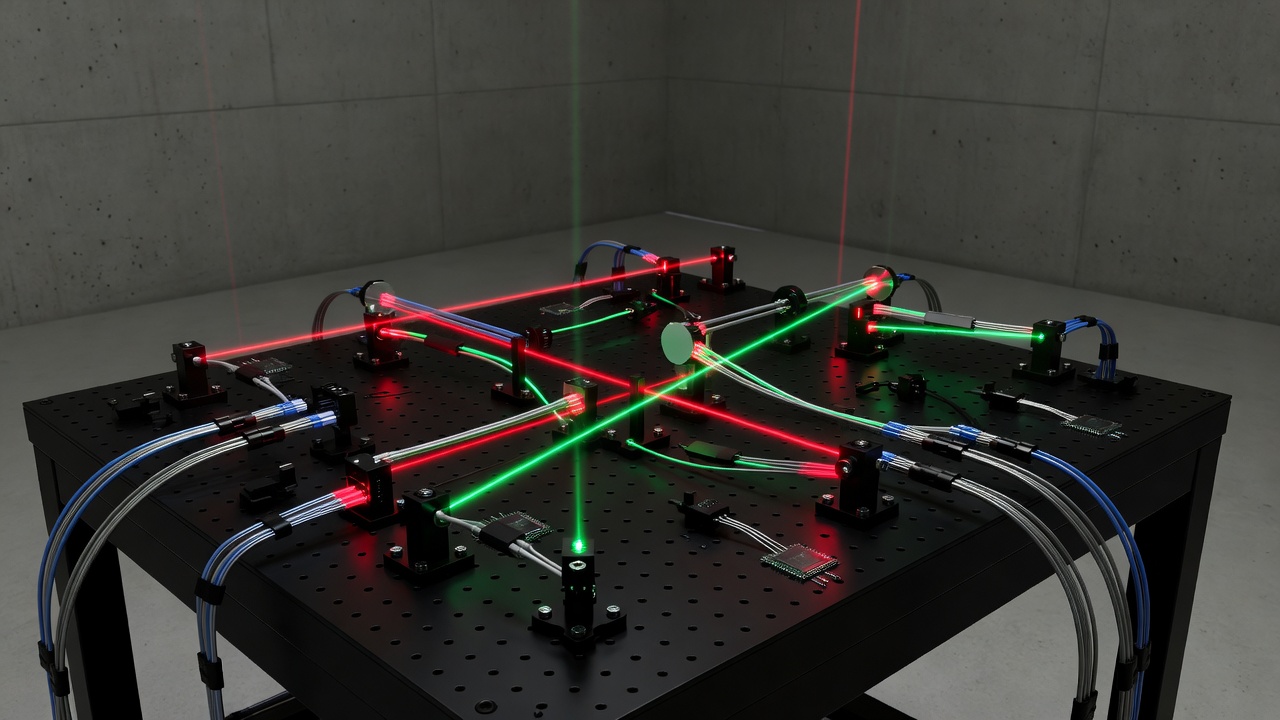
Researchers at Kyoto University and Hiroshima University have built an entangled measurement (a single joint measurement that identifies which entangled state a set of particles is in) for the W state, a multi-photon entangled state, and demonstrated it on 3 photons. The headline-friendly word is "teleportation", but no teleportation was performed. The buried lead is that the team can now identify a W state in one shot, where the standard alternative is to rebuild the state from a pile of measurements. For anyone planning multi-photon quantum protocols, that is the difference between reading a state and reconstructing it after the fact. The source also leaves out the one number that would show how good the device is: its fidelity.
What Happened
Kyoto University and Hiroshima University researchers, with Shigeki Takeuchi as corresponding author, report an entangled measurement that identifies the W state in a single shot. The experimental demonstration used 3 photons.
Takeuchi framed the result against an older milestone: "More than 25 years after the initial proposal concerning the entangled measurement for GHZ states, we have finally obtained the entangled measurement for the W state as well, with genuine experimental demonstration for 3-photon W states."
That sentence carries a precision point. The 25-plus years count from the proposal of the entangled measurement for GHZ states (a different class of three-or-more-particle entangled state). They do not measure how long the W-state problem sat open. The source says only that no comparable method for the W state had been proposed or demonstrated before this work. The GHZ-state measurement already existed.
The Technical Breakthrough
The design exploits a property of the W state called cyclic shift symmetry (the state stays the same when its photons are rotated through one another's positions in order). The team implements the measurement as a photonic quantum circuit that performs a quantum Fourier transformation (a quantum operation that converts a state's symmetry pattern into a readable outcome). The readout then tells the experimenter which W state was present.
In the experiment, three single photons were prepared with chosen polarization states (the orientation of each photon's light wave), and the device distinguished among different three-photon W states. The optical circuits were high-stability and could run for long periods without active control, which matters for any measurement that has to hold alignment while data accumulates.
The source reports no fidelity number, no error bar and no success rate. It also does not say whether the scheme is deterministic or probabilistic, or how much photon loss or post-selection overhead (throwing away runs that did not work) the demonstration carried. Those are the figures a reader would need to judge the device's quality, and they are not in the release.
The researchers say the method can, in principle, be applied to W states with any number of photons. That is a theoretical claim. The only experimental data point reported is 3 photons.
Why It Matters for Industry
The contrast the researchers draw is with quantum state tomography (reconstructing a quantum state by running many different measurements and fitting the results to a mathematical description). Tomography is long-established for photon polarization qubits. A paper by Daniel F. V. James, Paul G. Kwiat, William J. Munro and Andrew G. White, published in Physical Review A 64, 052312 (2001), describes two such techniques: direct tomographic reconstruction and a maximum likelihood method (a statistical fit that needs numerical optimization).
Per the Kyoto release, tomography's data requirements "rise exponentially" with photon number, while an entangled measurement identifies the state in one shot. No figures accompany the scaling claim, so the size of the saving at 3 photons is not quantified.
Takeuchi tied the work to the broader field: "In order to accelerate the research and development of quantum technologies, it is crucial to deepen our understanding of basic concepts to come up with innovative ideas."
The release lists possible applications: teleportation, communication protocols, transfer of multi-photon entangled states, and measurement-based quantum computing. None was demonstrated here. The source reports no dollar amounts, benchmark scores or commercial partners, so any commercial timeline is a projection this result does not yet support.
Competitive Landscape
No comparable W-state method existed before this work, so there is no head-to-head benchmark to cite, and no competing groups are named in the source. The items below are separate stories that show where quantum hardware effort sits today. They are context only and not direct competitors to a photonic W-state measurement.
- Quantinuum H2 processor: a Nature paper on non-Abelian anyons (exotic quasi-particles whose exchange order matters) used 54 qubits on the H2, with Ruben Verresen, assistant professor at UChicago PME, as a co-author and collaborators at Harvard and Stony Brook. This is a different hardware platform and a different problem.
- Alice & Bob and ENS Lyon: cat-qubit stabilization (cat qubits are a qubit design built to resist errors) using a DC voltage bias, an effort aimed at making individual qubits more robust.
- Diraq: reportedly plans an Albuquerque lab, with Andrew Dzurak associated with the company in the source material.
Independent analyst commentary specifically on this announcement was not publicly available at publication time.
The Bigger Picture
Entanglement is the phenomenon that troubled Albert Einstein, and the field has since sorted it into distinct classes. A paper by W. Dur, G. Vidal and J. I. Cirac, published in Phys. Rev. A 62, 062314 (2000), showed that three qubits can be entangled in two inequivalent ways, with the GHZ state and a W state as representatives. Two states belong to the same class if each can be obtained from the other by LOCC (local operations and classical communication) with nonzero probability. The same paper found that the W state keeps maximal entanglement between the two remaining qubits when any one of the three is traced out (ignored).
GHZ states have a long experimental record with photons: Bouwmeester et al. first realized them in 1999 (PRL 82, 1345-49), and Pan et al. applied them to a nonlocality test in Nature 403, 515-519 (2000). The W state is the other major class. Until this work, its entangled measurement was missing.
Measurement also sits at the center of one computing model. Raussendorf and Briegel proposed that a cluster state (a large, specially prepared entangled state) can serve as the resource for a whole computation, run by one-particle measurements only. The Kyoto and Hiroshima device is a different kind of measurement acting on a different state, so the link is conceptual. It does fit Takeuchi's argument that foundational building blocks drive applied progress.
What's Next
According to the release, the next steps are scaling beyond three photons to larger and more general multi-photon states, and developing on-chip photonic circuits for entangled measurements. The source gives no dates for either.
Several things the source leaves unreported would shape how the work is judged: the measured fidelity value, the journal and DOI, how the circuit scales in practice, a quantitative comparison with tomography at 3 photons, and the photon source and detector details. These are gaps in the release, not negative findings. The "any number of photons" claim also remains a theory statement until a larger demonstration exists.
The most striking thing here is how modest the demonstration is and how much it still unlocks. Three photons will not move a market, but a missing tool in the entanglement toolkit now exists, and the headline's teleportation is still a to-do item.
For an academic lab characterizing multi-photon states, the practical comparison is data volume. Tomography on a W state needs datasets that grow exponentially with photon count, and the identification arrives only after reconstruction. A one-shot entangled measurement returns the identity directly in a single run. If the unreported fidelity holds up at higher photon counts, that is the saving to watch, measured in experiment runs per state identified. Whether it scales is the question the next paper has to answer.
-- Aria Lin, Enterprise Technology Analyst
Sources: Osti · PubMed Central · ScienceDaily