DOE Launches $215 Million Prize Race For Fault-Tolerant Quantum ComputersDOE Launches $215 Million Prize Race For Fault-Tolerant Quantum ComputersDOE Launches $215 Million Prize Race For Fault-Tolerant Quantum ComputersDOE Launches $215 Million Prize Race For Fault-Tolerant Quantum Computers
September 18, 2026
The U.S. Department of Energy launched the Quantum Genesis Q Competition on September 18, 2026, offering up to $215 million to any private company that can build the world's first fault-tolerant quantum computer with at least 100 logical qubits capable of performing hundreds of
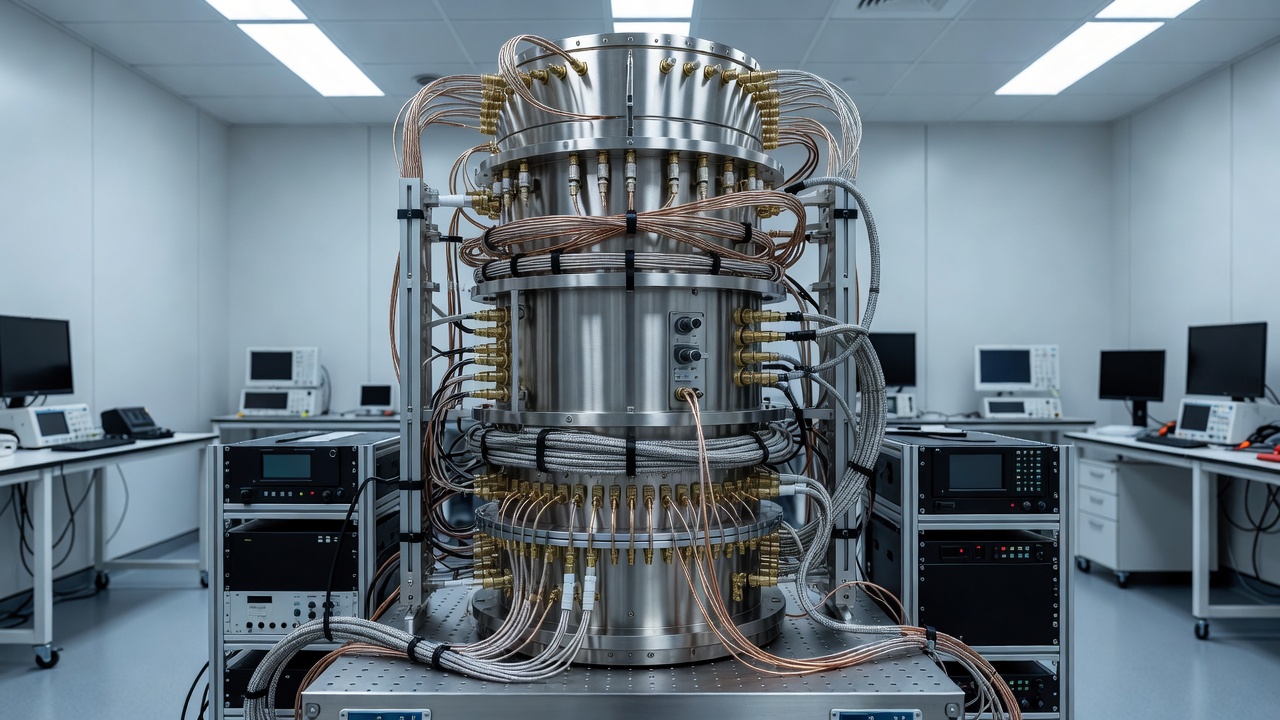
The U.S. Department of Energy launched the Quantum Genesis Q Competition on September 18, 2026, offering up to $215 million to any private company that can build the world's first fault-tolerant quantum computer with at least 100 logical qubits capable of performing hundreds of millions of error-corrected operations. The bigger story is not the headline figure: DOE structured the money as an escalating leaderboard, reserving two additional $50 million bonus pools for whoever pushes past 150 and then 200 logical qubits, turning fault-tolerant quantum computing into a federally funded race with a scoreboard attached. No company has publicly reached that bar, and with final applications due October 19, 2026, the clock is now running.
What Happened
The Department of Energy's Office of Advanced Scientific Computing Research, part of DOE's Office of Science, issued a Request for Applications for the Quantum Genesis Q Competition: an initiative with up to $215 million in planned funding to help private-sector teams demonstrate the world's first fault-tolerant, scientifically relevant quantum computers, or SRQCs (quantum systems that can detect and correct their own errors on the fly, making them reliable enough to run real scientific workloads rather than brief laboratory demonstrations). To qualify, applicants must propose a machine with at least 100 logical qubits (error-corrected qubits built by combining many noisy physical qubits into a single unit stable enough to hold a computation steady) capable of performing hundreds of millions of fault-tolerant operations.
- Up to $215 million in planned funding for private-sector applicants
- Minimum of 100 logical qubits required to qualify
- Machines must perform hundreds of millions of fault-tolerant operations
- Final applications due October 19, 2026
"Through the Quantum Genesis Q Competition, we are building a new era of computational power for the nation through innovative public-private partnerships," said Dario Gil, DOE's Under Secretary for Science, in the agency's announcement.
The competition runs in two phases. Phase I hands out fixed awards, worth up to $1.5 million per awardee, for early technical milestones. Phase II reserves the largest sums for teams that actually cross the logical-qubit thresholds, with escalating bonus pools for anyone who goes further than the 100-qubit floor. That structure, and the hard October deadline behind it, is what separates Genesis Q from a typical research grant: it functions less like seed funding and more like a federally underwritten prize competition, paying out only when a specific, verifiable technical bar is cleared.
The Technical Breakthrough
DOE's threshold is deliberately narrow. It is not counting raw, error-prone physical qubits, the way most public demonstrations do, but logical qubits that have already been error-corrected into a stable computational unit. The competition ties funding directly to that count, with the reward escalating as teams clear each tier.
| Threshold | Program Phase | Available Funding |
|---|---|---|
| Early milestones (pre-demonstration) | Phase I | Up to $1.5 million per awardee |
| 100 logical qubits | Phase II base pool | $100 million, shared among qualifying awardees |
| 150 logical qubits | Phase II bonus pool 1 | $50 million |
| 200 logical qubits | Phase II bonus pool 2 | $50 million |
The scale of the ask becomes clearer against where the industry currently stands. Google's Willow processor, a superconducting chip the company detailed in December 2024, was described by Google as the first to demonstrate below-threshold quantum error correction, meaning error rates fall rather than rise as more physical qubits are added. Even that milestone chip falls well short of DOE's bar: Willow was not built to sustain 100 logical qubits or run hundreds of millions of fault-tolerant operations, the specific combination Genesis Q is now paying companies to reach. DOE is effectively asking applicants to close that gap well before the competition's own incentive pools are exhausted.
Why It Matters for Industry
The two-phase structure is designed to de-risk the bet on both sides. Phase I's fixed awards, worth up to $1.5 million per awardee, give companies capital to fund early milestones before they have to prove anything close to a full fault-tolerant system. Phase II is where the real money sits: a $100 million general incentive pool split among whichever awardees actually demonstrate a first-generation SRQC with 100 or more logical qubits, plus the two $50 million bonus pools for teams that keep scaling to 150 and 200 qubits.
That staged, milestone-gated design gives private quantum computing companies something they rarely get from federal research funding: a clear, published bar tied to escalating cash rather than a single up-or-down grant decision. A company that clears 100 logical qubits collects from the base pool even if a rival reaches 200 first; a company that pushes further collects again from the bonus pools. For an industry where fault tolerance has mostly lived in roadmaps and peer-reviewed papers rather than working hardware, a federal buyer willing to pay per verified milestone, rather than per proposal, changes the incentive calculus for how aggressively companies fund their own scaling programs.
Competitive Landscape
No directly comparable commercial peers were publicly identifiable at publication time for the Genesis Q Competition itself: DOE's announcement names no specific applicants, frontrunners, or eligible companies beyond "private sector" generically. What DOE has named is a parallel, separately funded track: the Quantum High-Performance Computing Validation and Verification Testbed Lab Call, worth up to $45 million in planned funding, with $14 million already committed in fiscal year 2026. Unlike Genesis Q, that Lab Call is restricted to DOE's own National Laboratories, which will build testbeds to characterize, in DOE's words, "every layer of the computing stack, from physical hardware and quantum gates to logical architectures, quantum algorithms and applications, and classical control systems."
The two tracks are complementary rather than competing: private companies chase the qubit-count prize money under Genesis Q, while national labs build the independent infrastructure that will ultimately help verify their claims. Independent analyst commentary specifically on this announcement was not publicly available at publication time.
The Bigger Picture
Genesis Q did not emerge in isolation. DOE says the competition was informed by the Office of Science Advisory Committee's report, "Path to an Integrated Quantum Future." Gil framed the stakes in the same announcement: "This competition will enable new quantum computing capabilities and unleash new computational frontiers, driving new scientific and technological discoveries that have previously only been theorized."
The money behind that ambition is, for now, mostly a promise. Of the $215 million planned for Genesis Q, only $2.5 million has actually been committed in fiscal year 2026; the rest depends on future congressional appropriations DOE does not control. The pattern repeats on the Lab Call side, where $14 million of the planned $45 million is committed so far. Genesis Q is DOE's specific, dollar-denominated bet on accelerating fault-tolerant quantum computing, and its ultimate size will be set by lawmakers, not by the agency running the competition.
What's Next
DOE will hold a virtual informational webinar for potential applicants on September 25, 2026, at 1:00 p.m. Eastern, walking through the Request for Applications and the separate Lab Call for DOE National Laboratories. Final applications for the Genesis Q Competition are due October 19, 2026, giving interested companies about a month from today's launch to assemble a technical proposal against a bar, 100 or more logical qubits running hundreds of millions of fault-tolerant operations, that no team has publicly cleared.
What happens after the deadline is less certain than the technical target. DOE has not disclosed how it will verify a claimed logical-qubit count, how many awards it expects to make, or what selection criteria beyond the stated thresholds will separate winners from also-rans. And the money itself remains a plan more than a budget: with just over one percent of the headline $215 million actually committed so far, the competition's real scale will be decided in future appropriations bills, not in the Request for Applications published this week.
The most telling detail in Genesis Q is not the $215 million ceiling, it is the $2.5 million floor: DOE is betting big on paper while committing small in practice, asking industry to build fault-tolerant machines against a deadline the agency's own budget has not yet caught up to. If a company actually clears 100 logical qubits on schedule, the scoreboard DOE built this week will matter far more than the number printed on the press release.
For developers and researchers building on today's quantum hardware, the practical translation is straightforward: DOE is not funding another handful of physical qubits bolted onto an existing chip, it is funding the error-correction overhead that turns physical qubits into logical ones. A team that can show 100 logical qubits running hundreds of millions of fault-tolerant operations is showing a machine stable enough to execute real algorithms end to end, not just survive a benchmark circuit for a few seconds. That is the difference between a research demo and a computer developers can actually target.
-- Aria Lin, Enterprise Technology Analyst
Sources: U.S. Department of Energy, IE Exchange Funding Opportunity FAQ - The Quantum Insider