Best Retro Gaming Consoles: Evercade Nexus vs Atari Gamestation Go vs M64
November 25, 2026
Retro gaming hardware now splits into cartridge handhelds, arcade-style portables, and boutique N64 consoles priced from $160 to $230. Those three approaches don't compete on the same terms, and sorting through screens, controls, game libraries, and add-on costs takes real
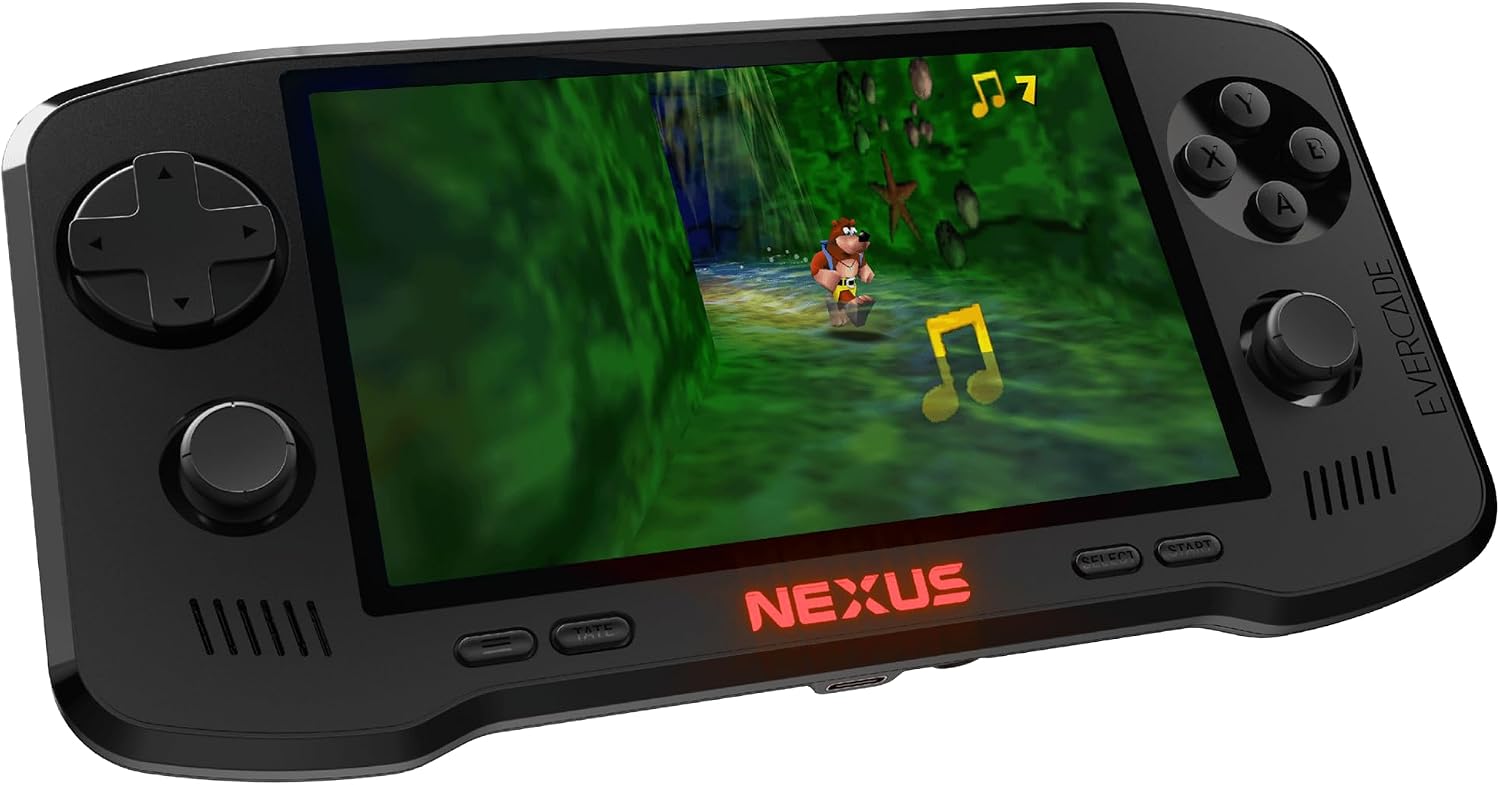
Retro gaming hardware now splits into cartridge handhelds, arcade-style portables, and boutique N64 consoles priced from $160 to $230. Those three approaches don't compete on the same terms, and sorting through screens, controls, game libraries, and add-on costs takes real effort before you buy.
This guide covers three retro gaming consoles: the Evercade Nexus, the My Arcade Atari Gamestation Go, and the ModRetro M64. We compare them on battery life, controls, display, game library, build quality, and total cost of ownership. It's written for people who want classic games on modern hardware without a heavy emulation setup, whether that means a handheld for the commute, an arcade-style portable that doubles as a TV console, or a way to run real N64 cartridges in 4K.
Why You Can Trust This Guide
Every console in this guide gets the same evaluation: battery endurance, screen quality, control feel and layout, build and ergonomics, game library depth, ports and TV output, and total cost once required accessories are counted. Revuzia accepts no paid placement, and manufacturers get no favorable coverage in exchange for review units.
We cross-reference published measurements from independent testing with manufacturer spec sheets and hands-on impressions from reviewers who spent extended time with the hardware. When a manufacturer's claim and an independent result disagree, we report both. For example, Evercade rates the Nexus at 5+ hours of battery, while independent testing measured about 4 hours in Banjo-Kazooie at default brightness.
Spotted an error or want us to review a product? Email [email protected].
Our Top Picks at a Glance
Best Overall: Evercade Nexus
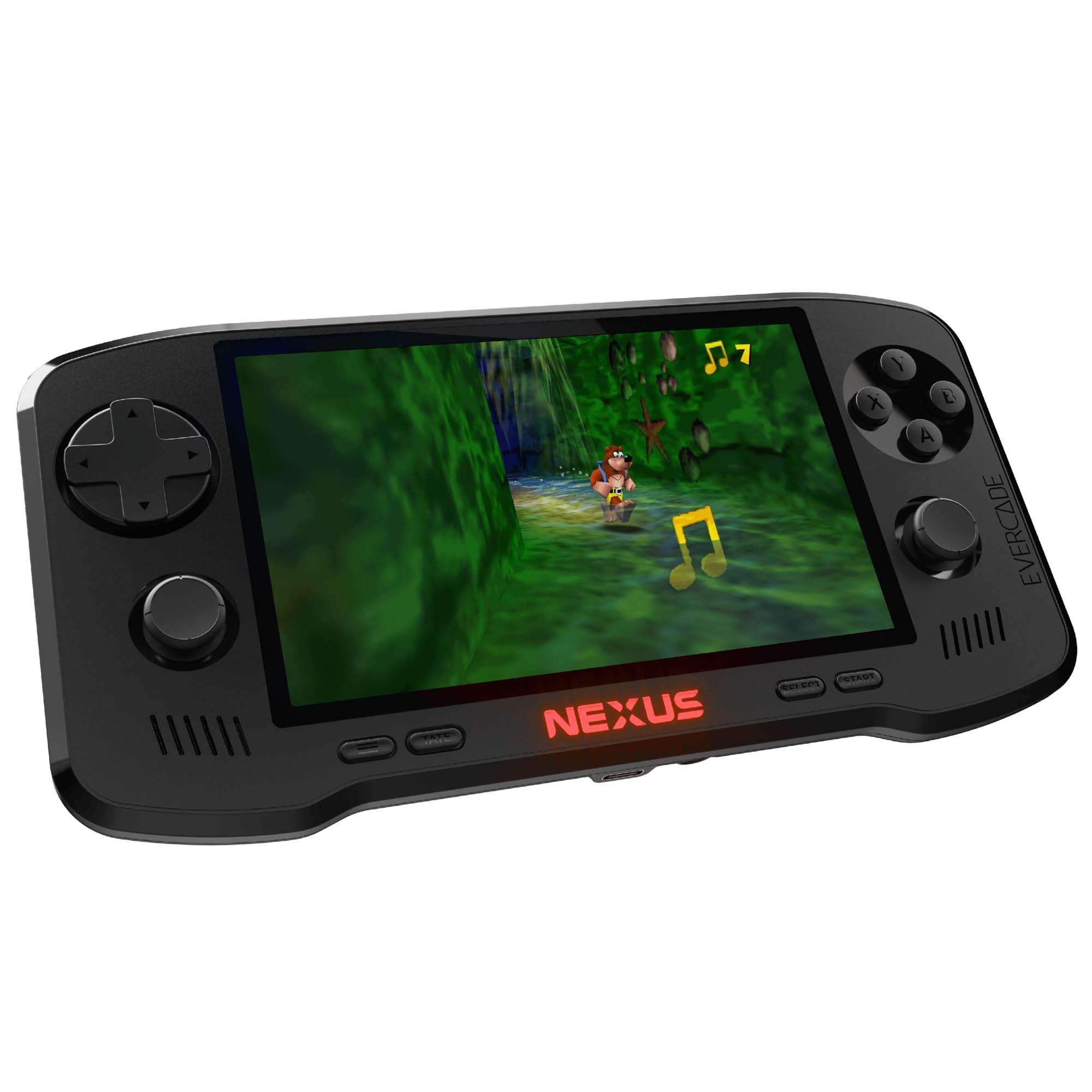
The Evercade Nexus earns the top spot because both reviewers who covered it gave a positive verdict, backed by about 4 hours of measured battery life and the first dual analog sticks on an Evercade.
Key specs. The Nexus has a 5.89-inch IPS display at 840 x 512, the largest screen of any Evercade device. It has one USB-C port, a 3.5mm headphone jack, and a cartridge slot. It plays all 80+ Evercade cartridges, covering more than 700 games from the first video-game generation up to the 64-bit era, and supports EverSync wireless local multiplayer. Evercade rates battery at 5+ hours; independent testing measured about 4 hours in Banjo-Kazooie at default LED brightness. In that reviewer's separate tests, the Nintendo Switch 2 lasted 2 hours 40 minutes and the Steam Deck OLED 2 hours 9 minutes.
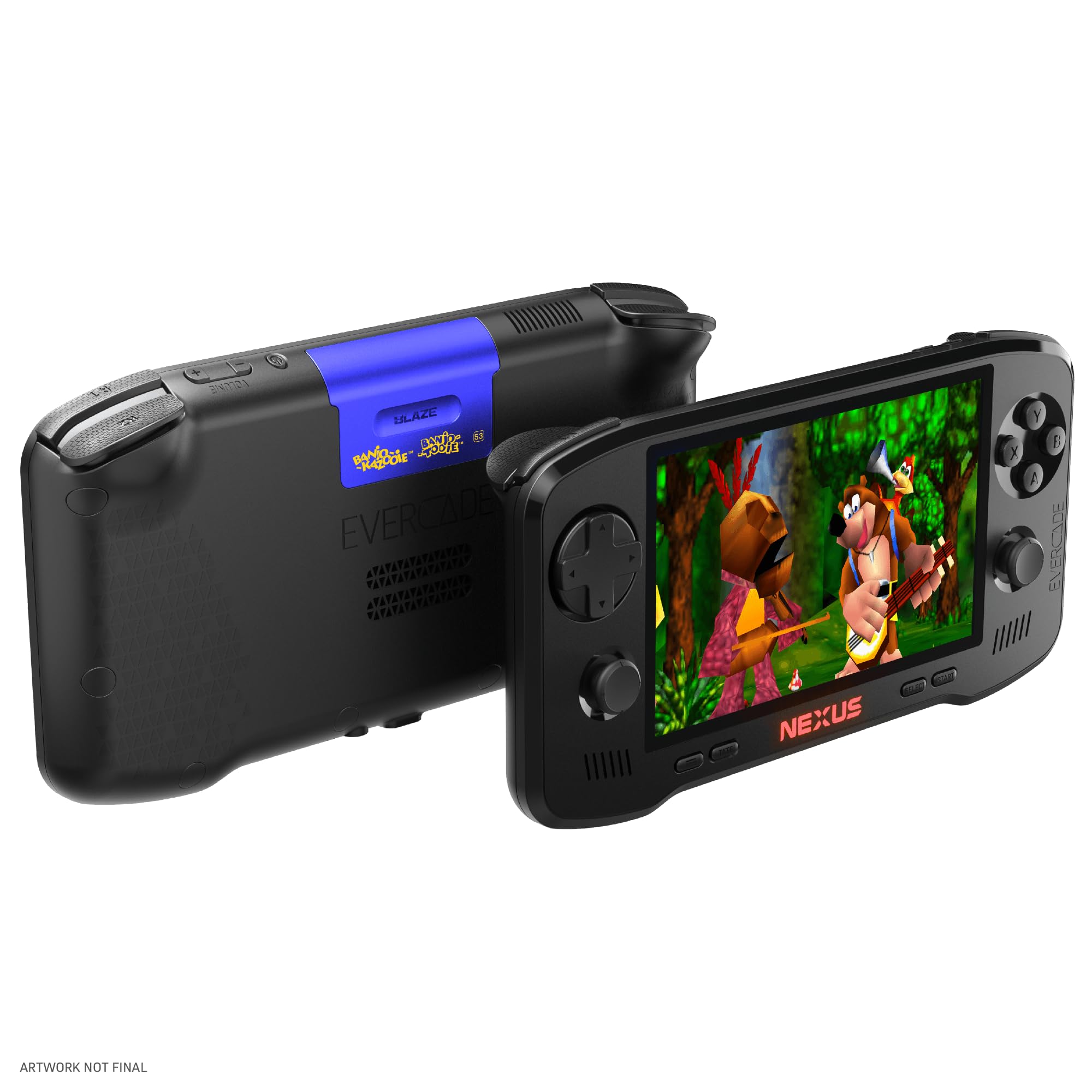
Who it's for. Buy this if you want a true handheld for 3D-era retro games and twin-stick arcade collections. It launches bundled with Banjo-Kazooie and Banjo-Tooie, which reviewers called excellent native ports that look vibrant on the screen. Setup is quick, needs no account, online ID, or subscription, and asks only for a small firmware update over Wi-Fi. Because games are physical cartridges, there are no installs, no online requirement, and no revocable licenses, and you can lend or resell them. Cartridges work across the whole Evercade range back to 2020.
Price and value. The $199.99 Amazon listing is the Banjo-Kazooie double pack, and the same price appears at GameStop. There is no digital storefront; the only digital game is a rotating Game of the Month. Every other game is a cartridge you buy separately, so the real cost climbs with your library.
Where it falls short. Reviewers describe it as almost the perfect handheld for retro fans, but also as a device with some growing up to do. The Evercade Nexus has no suspend feature, and its boot-up times are lengthy.
Pros
- Dual analog sticks that reviewers called sturdy, with a "chunky click" on press
- About 4 hours of battery in independent testing, well ahead of the Switch 2 and Steam Deck OLED in the same reviewer's comparison
- 700+ games across 80+ cartridges, all backward compatible
- Bundled Banjo-Kazooie and Banjo-Tooie
Cons
- Can be slightly uncomfortable to hold for long sessions
- Access to global settings depends on the game
- Games are bought separately as cartridges, and there is no digital storefront
Best Budget: My Arcade Atari Gamestation Go
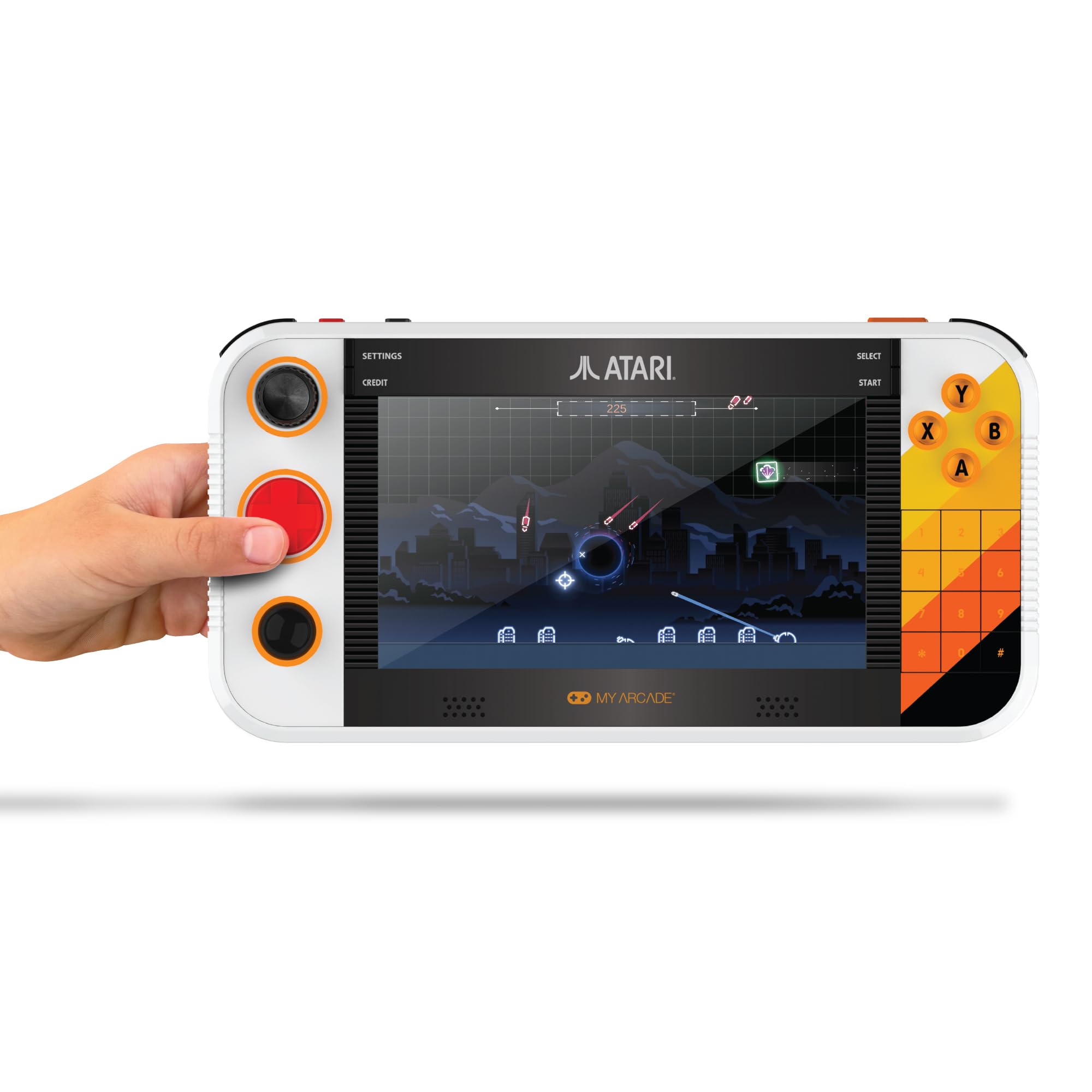
At $160.98 on Amazon, the Gamestation Go is the cheapest of the three, and its 200+ built-in games mean there is nothing else to buy to start playing.
Key specs. It has a 7-inch landscape display, a 7,200mAh battery rated at 4 to 5 hours per charge, and measures 269 x 133 x 26mm at 565g (1.25 lb). Ports include HDMI, three USB-C, a headphone jack, and a microSD slot for extra games. The controls are unusual: a paddle/dial/spinner, D-pad, trackball, ABXY buttons, 2x2 shoulder buttons, and a numeric keypad. The box includes an HDMI cable, a USB-C cable, and a power brick. SmartGlow colored lighting and an integrated kickstand round it out.
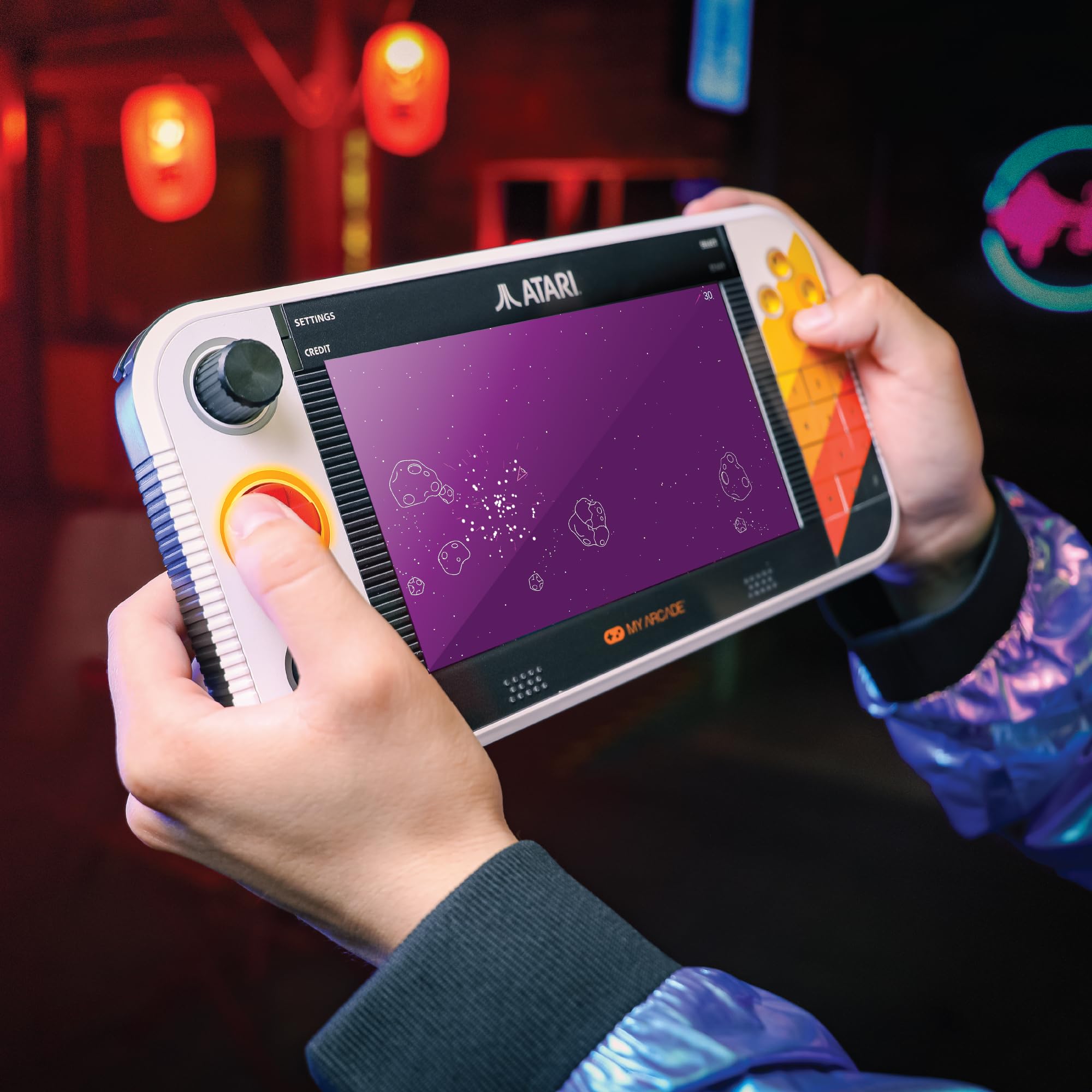
Who it's for. This suits classic Atari and arcade fans. Reviewers found playing Breakout with the paddle felt far better than any other input, and called the trackball "remarkably precise," especially over HDMI on a TV. Arcade racers ran about as smoothly as on an entry-level Ayn Odin Base. Reviewers rated the grip comfortable, one even preferring it to the Switch 2.
Build and screen. The body is all plastic. It feels solid, with slight twist-flex and no creaking, but it lacks a touch of premium flair. The 7-inch screen is decent: below a Steam Deck running emulators, but able to hold its own against cheaper retro handhelds. Repairability is limited, because the case cannot be opened after removing the battery cover.
Price and value. The official US list price is $179.99, so the Amazon price of $160.98 is a real saving. One reviewer still found it high compared with other portable retro options, and noted that Atari added fewer of its own titles than hoped. Wired GamePad and Arcade Stick accessories are planned, which may eventually solve the multiplayer gap.
Pros
- 200+ built-in games from Atari, Jaleco, Namco, and others, expandable by microSD
- Authentic paddle, trackball, and keypad controls
- HDMI output for TV play
- Complete accessories in the box
Cons
- The unique controls cannot be user-configured
- Rendering issues showed up in classic vector games
- All-plastic build that lacks a touch of premium flair
Independent testing scored it 7/10, noting that Atari fans add a point and general retro gamers subtract one or two. That is a fair summary: it's a good buy for the right audience, not a universal one.
Best for 4K TV Play: ModRetro M64
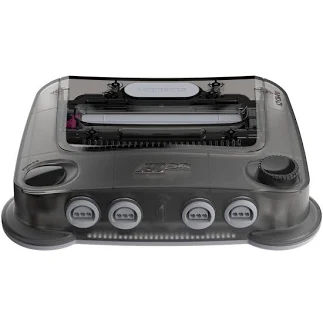
The ModRetro M64 is the only option here that plays original N64 cartridges and outputs to a 4K TV, which makes it the pick for anyone with a shelf of N64 games.
Key specs. It plays original N64 cartridges and ModRetro's own new games over HDMI, upscaling the N64's native 320x240 to 2160p. It has four controller ports on the front, takes original N64 controllers plus wired or Bluetooth pads, and is USB-C powered. The transparent shell comes in four colors, with a light bar in front of the cartridge and an eject button. Start + Z opens a settings overlay with resolution, CRT filter, and software update options. The M64 Pro Controller, sold separately, has the classic trident shape, a Z-trigger, a battery pack, and wired or Bluetooth connection.
Who it's for. Buy this if you want the real-cartridge experience with modern output and a premium look. Games boot straight in, with no top-level menu. One reviewer who used a pre-production unit for a month said, "I can't see myself playing N64 games any other way," and praised the controller's weight and Z-trigger. That preview carried a disclaimer that hardware and software were not final.
Image quality. In a full review on a 77-inch OLED TV, the picture with no filters looked a bit dull and muddy next to the Analogue 3D, and even the Switch 2's emulated N64 image looked better in that clean-output comparison. Clean 4K output of a 320x240 source looks very pixelated, so the CRT filters are not optional extras. They are how you get a good picture from this machine.
Price and value. The console is $229.99, and the Pro Controller adds $90. A wired Hyperkin controller costs $30, and original N64 controllers also work. At $230 the M64 is the most expensive option here, and reviewers did not find it feature-complete or bug-free at that price.
Pros
- Plays real N64 cartridges that load instantly
- Four controller ports, Bluetooth support, and original controller compatibility
- 4K HDMI output with CRT filters
- Distinctive transparent design and a substantial-feeling controller
Cons
- With no filters, an independent comparison found the Analogue 3D beat it on brightness, color saturation, and contrast
- Clean 4K output looks very pixelated, so CRT filters matter
- One full review concluded it "gets more wrong than it gets right"
- The Pro Controller is an additional purchase
It is also not portable, so casual N64 fans may be better served by the limited N64 library on Nintendo Switch Online, and hardcore fans by the Analogue 3D.
How We Chose
We started with the criteria that matter most for retro hardware: how the games are accessed (cartridge, built-in, or both), control quality for the era of games supported, screen or TV output quality, battery life for handhelds, and what the total cost looks like once required extras are added.
Evaluation combined independent measurements, manufacturer specifications, and hands-on reports from reviewers. Battery claims were checked against measured results wherever they existed, and image quality was judged from direct comparisons against rival hardware.
Products were marked down for features that fall short of their price, such as missing multiplayer, unconfigurable controls, or image quality below a more established rival. We also weighed ecosystem risk: physical cartridges you can resell rank above licenses that can be revoked.
All three products here are retro gaming consoles, but they serve different players, so the labels reflect the best fit for a specific need rather than a single scoreboard.
What to Look For
Portable or TV. Decide first where you will play. Handhelds like the Evercade Nexus and Gamestation Go work anywhere and also suit short sessions. The M64 is a TV console and needs a display and power.
Game access model. Built-in libraries are the cheapest way to start, with the Gamestation Go's 200+ games ready on day one. Cartridge systems cost more over time but give you resale value and no online requirement.
Controls that match the games. Dual analog sticks matter for 3D-era titles. Paddles and trackballs matter for classic arcade games. A D-pad and face buttons are enough for most 2D platformers.
Display and output quality. Larger screens help, but panel quality matters more than size. On a TV, check for scaling options and CRT filters, since clean upscaled retro games look very pixelated.
Battery and total cost. Look at tested endurance, not just rated hours, and add up what you will need beyond the console. A controller, extra cartridges, or a second player accessory can change which option is truly cheapest.
Bottom Line
For a commuter who wants 3D retro games on the go, pick the Evercade Nexus. About 4 hours of measured battery and dual analog sticks cover a typical trip, though a long haul may call for a charger.
For a budget buyer who wants a full library out of the box, pick the My Arcade Atari Gamestation Go at $160.98. Its 200+ built-in games and HDMI output mean no extra purchases to start playing on the couch or on the TV.
For an N64 collector with a 4K television and a closet of original cartridges, pick the ModRetro M64. Four controller ports let a full group play together, and the 2160p output with CRT filters gives old cartridges a modern home, as long as you accept its image-quality limits and budget for a controller.
Retro gaming hardware is getting more interesting and more uneven at the same time. The best buys still reward knowing exactly which games you want to play before you spend a dollar.
-- Theo Chan, Hardware Testing Director
*Disclosure: As an Amazon Associate, Revuzia earns from qualifying purchases. Prices and availability are accurate as of publication and may change.*