Best Power Banks: Four Picks for Laptops, iPhones, Hiking, and Budgets
November 20, 2026
The real problem is matching capacity, output wattage, and weight to how you actually carry and charge your gear. This guide compares the UGREEN Nexode 200W 25,000mAh, the Anker Nano, the Ridge Power Bank, and the Nitecore NB10000 Gen4.
The real problem is matching capacity, output wattage, and weight to how you actually carry and charge your gear.
This guide compares the UGREEN Nexode 200W 25,000mAh, the Anker Nano, the Ridge Power Bank, and the Nitecore NB10000 Gen4. It is written for commuters, travelers, hikers, and anyone tired of a phone that dies by mid-afternoon. For each pick you'll find the numbers that matter, who should buy it, and where it falls short.
Why You Can Trust This Guide
Revuzia's hardware team evaluates every Power & Charging product against the same checklist: usable capacity versus rated capacity, per-port and combined output wattage, weight and portability, recharge time for the bank itself, heat behavior under load, build quality, and the value of included cables and features. Nobody pays for placement, and we do not give favorable coverage in exchange for review units.
Our verdicts come from cross-referencing three kinds of evidence: published measurements from independent testers, manufacturer spec sheets, and verified buyer feedback across thousands of owner reviews. When a manufacturer claim and independent measurements disagree, we report both rather than picking the friendlier number. Anything a manufacturer states, such as a rated output or a water-resistance class, is attributed to that manufacturer. Anything measured by a third party is labeled that way.
If you spot an error or want a product considered for a future update, email [email protected].
Our Top Picks at a Glance
Best Overall: UGREEN Nexode 200W 25,000mAh Power Bank
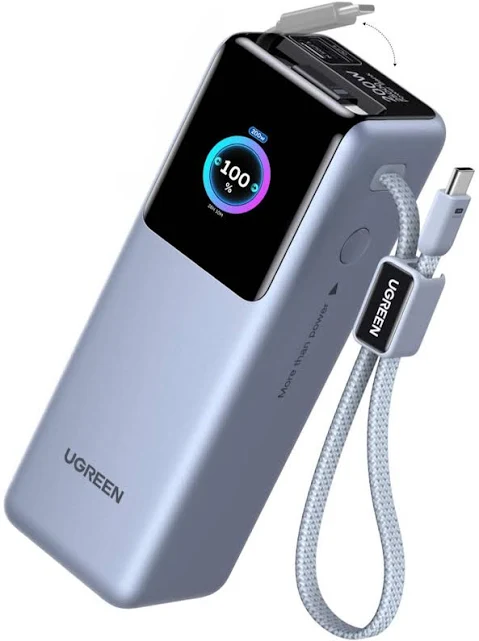
The UGREEN Nexode 200W earns the top spot because it has the most output, the most capacity, and the most independent testing behind it. It is also the only bank here that can run a laptop and a phone together.
Key specs. Capacity is 25,000mAh, built from five 5,000mAh cells. Port output is where it separates itself: USB-C1 delivers up to 140W, USB-C2 up to 100W, and the USB-A port 22.5W, within a 200W combined budget. Input is 65W. It weighs 609g by one reviewer's figure, and a plastic chassis with rubber feet on one side holds a TFT display showing real-time voltage, current, input and output power, and time remaining.
Independent reviewers report it charges a MacBook Pro about 1.5 times or an iPhone 15 up to 5 times per full bank. A reviewer cross-checked the display readings against a Power-Z KM003C tester and found them accurate, which matters because a display you can't trust is just decoration. The same reviewers report consistent efficiency after a few dozen charge cycles and no problems over one to three months of use, and they describe the build as having a "reassuringly solid heft."
Who it's for. Travelers, remote workers, and anyone who wants a laptop and phone running off one bank on a long flight or a day away from outlets. The verdicts from reviewers were "terrific choice" and "standout travel charger," and buyers rate it 4.8 out of 5 across 418 reviews.
One caution: reviewers disagree about how long the bank takes to refill. One says well over three hours, another says 1.5 to 2 hours with a compatible 65W charger, so plan for the slower end until you test your own charger.
Pros
- 140W USB-C1 and 200W combined output, the highest of the four
- 25,000mAh from five 5,000mAh cells
- TFT display checked as accurate against a Power-Z tester
- Charges a MacBook Pro about 1.5 times, or an iPhone 15 up to 5 times
Cons
- The USB-A port tops out at 22.5W
- 65W input is the limit on recharging, and one reviewer found it slow
- At about 609g it is far heavier than the 10,000mAh banks
Best Budget: Anker Nano Power Bank
Key specs. The Amazon listing describes a Nano Magnetic Power Bank, 5,000mAh, Qi2-Certified, 15W Portable Charger. That title is the only spec information we have for this exact model: 5,000mAh capacity and 15W wireless output over a Qi2-certified magnetic connection. Shoppers rate the Anker Nano line 4.7 out of 5 across 7,300 reviews, the largest sample here.
The test data reviewers found covers two other Anker Nano banks, and it should not be read as results for this one. The 10,000mAh 30W model weighs 216g, measures 114 x 53 x 25mm, and has a built-in USB-C cable and a TFT screen; on a Pixel 7 Pro it reached about 50% in just over 30 minutes. The 10,000mAh 45W retractable-cable model took a Galaxy S24 FE from 0 to 100% in about 80 minutes, though thermal throttling cut its peak power. We mention them only to show the range of the Nano family.
Who it's for. Someone whose phone usually makes it through the day but occasionally needs a top-up before dinner, and who wants a low-cost battery on the back of a Qi2-compatible phone with no cable to untangle.
Pros
- Qi2-certified 15W magnetic wireless charging with no cable
- 4.7/5 across 7,300 buyer reviews, the biggest sample here
- 5,000mAh is small enough for a pocket
Cons
- 5,000mAh is a partial charge for most phones, not a full day's reserve
- Related 10,000mAh Nano models show a screen that is hard to read in sunlight and a battery-time estimate that is not well calibrated
Best for iPhone Users: Ridge Power Bank
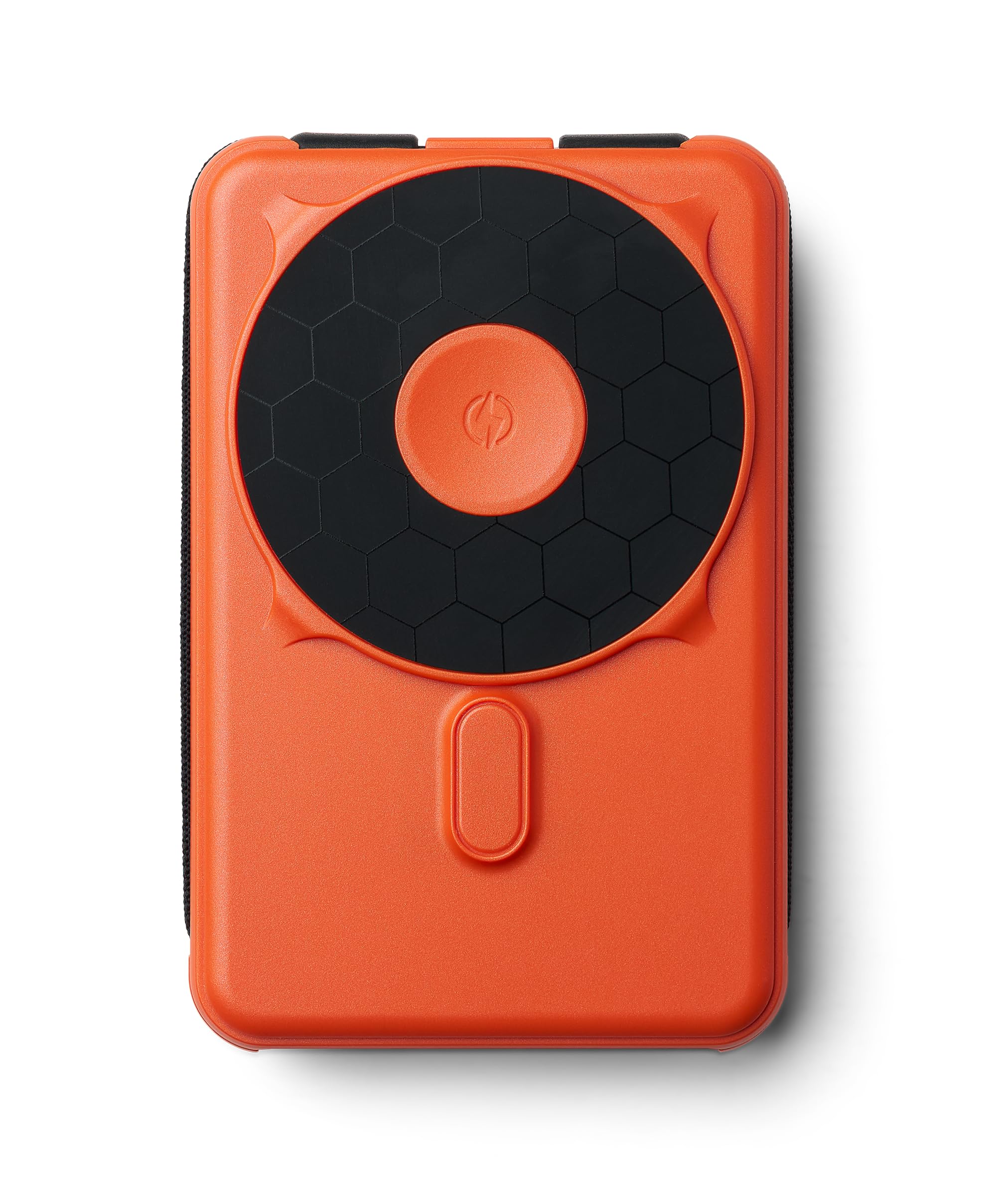
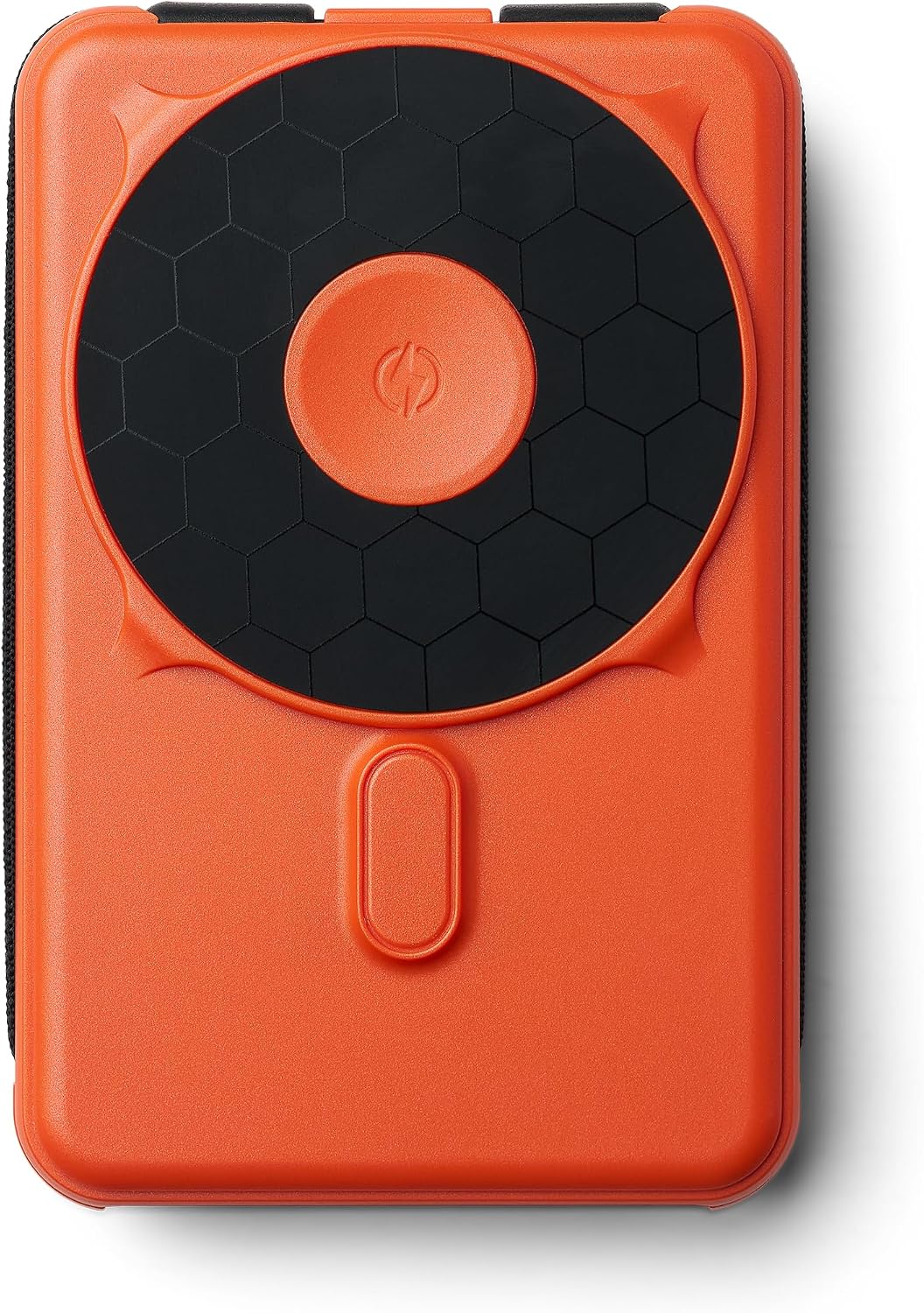
The Ridge Power Bank is the best fit for iPhone owners because it removes the most friction from daily charging: it has the magnet, both cables, and a kickstand in a single 10,000mAh body, and owners rate it highly in large numbers.
Key specs. Ridge lists a 10,000mAh capacity, good for up to three full iPhone charges. It outputs 15W over MagSafe wireless and 20W over USB-C Power Delivery. Both a USB-C and a Lightning cable are built in, so there is no separate cable to forget. It also charges an Apple Watch at the certified 2.5W rate and tops up AirPods cases. Pass-through charging lets it recharge itself while powering your devices, and an LED indicator shows charge status. An integrated kickstand props your phone up for video while it charges. The Ridge Power Bank weighs 7.4 oz (209 g) and measures 105 x 68.3 x 16.2 mm.
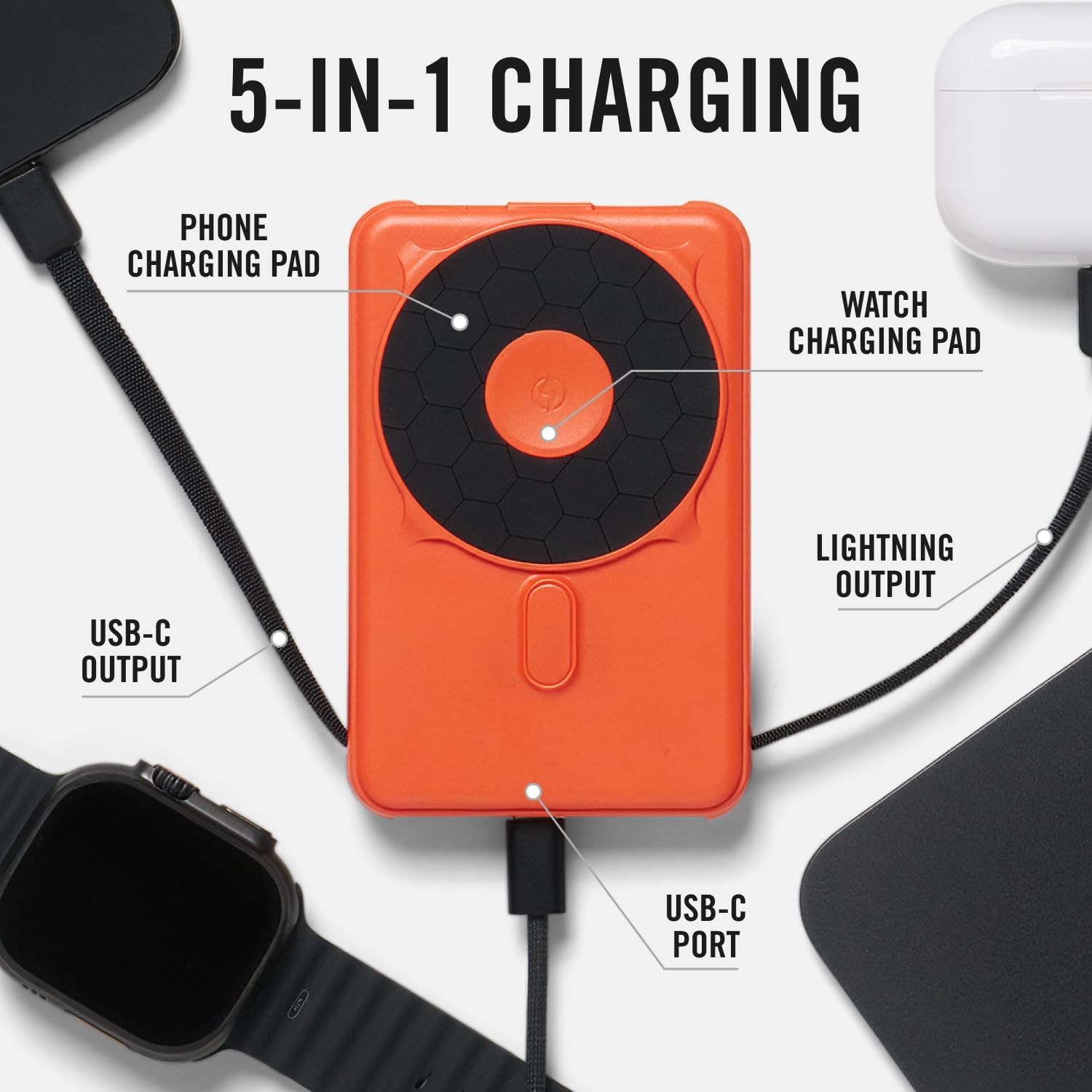
Who it's for. This is the pick for iPhone users who want one object in their pocket that handles the phone, the watch, and the earbuds without a cable bundle. The strong magnetic attachment keeps the phone seated while you walk, and the kickstand turns a desk or airplane tray into a hands-free viewing setup. On Amazon it comes in Basecamp Orange and Matte Black; other colors and the 3-pack bundle are sold only through the manufacturer.
Owner feedback backs it up. Ridge's own site shows 4.6 out of 5 across 2,582 reviews, with 2.2k of those five-star, and a separate shopping listing shows 4.9 out of 5 across 432 reviews. Ridge backs it with a 99-day risk-free trial and a "Built for Life" replacement warranty, and one buyer reports a warranty claim was "handled promptly."
Pros
- Built-in USB-C and Lightning cables, so nothing extra to carry
- 15W MagSafe plus 20W USB-C covers phone, watch, and AirPods at once
- 4.6/5 across 2,582 manufacturer-site reviews, with a 99-day trial
- Pass-through charging and an integrated kickstand
Cons
- Some buyers report slower charging speeds and occasional warmth, and one buyer says the phone runs cooler on the cables than on MagSafe
- A few buyers find the built-in cables tricky to pull out and worry about long-term retention
- The 15W wireless and 20W USB-C ceilings rule out laptop charging
Best for Outdoors: Nitecore NB10000 Gen4 Power Bank
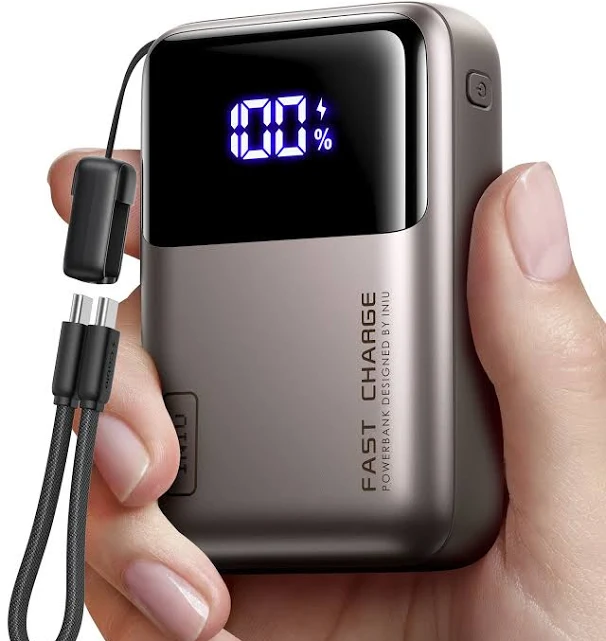
The Nitecore NB10000 Gen4 is the bank to carry when weight, water, and rough handling matter more than extra ports.
Key specs. The Gen4 uses silicon-carbon cells to reach 10,000mAh / 39Wh, more than the roughly 37Wh typical of 10,000mAh banks. It weighs 5.0 oz, which makes it the lightest bank in this guide with a published weight. Nitecore rates deliverable energy at 7,200mAh (about 36Wh) at 1A/5V in eco mode and 6,800mAh (34Wh) at 3A/5V, which Nitecore says is up to about 20% more usable energy than the Gen 3. The manufacturer also claims comparability with 13,000mAh banks from other brands, which is a claim, not an independent result.
Two USB-C ports handle both input and output, with PD up to 22.5W in each direction (5V/9V/12V), and pass-through charging is supported. The housing is a carbon-fiber composite with a flame-retardant frame, and the bank carries an IPX7 water-resistance rating. The illuminated ports wake with a tap or knock, work with gloves on, and can be disabled. A short USB-C cable is included and doubles as a carrying loop.
Who it's for. Hikers, campers, and commuters who want a light, tough bank that survives rain and drops. Independent recharge testing found the bank itself refills from 0 to 100% in about 4 hours on a QC 3.0 wall charger, with a second test landing at 3 hours 2 minutes, which that reviewer called one of the fastest recharge times of the banks they tested. Buyers rate it 4.7 out of 5 across 595 reviews.
Pros
- 5.0 oz with up to about 36Wh of rated deliverable energy
- IPX7 water resistance and a carbon-fiber composite housing
- 22.5W USB-C PD in both directions, with illuminated ports for dark tents and bags
- Among the faster recharge times in independent testing
Cons
- 22.5W output suits phones, not laptops
- Recharging the bank itself takes roughly 3 to 4 hours
- No wireless charging listed
How We Chose
We started with the criteria that decide whether a power bank gets used or ends up in a drawer: real capacity, output wattage, weight, recharge speed, heat, build quality, and how many devices it can serve at once. Capacity alone never decided a pick, since a larger number on the label does not guarantee more usable energy once voltage conversion losses are taken out.
We then compared each product's manufacturer specifications against independent measurements wherever they existed. The Nitecore's rated deliverable energy, the UGREEN's display accuracy check, and the recharge-time results all came from that comparison. We weighted owner feedback by volume and consistency, which is why the Ridge's 2,582-review base and the Anker's 7,300-review base carry real weight.
We also graded how much evidence sits behind each pick. The UGREEN and Nitecore had detailed testing and specs. The Ridge weighs 209 g and measures 105 x 68.3 x 16.2 mm.
All four products are portable power banks, and each had to have a clear job it does better than the others. Each of the four earned one distinct label: Best Overall, Best Budget, Best for iPhone Users, and Best for Outdoors. No label repeats, and no product has to pretend to be good at everything.
What to Look For
Capacity, in realistic terms. A 10,000mAh bank rarely delivers 10,000mAh to your phone because conversion losses take a share. Look for rated deliverable energy, like the Nitecore's 34 to 36Wh figure, instead of relying on the label alone. As a rule of thumb, 10,000mAh covers roughly two to three phone charges, while 25,000mAh can also cover a laptop.
Output wattage per port. Phones top out at modest wattage, so a 20W or 22.5W port is plenty for them. Laptops need much more: the UGREEN's 140W port is what makes it a real laptop option. Also check the combined budget, since multiple devices share a total, such as the UGREEN's 200W.
Weight and size. You will carry this every day, so weight matters more than most spec sheets suggest. The Nitecore's 5.0 oz and the UGREEN's roughly 609g are opposite ends of the practical range, and the right answer depends on whether you carry a bag. The Ridge Power Bank weighs 7.4 oz (209 g).
Built-in cables and wireless charging. Built-in cables, like the Ridge's USB-C and Lightning pair, remove the most common reason a bank sits unused: no cable. Magnetic wireless charging, like the Ridge's 15W MagSafe or the Anker's Qi2 15W, adds convenience for compatible phones, though wired charging is usually faster.
Recharge speed and durability. A bank that takes four hours to refill is a problem if you rarely charge overnight. Look at input wattage, and for outdoor use check for a water-resistance rating like the Nitecore's IPX7.
Bottom Line
For most people who carry a laptop or more than one device, pick the UGREEN Nexode 200W: its 140W port and 25,000mAh capacity can charge a MacBook Pro about 1.5 times per full bank, according to independent reviewers, and its display was checked against a Power-Z tester.
The trade-off is weight: at about 609g it is far heavier than the 10,000mAh banks, so it suits a bag rather than a pocket.
For an iPhone user who commutes and wants one pocketable object for phone, watch, and earbuds, pick the Ridge Power Bank: 15W MagSafe, 20W USB-C, and built-in Lightning and USB-C cables replace three things you would otherwise carry.
For a hiker or camper carrying one bank for a three-day trip, pick the Nitecore NB10000 Gen4: its 5.0 oz weight, IPX7 rating, and up to 36Wh of rated deliverable energy suit the load better than any heavier option.
Power banks have quietly become one of the most useful categories in consumer tech, and the gap between a good one and a mediocre one now comes down to details like usable energy, per-port wattage, and weight. The best advice is to buy for the job you actually do every day, not the biggest number on the box.
-- Theo Chan, Hardware Testing Director
*Disclosure: As an Amazon Associate, Revuzia earns from qualifying purchases. Prices and availability are accurate as of publication and may change.*