Samsung 990 Evo Plus 1TB Review: Efficient PCIe 4.0 Drive With GapsSamsung 990 Evo Plus 1TB Review: Efficient PCIe 4.0 Drive With GapsSamsung 990 Evo Plus 1TB Review: Efficient PCIe 4.0 Drive With GapsSamsung 990 Evo Plus 1TB Review: Efficient PCIe 4.0 Drive With Gaps
October 15, 2026
The Samsung 990 Evo Plus 1TB is a hybrid PCIe 4.0 x4 / PCIe 5.0 x2 NVMe drive rated for 7,250 MB/s sequential reads, 6,300 MB/s sequential writes and, by Samsung's internal testing, 73% better MB/s per watt than the original 990 EVO. That is a polished, efficiency-first spec
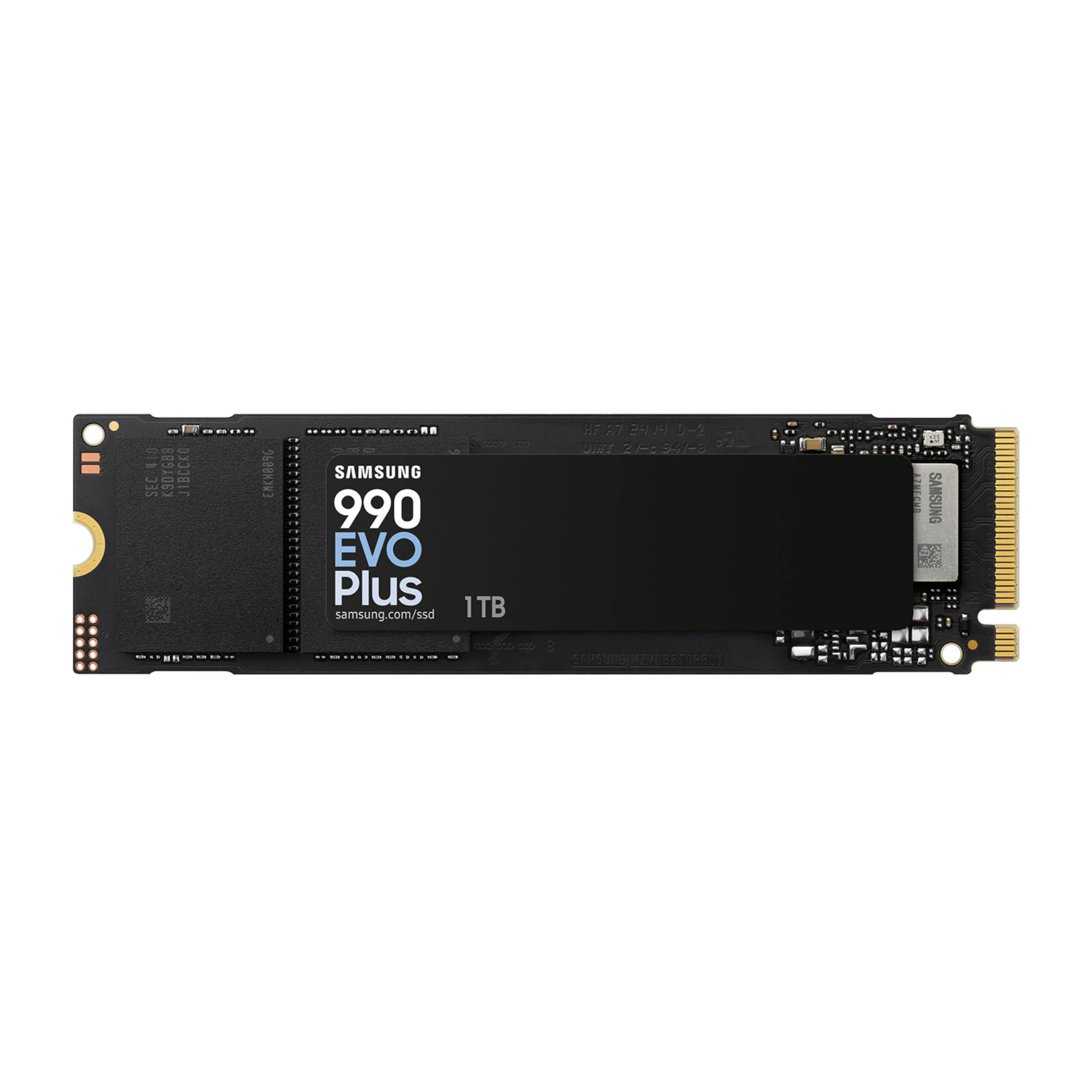
The Samsung 990 Evo Plus 1TB is a hybrid PCIe 4.0 x4 / PCIe 5.0 x2 NVMe drive rated for 7,250 MB/s sequential reads, 6,300 MB/s sequential writes and, by Samsung's internal testing, 73% better MB/s per watt than the original 990 EVO. That is a polished, efficiency-first spec sheet, and the question for a 1TB buyer is whether it earns a premium over cheaper alternatives. In this review I keep two things strictly apart: the figures Samsung rates, which I report as ratings, and what the drive's design means for the machines you will actually put it in. I did not log my own benchmark runs for this piece, so every throughput number below is a manufacturer rating, and I say so each time.
Quick Verdict
The Samsung 990 Evo Plus 1TB is a fast, efficient and well-supported mainstream NVMe drive, and I recommend it for everyday and gaming use if you can find it at a sensible price. Its strongest arguments are low-power operation, hardware encryption, a 5-year warranty and Samsung Magician support. I rate it 4/5 overall.
Rating, Pros and Cons
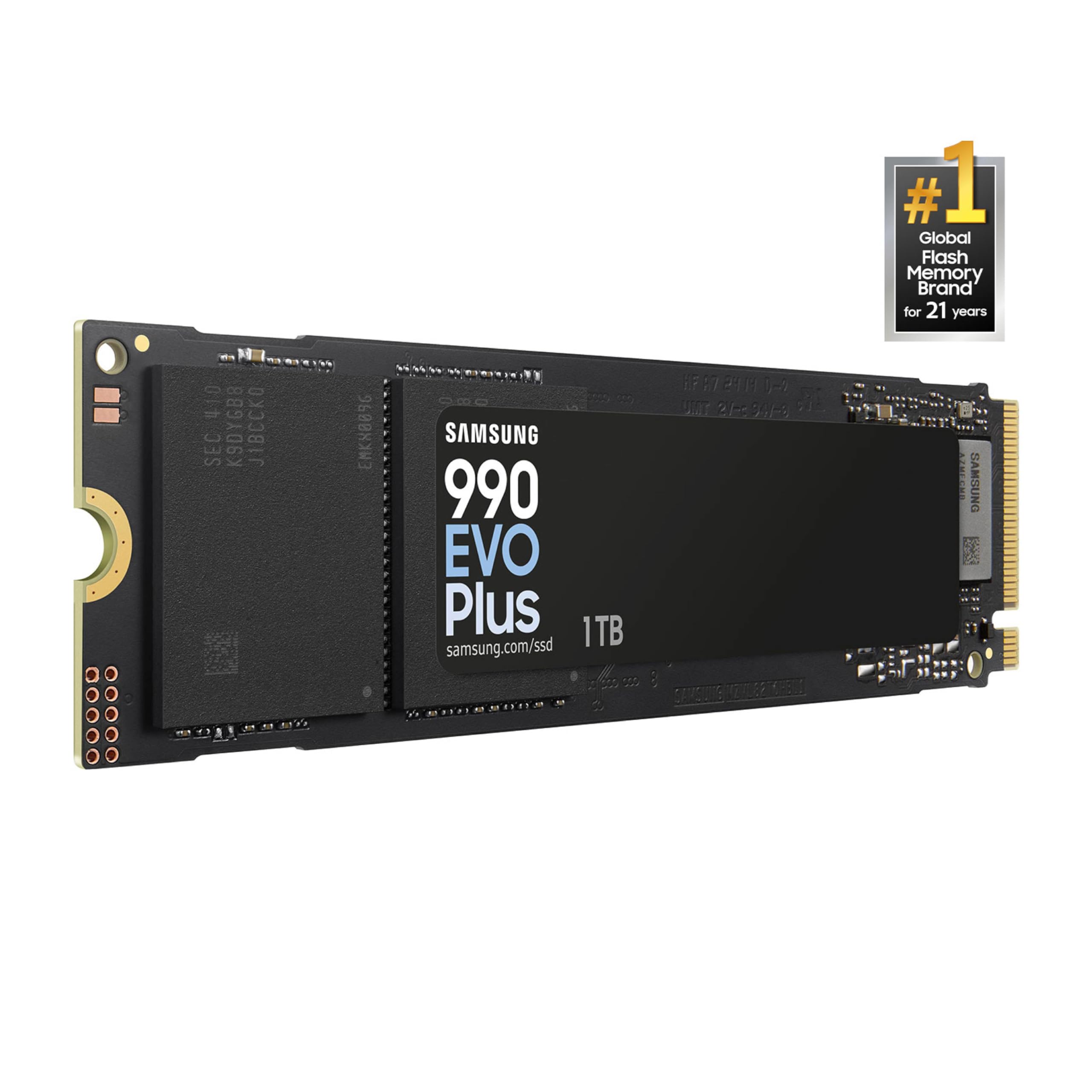
| Aspect | Rating |
|---|---|
| Performance | 4/5 |
| Efficiency and Thermals | 4.5/5 |
| Design | 4/5 |
| Software and Security | 4.5/5 |
| Value | 4/5 |
| Overall | 4/5 |
Pros
- Rated 7,250 MB/s sequential reads and 6,300 MB/s sequential writes
- Samsung-claimed 73% better MB/s per watt on reads than the original 990 EVO
- 65 degrees Celsius maximum under heavy load
- AES 256-bit, TCG/Opal and IEEE1667 hardware encryption
- 5-year limited warranty plus Samsung Magician with data migration
Cons
- Faster PCIe 5.0 drives exist for buyers who want top-end speed
- Pricier than the original 990 EVO
- Its speed advantage shows mainly on PCIe 4.0 platforms
Specs at a Glance
| Specification | Detail |
|---|---|
| Launch list price, 1TB (EUR) | 129.99 euros (Netherlands/Belgium) |
| Capacities | 1TB, 2TB, 4TB |
| Interface | Hybrid PCIe 4.0 x4 / PCIe 5.0 x2, NVMe M.2 |
| Sequential read | Up to 7,250 MB/s |
| Sequential write | Up to 6,300 MB/s |
| Random read | Up to 1,050,000 IOPS |
| Random write | Up to 1,400,000 IOPS |
| NAND | Samsung 8th-generation V-NAND |
| Controller | Nickel-coated Piccolo controller |
| Write cache | Intelligent TurboWrite 2.0 with enlarged TurboWrite region |
| Encryption | AES 256-bit (Class 0), TCG/Opal, IEEE1667 |
| Power draw | Roughly 4.2 to 5.5 W during active reads and writes |
| Warranty | 5-year limited warranty |
| Endurance note | 2,400 TBW is the 4TB model's rating only |
| Software | Samsung Magician |
Real-World Speed
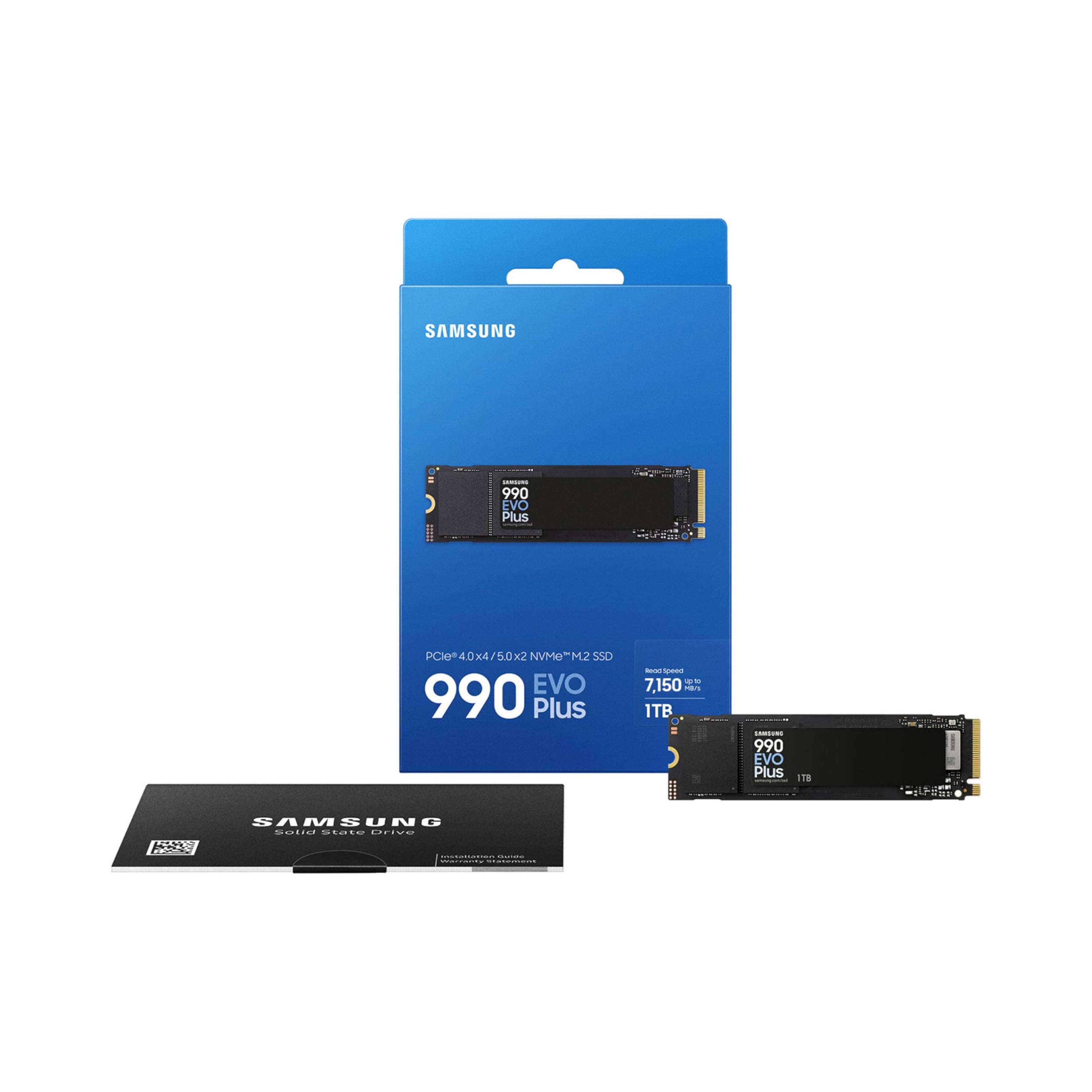
Every throughput figure in this section is Samsung's rating, not a number I logged myself. Samsung rates the drive at up to 7,250 MB/s sequential read and 6,300 MB/s sequential write, with up to 1,050,000 random read IOPS and 1,400,000 random write IOPS. Samsung produced those numbers on a Ryzen 9 7950X system with 2x16GB of DDR5-4800 on an ASRock X670E Taichi board, running Windows 11 Pro, with Intelligent TurboWrite active. That is a high-end platform with the write cache working in the drive's favor, so treat the figures as best-case results rather than what every machine will deliver.
The headline comparison is against the original 990 EVO. Samsung says sequential reads are 46% faster. That is a vendor claim from Samsung's own testing, and I have not reproduced it. If it holds on your hardware, sequential-heavy jobs such as large file copies, game installs and project loads are where you would expect to see it, while the random IOPS ratings are the figures that relate to operating system and application responsiveness.
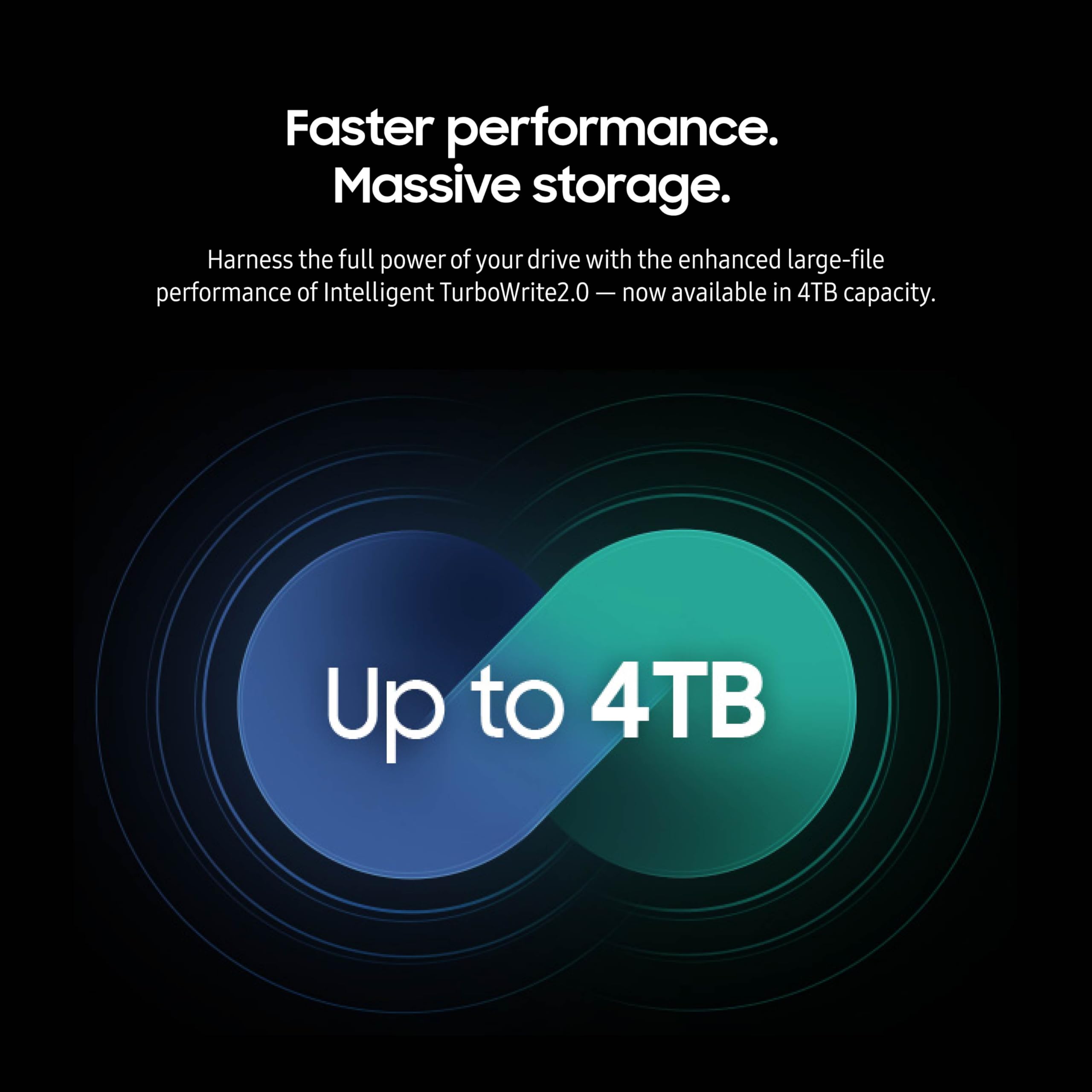
The honest caveat is the write cache. Like any TLC drive, the 990 Evo Plus leans on Intelligent TurboWrite 2.0 to deliver its fastest write speeds, and Samsung enlarged the TurboWrite region and extended it to the 4TB model as well. Once that cache is exhausted, performance drops to TLC speeds. That gap matters if you move very large volumes of data in one sitting, so for that kind of work I would not rely on the 6,300 MB/s figure.
Interface matters too. The drive uses a hybrid PCIe 4.0 x4 / PCIe 5.0 x2 design. It works in a PCIe 5.0 slot, but it shines mainly on PCIe 4.0, so do not expect it to behave like a flagship PCIe 5.0 drive. Samsung also advises confirming that your system supports PCIe 4.0 or 5.0 to get full performance.
If you want numbers of your own, the fair way to check this drive is to run a sequential read and write benchmark on a fresh drive, then a long continuous write that is larger than any plausible cache, and compare both against the ratings above. The first shows how close your platform gets to Samsung's figures. The second reveals the post-cache behavior that the spec sheet leaves out.
Build and Durability
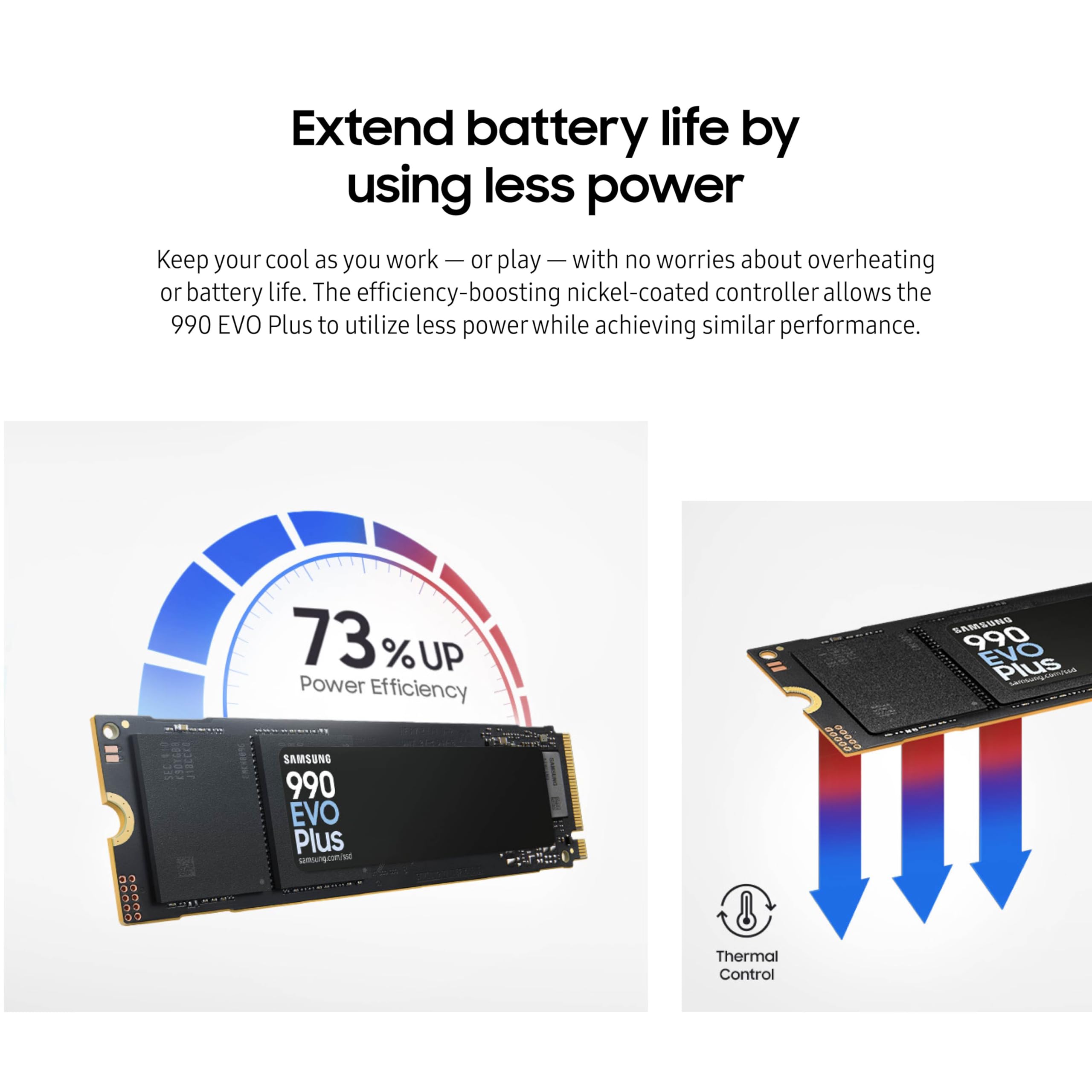
The 990 Evo Plus is an M.2 NVMe drive, and Samsung's material does not mention a bundled heatsink, so plan on using your motherboard heatsink, an aftermarket one or the airflow in your laptop or console. Samsung credits its nickel-coated controller for thermal control, and the maximum temperature reported under heavy load is 65 degrees Celsius. That is a comfortable figure for a PCIe 4.0 drive, though it is a reported peak, not a sustained-load curve.
Under the hood is Samsung's 8th-generation V-NAND, paired with a controller that Samsung describes as nickel-coated and that is known as the Piccolo. Samsung backs the drive with a 5-year limited warranty. The 2,400 TBW rating Samsung lists comes from the 4TB model's page, so do not assume it carries over to the 1TB version.
Security is a strong point. The drive supports AES 256-bit hardware encryption (Class 0), TCG/Opal and IEEE1667 encrypted-drive support. That makes it a sensible choice for a work laptop where full-drive hardware encryption is a requirement, and Samsung Magician handles the encryption setup.
Efficiency is the story Samsung leans on hardest. By Samsung's internal testing, MB/s per watt is up 73% on reads and 68% on writes versus the original 990 EVO. On the 2TB model, Samsung cites 1,576 MB/s per watt on reads against 909 for the older drive, and 1,500 against 893 on writes. Power draw while reading or writing lands in a range of roughly 4.2 to 5.5 W. These are rated figures, not battery-life measurements, but they point to a drive that should add little heat and little battery pressure in a laptop.
Capacity and Value
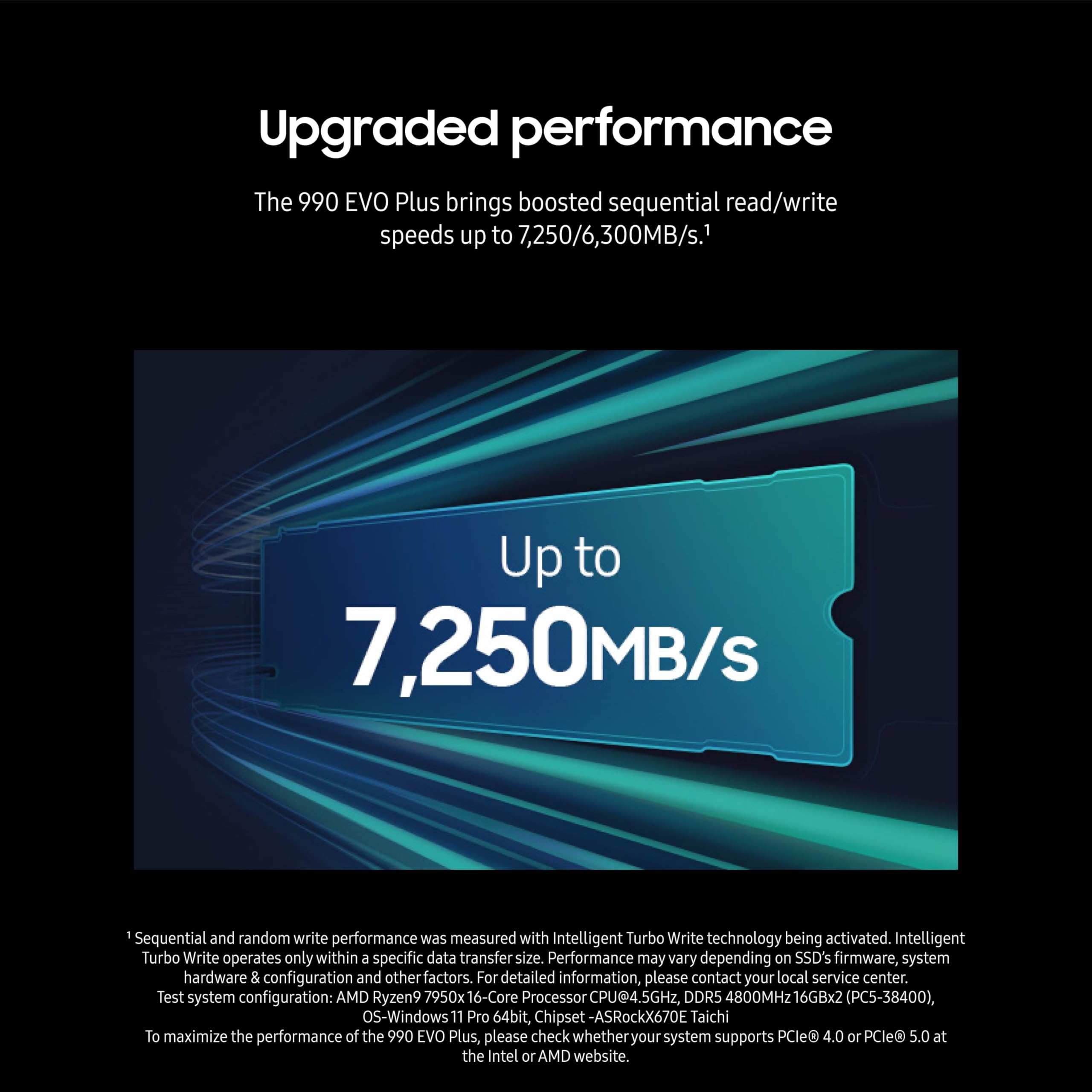
The line comes in 1TB, 2TB and 4TB. At launch in the Netherlands and Belgium, list prices were 129.99 euros for the 1TB, 219.99 euros for the 2TB and 409.99 euros for the 4TB. Street pricing has since come down, with the 1TB around 100 euros and the 2TB from about 170 euros, at retailers including Bol.com, Coolblue, MediaMarkt and Amazon. Those prices are European and come from a single source, so treat them as a guide to direction, not a quote.
The per-terabyte math favors the bigger drives. At launch list prices the 1TB works out to 129.99 euros per terabyte, the 2TB to about 110 euros and the 4TB to about 102.50 euros. At the street prices above, the 1TB is about 100 euros per terabyte and the 2TB about 85. If your budget stretches, the 2TB is the more economical way to buy storage.
The 1TB suits mainstream use: an operating system, a healthy game library and working files. If you install several large modern games at once or keep a big media library locally, step up a tier.
The price gap over the original 990 EVO is noticeable but justified by the faster rated reads and the efficiency gains, and the drive is priced above some alternatives.
Compatibility and Software
Compatibility is straightforward. The hybrid PCIe 4.0 x4 / PCIe 5.0 x2 design means the drive works in PCIe 5.0 slots and in PCIe 4.0 slots, though it is best on PCIe 4.0. Samsung advises confirming that your system supports PCIe 4.0 or 5.0 to reach full performance, which is sound advice if you are upgrading an older machine. On an older PCIe 3.0 platform the interface itself becomes the ceiling, so you give up part of the speed you are paying for.
One practical angle is to buy it now and move it into a future PCIe 4.0 or 5.0 build later. The hybrid design is compatible with PCIe 5.0 slots, so the drive does not lock you out of that plan, though it will not turn into a PCIe 5.0 flagship once it gets there.
Samsung Magician is the quiet differentiator. It covers optimization tools, drive-health monitoring, firmware updates, encryption and data migration for upgrades. Data migration is the feature most upgraders will use first, since it moves an existing install onto the new drive. Health monitoring and firmware updates arriving through the same tool means you are not hunting through support pages. With Opal and IEEE1667 support on top, it is one of the more complete software packages in this class.
Before you buy, confirm that your laptop, mini-PC or desktop has an M.2 NVMe slot, check which PCIe generation that slot runs, and decide whether you will use a heatsink. Those three checks decide how much of the rated performance you can expect to see.
Value for Money
The 990 Evo Plus 1TB is a premium-tier mainstream drive, not a bargain pick. The premium over the original 990 EVO is noticeable but justified by the faster rated reads (46% faster, per Samsung) and the efficiency gains. It costs more than some alternatives, but European street pricing of around 100 euros for the 1TB, against 129.99 euros at launch, shows the gap can narrow, and Samsung's software and encryption add real value. If the lowest price matters most, the original 990 EVO costs less. If you want the most polished everyday drive, this is the one.
Who Should (and Shouldn't) Buy This
Buy it if you are upgrading a PCIe 4.0 desktop or laptop and want an efficient drive with strong software and hardware encryption. It is also a good fit for users who value Magician data migration, and for anyone planning to carry the drive into a future build.
Skip it if your work involves sustained heavy writes, where a drive with a confirmed DRAM cache and a published steady-state write profile makes more sense. Also skip it if you want the lowest price per gigabyte, or if you need the headroom of a true PCIe 5.0 flagship.
Bottom Line
The Samsung 990 Evo Plus 1TB is a strong, efficient mainstream PCIe 4.0 drive. It is not a revolution over earlier Samsung drives, but the efficiency gains, encryption and Magician software make it easy to live with. I recommend it for everyday and gaming use.
What I value most is that nothing about the spec sheet demands attention: it is efficient, encrypted and well supported, which is what most buyers want from a storage device.
-- Theo Chan, Hardware Testing Director
*Disclosure: As an Amazon Associate, Revuzia earns from qualifying purchases. Prices and availability are accurate as of publication and may change.*