LG C6 OLED evo AI Smart 4K TV Review: Brighter and 165Hz-Ready, but PriceyLG C6 OLED evo AI Smart 4K TV Review: Brighter and 165Hz-Ready, but PriceyLG C6 OLED evo AI Smart 4K TV Review: Brighter and 165Hz-Ready, but PriceyLG C6 OLED evo AI Smart 4K TV Review: Brighter and 165Hz-Ready, but Pricey
October 5, 2026
The LG C6 OLED evo AI Smart 4K TV is reviewed here in its 65-inch model, with a 165Hz PC gaming ceiling and a new Alpha 11 Gen 3 processor. After time with the set, our first impression is that it is a brighter, richer and more refined version of an OLED we already loved.
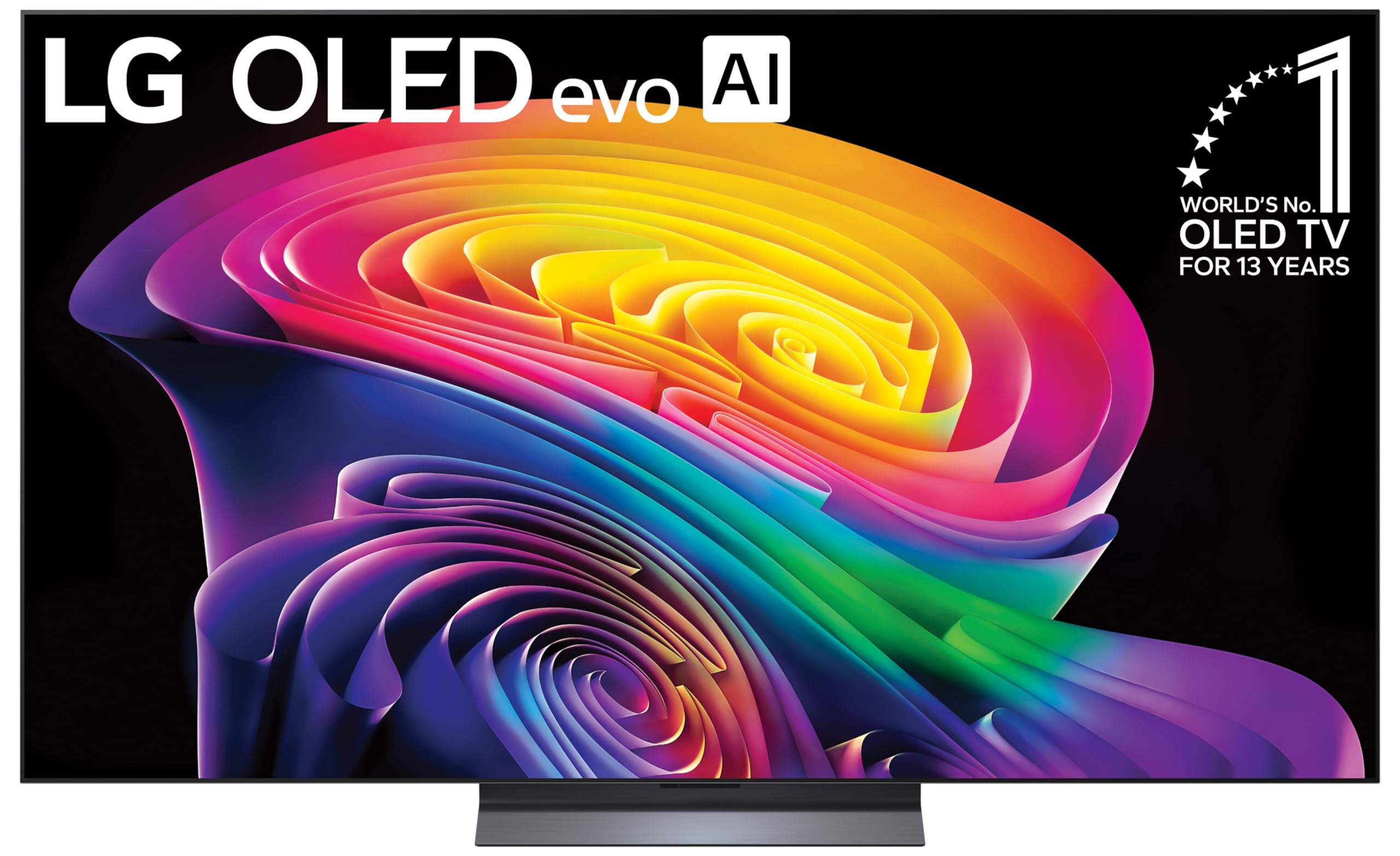
The LG C6 OLED evo AI Smart 4K TV is reviewed here in its 65-inch model, with a 165Hz PC gaming ceiling and a new Alpha 11 Gen 3 processor. After time with the set, our first impression is that it is a brighter, richer and more refined version of an OLED we already loved. The harder question is whether that is worth paying a premium for while the C5 and other 2025 sets are still heavily discounted. The design is essentially unchanged, so what you are really buying is processing, brightness and a higher PC refresh ceiling.
Quick Verdict
The LG C6 OLED evo AI Smart 4K TV is a top-tier OLED for most buyers at $1499.99, and an easy pick for PC gamers who want 165Hz. Its strongest argument is a visibly brighter picture than the C5 with the same four full-spec HDMI 2.1 ports. Its weakness is the launch premium, since the discounted C5 delivers much of the same experience. Our overall rating is 4.0/5: buy now if you game on PC or want the newest features, and wait or grab a C5 if value matters most.
Ratings and Pros/Cons
| Aspect | Rating |
|---|---|
| Picture Quality | 4.5/5 |
| Gaming | 5/5 |
| Smart Platform | 4/5 |
| Sound | 3/5 |
| Value for Money | 3.5/5 |
| Overall | 4.0/5 |
Pros
- 4K/165Hz VRR support for PC gaming, up from the C5's 144Hz cap
- Four HDMI 2.1 ports that each support the full feature set
- Strong brightness and color, with a visible lift over the C5 even in Filmmaker Mode
- Dolby Vision, HDR10 and HLG support
- Alpha 11 Gen 3 processor with Dual AI Super Resolution and a 12-bit pipeline
Cons
- No HDR10+ support
- Consoles are capped at 120Hz, so the 165Hz ceiling is a PC-only benefit
- The 55 and 65-inch sizes use a WOLED panel rather than the newer Primary RGB Tandem OLED
- The launch price sits well above the heavily discounted C5
Specs at a Glance
| Specification | Detail |
|---|---|
| Price | $1499.99 |
| Model Reviewed | OLED65C6 (65-inch) |
| Release | March 2026 |
| Panel Type | WOLED at 55 and 65 inches |
| Resolution | 3,840 x 2,160 |
| Sizes (C6) | 42, 48, 55 and 65 inches |
| Sizes (C6H, Primary RGB Tandem) | 77 and 83 inches |
| Refresh Rate | 144Hz spec, 4K/165Hz VRR on PC, 120Hz on consoles |
| HDMI | Four HDMI 2.1 ports, one with eARC |
| HDR Formats | Dolby Vision, HDR10, HLG (no HDR10+) |
| Processor | Alpha 11 Gen 3 |
| Smart OS | webOS 26 |
| Speakers | 2.2 channel |
| USB | Two USB-A ports |
| Other Connections | Ethernet, optical digital audio out, 3.5mm jack, serial port, antenna/cable input |
| Wireless | Wi-Fi 5, Bluetooth 5.3 |
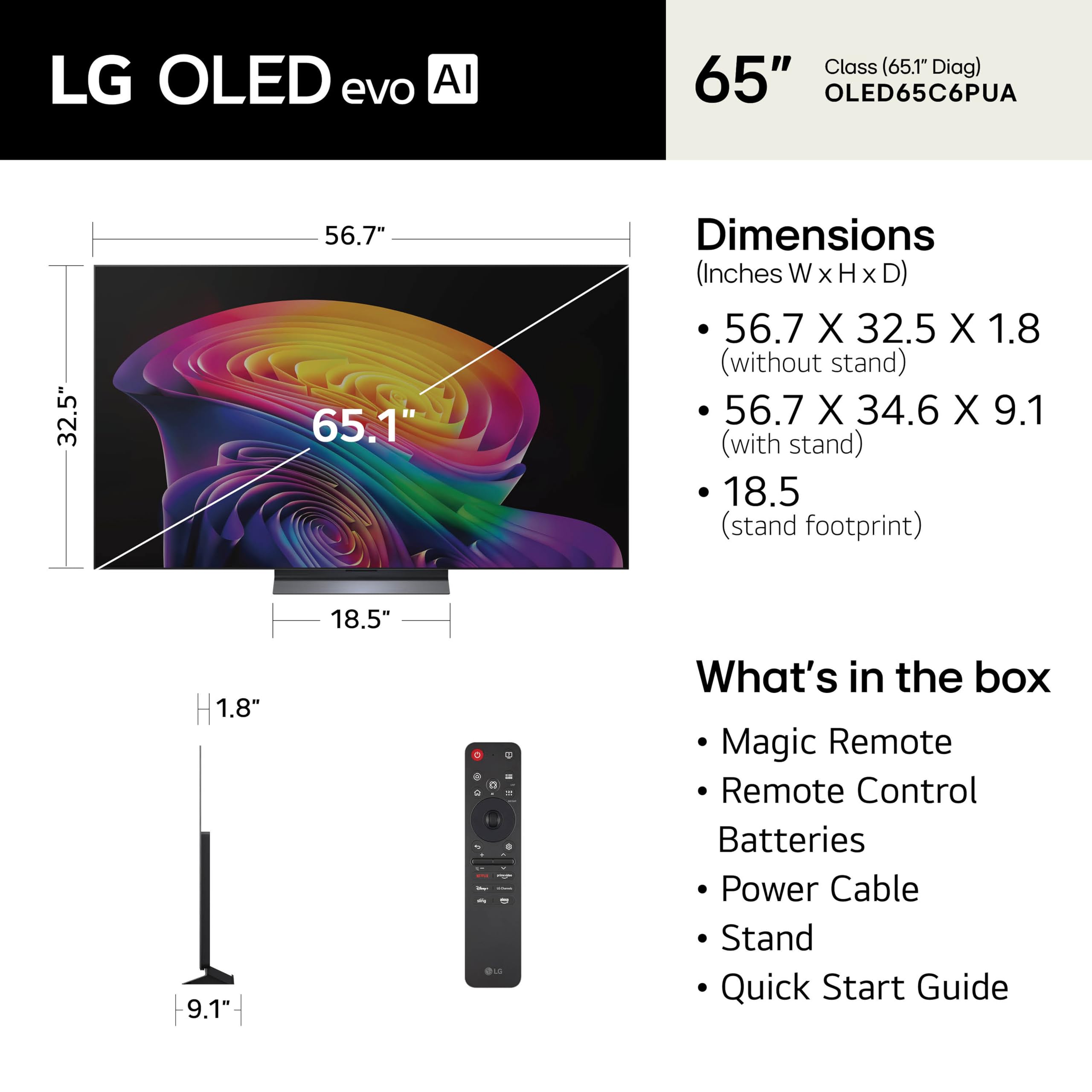
| Dimensions (no stand, 65-inch) | 83 x 144 x 4.5cm (32.5 x 56.7 x 1.8 inches) |
| Weight (no stand, 65-inch) | 36.6 pounds |
Picture Quality
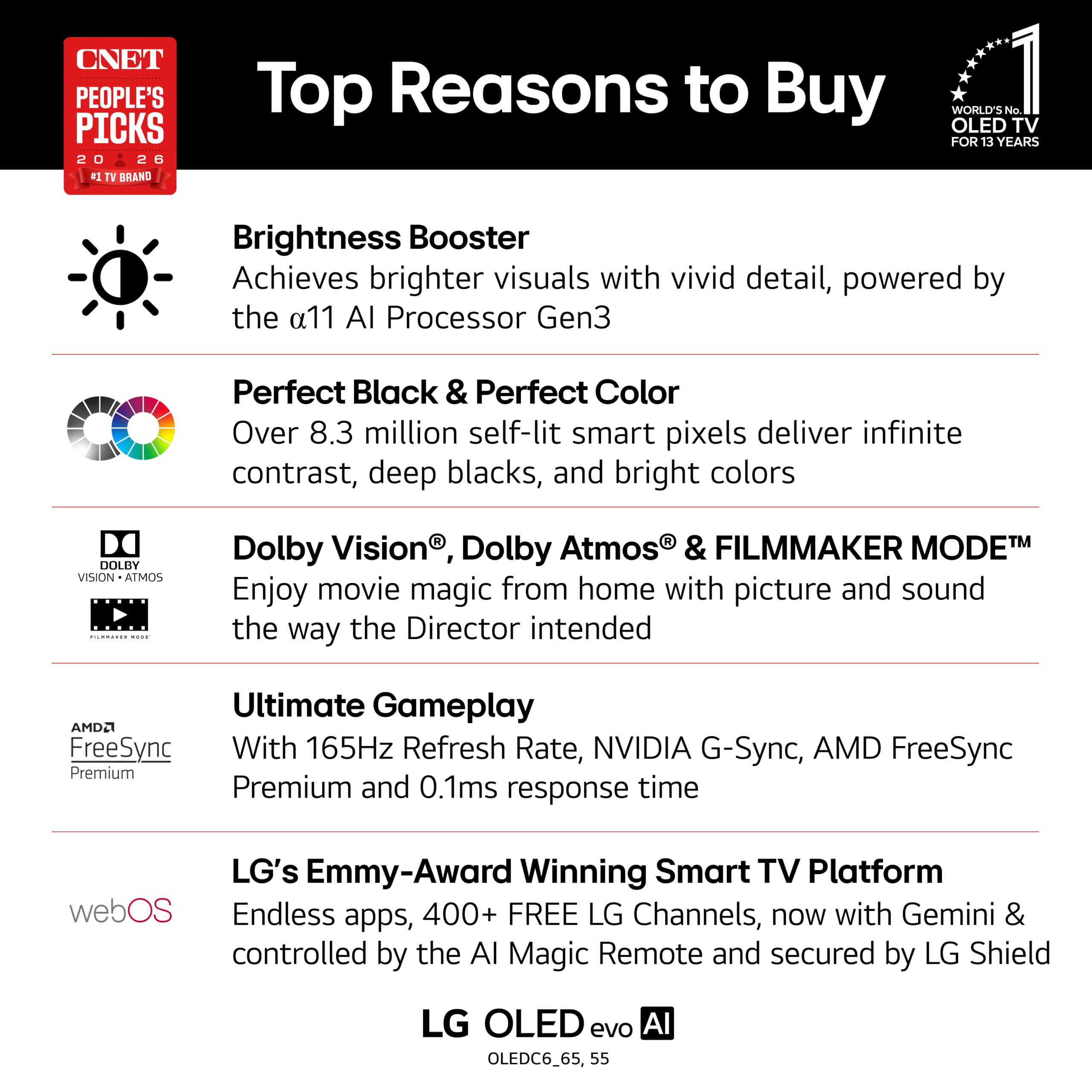
Picture quality is where the C6 earns its place. We measured 355 nits in SDR and 1,355 nits in HDR on the 65-inch model. For context, the Samsung S90F OLED measured 255 nits SDR and 1,231 nits HDR in the same testing. The Sony Bravia 8 II measured 103 nits SDR and 1,584 nits HDR. That puts the C6 ahead of both rivals in SDR, ahead of the S90F but behind the Bravia 8 II in HDR, and a step brighter than the C5 in side-by-side viewing.
The brightness gain over the C5 is immediately obvious, even in Filmmaker Mode. Highlights hit harder, such as the water glints in Pan, and reds and oranges look richer. Viewing in a bright room is also more comfortable than on previous C-series sets. This is not a new panel at 65 inches, so processing is the likely source of the gain. The Alpha 11 Gen 3 processor uses a 12-bit processing pipeline plus an extra brightness-control layer aimed at intense light sources and reflections.
The processor also adds Dual AI Super Resolution, which makes two upscaling passes: one for edges and one for texture and detail. Lower-resolution streams looked clean and sharp, and YouTube 8K content looked great. AI HDR Remastering is the weaker idea. It analyzes each frame, remastering SDR to look more like HDR and refining HDR further. In accurate picture modes the effect is extremely subtle, but in other modes it looked like an unnatural filter. We would leave it off.
Out of the box, the best settings we found were Filmmaker Mode, TruMotion set to Cinematic Movement, and Near Black Detail lowered from 0 to -1. At the default setting, blacks in Alien: Romulus looked slightly raised compared with the C5. At -1 they returned to inky blacks while keeping more shadow detail than the C5 managed. Filmmaker Mode also gives a warmer, more cinematic look, and we think it should be the default.
Color accuracy is good, but the C6 does not win it. We measured a Delta-E of 1.53, against 1.25 for the C5 and 1.12 for the S90F (lower is better). All three look great to the eye, but this is the clearest spot where the C6 is not an improvement over last year's set. Weapons had deep, saturated color in the fake blood, and the cool blues in Paradise looked excellent.
On panel technology, the 55 and 65-inch sizes use a WOLED panel. The newer Primary RGB Tandem OLED is reserved for the 77 and 83-inch sizes, which are sold as the C6H. If that panel matters to you, you need to go larger. On HDR formats, the C6 supports Dolby Vision, HDR10 and HLG, with no HDR10+. LG also did not implement Dolby Vision 2 this year, though no content is currently available in that format.
Gaming Features
Gaming is the C6's strongest category. All four HDMI 2.1 ports support the full feature set, so you never have to juggle which console goes where. The headline change is on PC, where VRR now runs up to 4K/165Hz, up from the C5's 144Hz cap. If you have a high-end graphics card and want every frame, this is the main reason to choose the C6 over its predecessor.
Consoles are a different story. Both the PS5 and Xbox Series X are limited to 120Hz, so the 165Hz upgrade does nothing for them. That is not a flaw, since 120Hz is as high as those consoles output, but it does mean console gamers get less from the upgrade than PC players do.
The rest of the feature list is complete: 4K/120Hz, VRR, ALLM, Dolby Vision game mode and HGiG. The Game Optimiser dashboard returns, putting the useful settings in one place. Input lag measured 9.1ms in gaming mode, the same as the C5 and the S90F. In practice the TV felt immediately responsive.
Playing Marvel's Spider-Man 2 with the Game Optimiser dashboard on, VRR kept motion smooth and removed tearing. The picture also stays bright and punchy in HDR games, which suits fast, colorful titles well.
Cloud gaming is covered through GeForce Now, Xbox Cloud Gaming and Amazon Luna, all accessible without extra hardware. For anyone who wants to game without owning a console, that is a genuinely useful extra.
Smart Platform and Apps

The C6 runs webOS 26. Most of the changes this year are AI-centric, but the interface itself is easy to use and responsive. The Home Hub is faster, and there is a new My Page widget area. The Continue Watching row works only with Amazon Prime Video, so it is less useful than it sounds if you spread viewing across several services.
App support is broad and well optimized. All the major streaming services are present, and apps offer excellent support for Dolby Vision and Dolby Atmos formats. In the UK, Discovery+ is missing, which matters for some TNT Sports events. Everything else we tried launched and played without trouble.
The AI features are the weak spot. AI search often identified the show we asked for, but it sometimes failed to launch it inside certain apps, which defeats the purpose. The AI dialogue clarity mode was irritating, raising voices too much and washing out the rest of the audio. We turned both off and went back to the standard interface.
One more thing to know is that the home screen carries large banner ads. They can be turned off in settings, and we recommend doing so on day one.
Sound and Connectivity
The speakers are a 2.2-channel setup, and built-in sound is the lowest-scoring part of our review. A 2.2-channel system in a panel this thin is a compromise, so we rate it below the picture. It is fine for casual viewing and news, but if you care about movies or games we would plan on a soundbar.
That plan runs into a small design annoyance. The angled central pedestal can make soundbar placement awkward. If you wall mount the set, the rear housing on the lower back holds the speakers, processing and connections, and it pushes the screen slightly off the wall.
The connection list is generous. There are four HDMI 2.1 ports, one of which supports eARC for sending lossless audio to a soundbar or receiver. You also get two USB-A ports, Ethernet, an optical digital audio output, a 3.5mm jack, a serial port and an antenna/cable input. Wireless covers Wi-Fi 5 and Bluetooth 5.3. Wi-Fi 5 is not the newest standard, so wired Ethernet is the better choice if you stream a lot of high-bitrate content.
Design and Build
The ultra-thin panel is only a few millimeters thick across most of its surface, and it looks great on a wall, almost floating. The central pedestal has a brushed-metal finish, and the faux-marble finish on the back is carried over from the C5. The whole set feels sturdy. At 36.6 pounds without the stand, it is very light for its size, but the thin panel and sharp edges make it awkward to maneuver. Two people should handle it. The design is essentially unchanged from the C5 and several earlier generations.
Value for Money
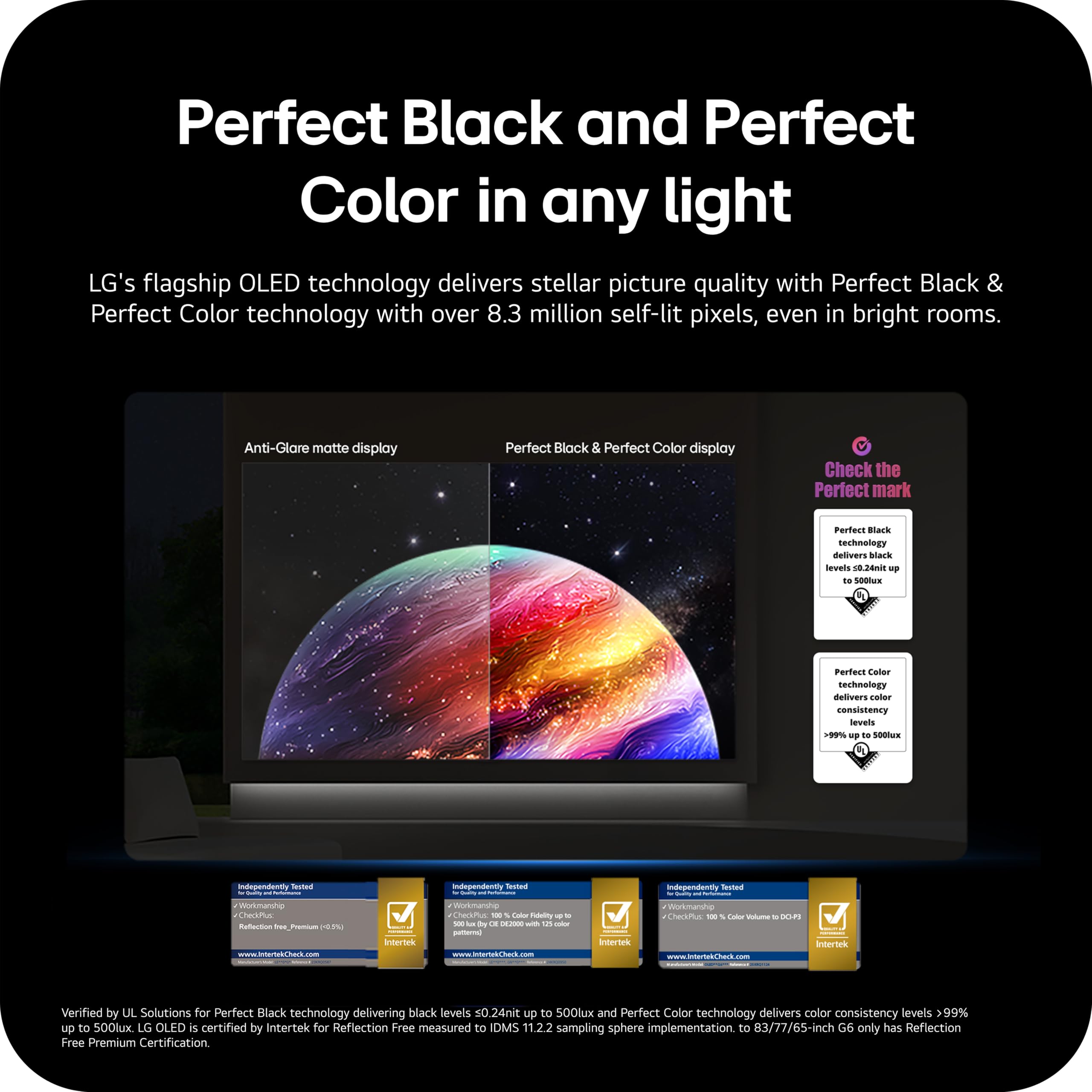
At $1499.99, that is a fair launch price for a set this bright. The problem is timing. The C5 and 2025 rivals are now heavily discounted, which makes the C6 look expensive by comparison. If you are not gaming on a 165Hz PC, the practical choices are a discounted C5 or waiting for the C6 to fall in price later in the year. We still recommend the C6 for most people who accept the premium.
Who Should Buy This
Buy now if you are a PC gamer who wants 165Hz, or an early adopter who wants the Alpha 11 Gen 3 processing and the brightest C-series picture so far. Four full-spec HDMI 2.1 ports also suit anyone with a crowded entertainment setup.
Wait or buy the C5 if you are value-focused, since the older set is a very small step down. Also skip the C6 if you need HDR10+, which it does not support. Finally, if you want the Primary RGB Tandem panel, look at the 77 and 83-inch C6H instead.
Bottom Line

The LG C6 OLED evo AI Smart 4K TV is a strong but pricey flagship-adjacent OLED. Buy it at $1499.99 for 165Hz PC gaming and the brightest, most refined C-series picture yet. If value matters more, wait for the price to drop or pick up a discounted C5, which gives up very little.
Every year I wonder whether the new C-series is a real upgrade or a refresh, and this year the honest answer is a refresh that happens to look better in a bright room. I would turn off the AI extras, set Near Black Detail to -1 and enjoy the picture. Then I would watch the price closely.
-- Miles Danner, Consumer Electronics Editor
*Disclosure: As an Amazon Associate, Revuzia earns from qualifying purchases. Prices and availability are accurate as of publication and may change.*