Physicists Predict Fractional Fermi Sea in Cycled Ultracold Cesium AtomsPhysicists Predict Fractional Fermi Sea in Cycled Ultracold Cesium AtomsPhysicists Predict Fractional Fermi Sea in Cycled Ultracold Cesium AtomsPhysicists Predict Fractional Fermi Sea in Cycled Ultracold Cesium Atoms
October 19, 2026
A theory paper in Physical Review Letters predicts that ultracold cesium atoms, confined to one dimension and cycled repeatedly between strong repulsion and strong attraction, can be driven into a highly excited but ordered state called a "fractional Fermi sea." The work comes
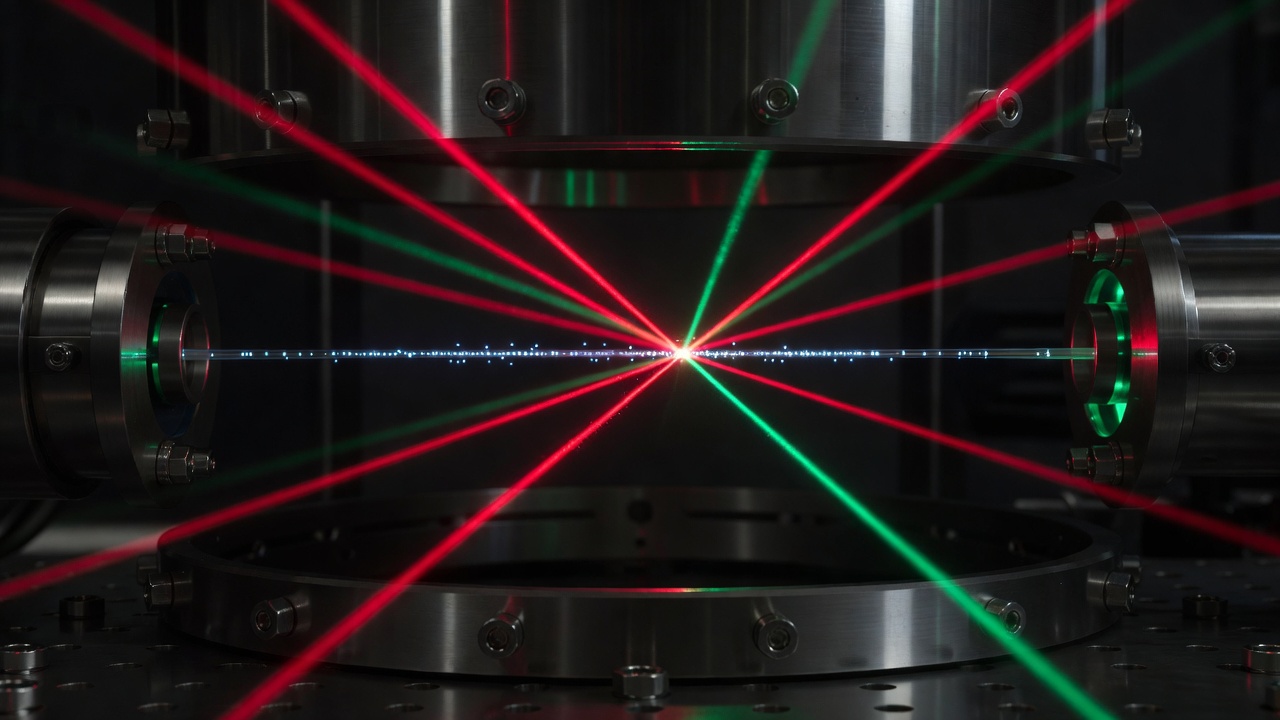
A theory paper in Physical Review Letters predicts that ultracold cesium atoms, confined to one dimension and cycled repeatedly between strong repulsion and strong attraction, can be driven into a highly excited but ordered state called a "fractional Fermi sea." The work comes from Hanns-Christoph Nägerl's group at the University of Innsbruck and theorist Alvise Bastianello of CNRS and Université Paris-Dauphine. It matters now because the signatures it predicts, including correlations that break the standard one-dimensional (1D) description, are exactly what a lab could test.
What the Researchers Found
The starting point is the Fermi sea (the arrangement fermions adopt at very low temperature: because no two can share a quantum state, they fill the available energy levels from the bottom up). It is the textbook picture of an orderly, cold quantum gas. The new paper asks what happens when interacting atoms are pushed far from that picture. Bastianello frames the question this way: "Fermions, for instance, stack neatly into the available energy states to form the so-called 'Fermi sea'. But what happens if one forces interacting atoms to continuously cycle through extreme conditions, smoothly shifting them from strongly repelling each other to strongly attracting each other?"
The obvious expectation is that such repeated forcing simply heats the gas into featureless disorder. The calculations say otherwise. Yi Zeng, the study's leading author, says: "Instead of simply heating the system, the interaction cycle reorganizes the atoms into a new many-body state. This gives us a controlled way to explore quantum matter beyond the usual equilibrium paradigms."
Starting from the ground state (the lowest-energy configuration), the protocol drives the atoms to a highly excited state that nonetheless keeps its underlying organization. Nägerl describes it: "This state is highly excited, but it is not random.
The Methodology
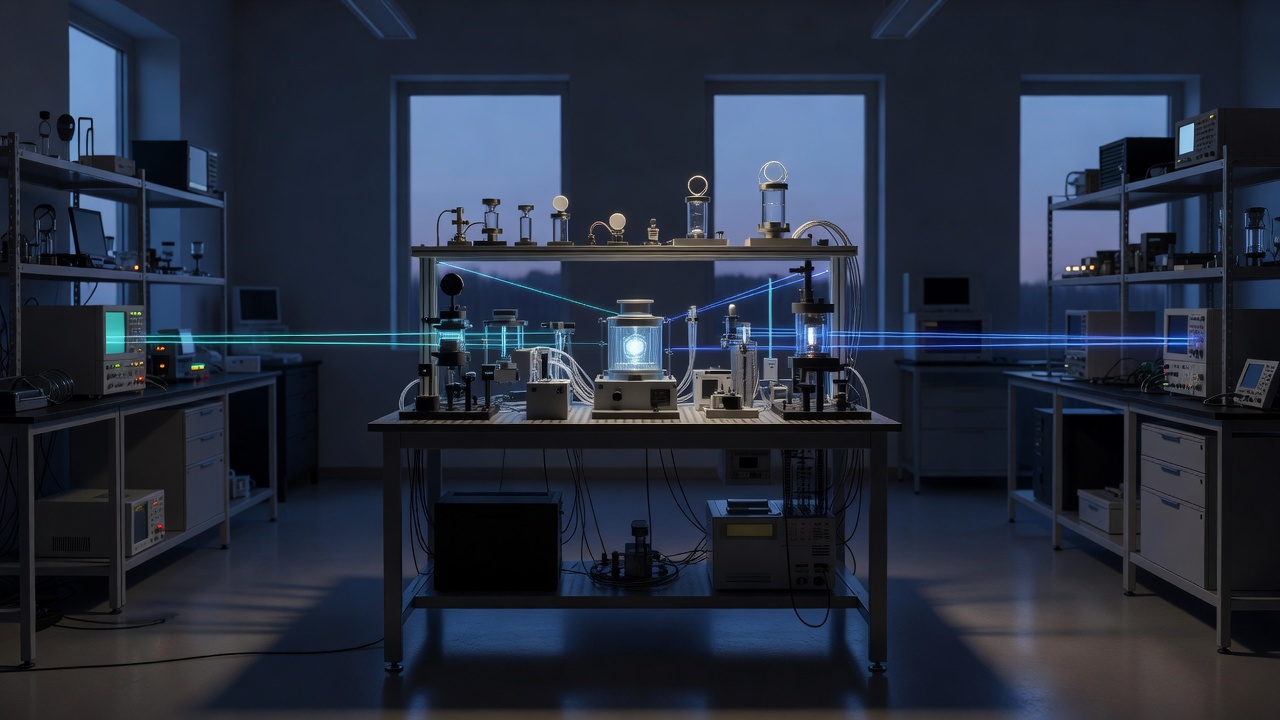
The protocol is conceptually simple. Researchers begin with a 1D gas of ultracold cesium atoms in its ground state, then smoothly sweep the interaction strength from strong repulsion to strong attraction, and repeat the cycle. The theory was developed by Bastianello, working with Nägerl's group, with Zeng as lead author, and it provides the foundation for recent experimental research by Nägerl's team.
The reported signatures are two. The first is pronounced Friedel oscillations (ripples in particle density that appear in a quantum system's response to a boundary or disturbance). The second is unusual distance-decay patterns in particle correlations (statistical links between particles at different positions, which normally fade with separation in a characteristic way). These decay patterns appear even when repulsion is relatively weak.
Both differ from the predictions of Tomonaga-Luttinger liquid theory (the standard framework for interacting quantum particles confined to one dimension). The authors describe the result as an "exotic critical phase" whose correlations go beyond existing 1D descriptions.
Those specifics live in the paper itself.
Why It Matters
The central claim is about method. Zeng calls the interaction cycle "a controlled way to explore quantum matter beyond the usual equilibrium paradigms." Most quantum phases are catalogued by cooling a system and watching where it settles; here a driven protocol produces order in a state that is far from the ground state. One cycle, repeated, replaces the usual route of cooling toward equilibrium.
Nägerl places it in the context of quantum simulation (using a controllable quantum system, here cold atoms, to mimic and probe other quantum systems): "The discovery of fractional Fermi seas shows how far we can push quantum simulation: not only reproducing known models, but creating and probing states that go beyond established paradigms." The distinction he draws is between reproducing known models and reaching states no existing model covers.
The researchers also float a new kind of quasiparticle, a collective excitation of the system that behaves like a particle in its own right. Nägerl says: "We are not yet sure how we should name these new quasiparticles. Perhaps 'super-Fermions'?" The name is an aside, not a finding, and the source does not describe what such excitations would be beyond that.
The researchers' claims in brief:
- Cycling interactions reorganizes atoms into a many-body state rather than merely heating them.
- The state is highly excited but carries hidden order visible in correlations.
- Its correlations differ from Tomonaga-Luttinger liquid predictions, even at relatively weak repulsion.
- Its excitations may constitute a new type of quasiparticle.
Competitive Landscape
The source does not compare this work with other laboratories or competing results, so no rankings can be drawn. It sets the finding only against ordinary equilibrium Fermi seas and Tomonaga-Luttinger liquid theory. The brief's peer items are contemporaneous quantum-state announcements, not rivals: Rutgers on a new way matter can exist, Oxford physicists on a Schrödinger's cat-like state, and Rice on a new quantum state for future technologies. They address different systems.
The broader context is ultracold-atom physics, which the review by Bloch, Dalibard and Zwerger describes as covering "many-body phenomena in dilute, ultracold gases," including strongly interacting gases in one and two dimensions. A review of 1D bosons by Cazalilla and colleagues likewise treats Tomonaga-Luttinger liquids as the baseline, with extensions to out-of-equilibrium situations. Against that baseline, this work is notable for proposing a state that departs from the Luttinger description rather than refining it.
Limitations and Caveats
The largest caveat is status. The PRL paper reports theoretical findings. Statements that atoms were "discovered" in this state, including the word's appearance in a quote, should be read with that in mind.
A snippet dates the finding to June 29, 2026, while the ScienceDaily page is dated October 18, 2026, a gap of almost four months. It may reflect the paper's or press release's date, or a snippet error.
Everything here rests on one press-release-style source quoting three scientists from three named institutions, with no independent expert comment.
What Comes Next
The researchers' own open questions are to name and characterize the new quasiparticles and to probe the correlations further. The decisive step is for the experimental work from Nägerl's team to show Friedel oscillations and anomalous correlation decay in real cesium gases, in a form other groups can examine.
Editor's inference, not a researcher claim: if the protocol works, other interaction-cycling sequences could be tried in the same apparatus, and the correlation exponents would give theorists a concrete target to model.
For an academic researcher working on 1D quantum gases, the practical takeaway is a testable fingerprint: if a Luttinger-liquid fit to measured correlations fails even at weak repulsion after repeated repulsive-to-attractive cycling, that is the signature the authors describe, and it would call for a different theoretical description.
The Last Word
The most striking thing here is the gap between the vocabulary and the evidence: "bizarre," "discovered," "super-Fermions," all attached to a prediction awaiting its experimental check. That is not a criticism. Theory that names its own testable fingerprints is doing its job, and the cesium gas will decide whether the hidden order is real.
-- Zara Velez, Emerging Technology Editor
Sources: PubMed Central · arXiv · ScienceDaily