DJI Osmo Action 6 Review: Bigger Sensor, Variable Aperture, Real Creator Upgrades
October 29, 2026
The DJI Osmo Action 6 Camera Standard Combo appears at $436.00 on a backordered US retailer listing, with a larger 1/1.1-inch sensor and a variable f/2.0 to f/4.0 aperture, a first for the Osmo Action line. My first impression is of a camera that finally treats low light and
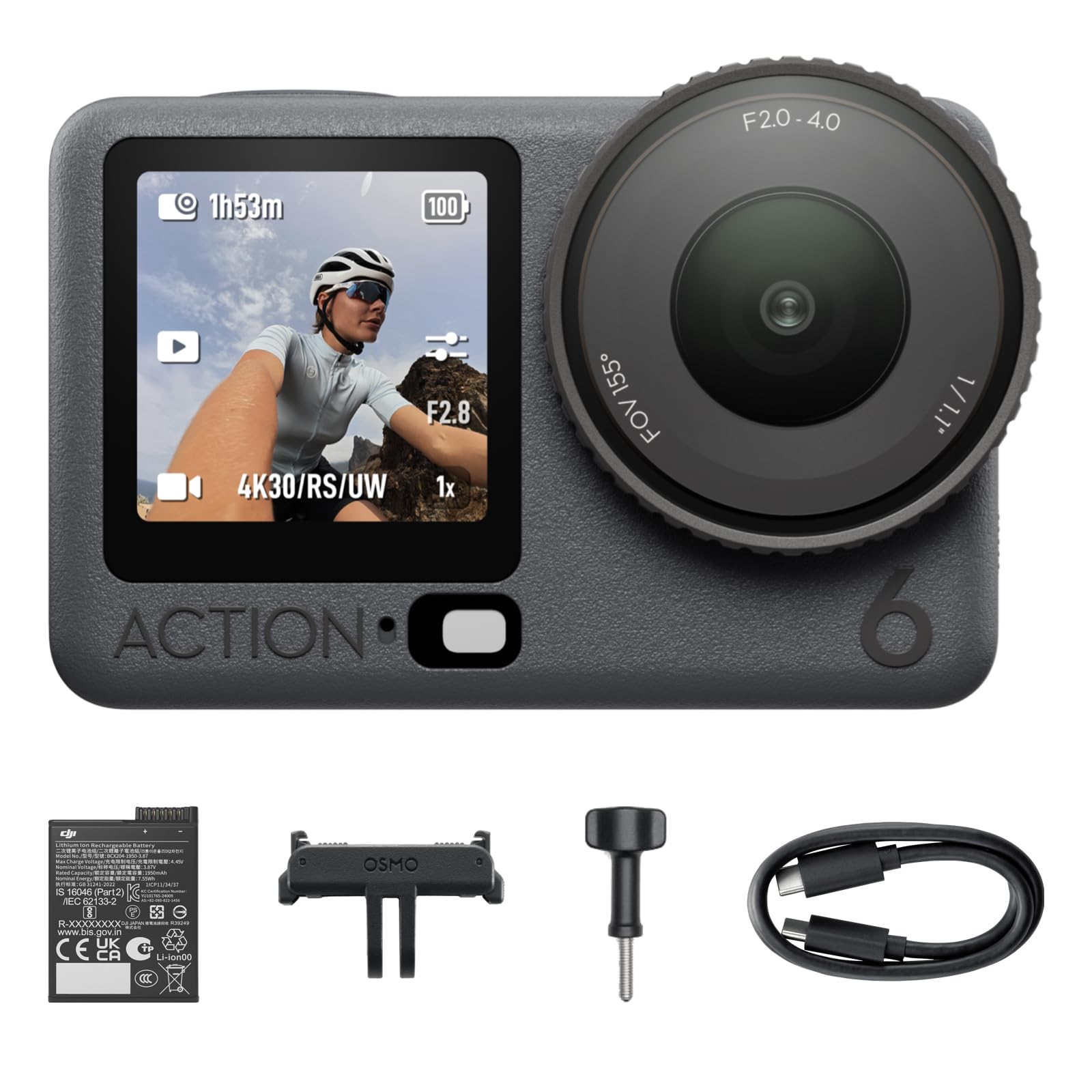
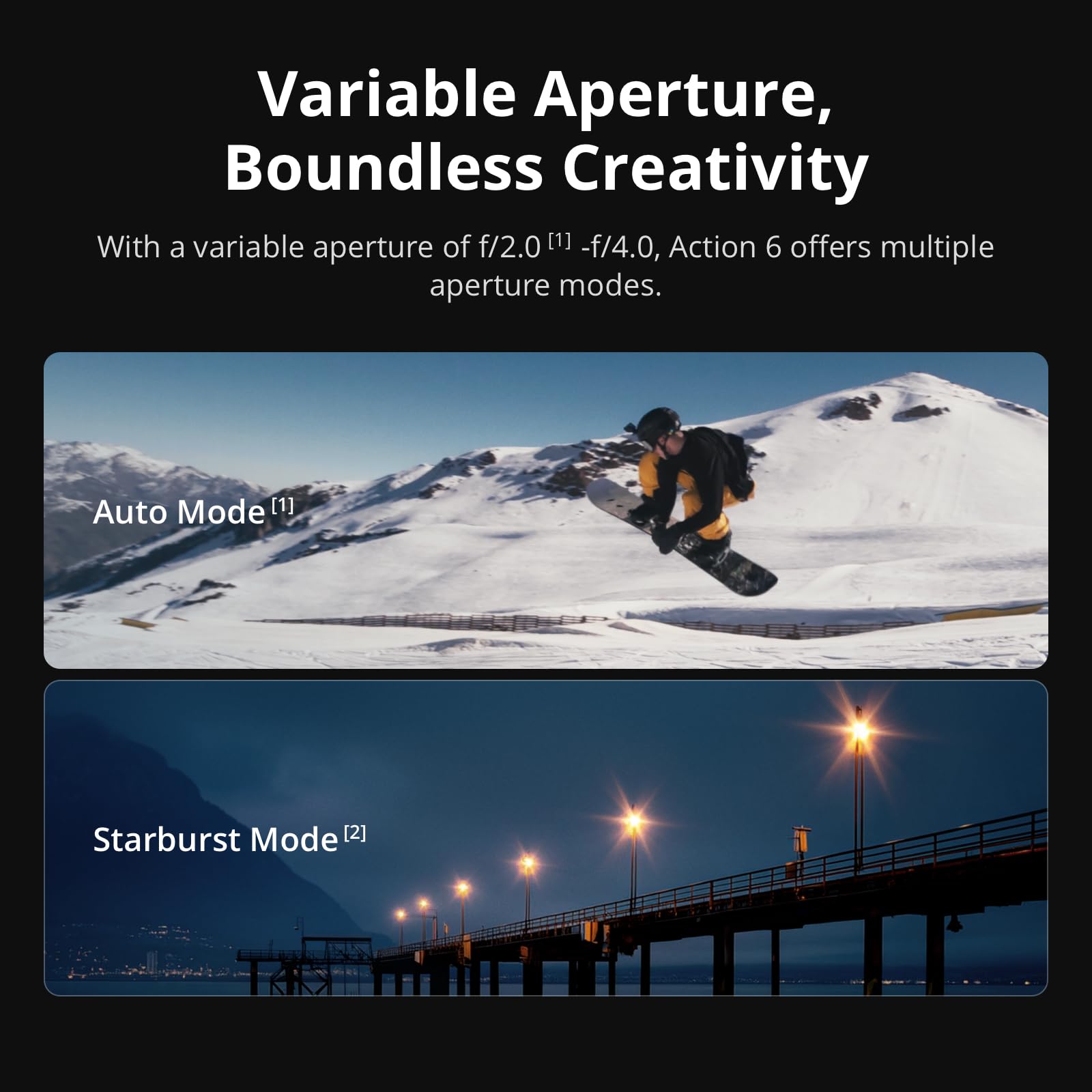
The DJI Osmo Action 6 Camera Standard Combo appears at $436.00 on a backordered US retailer listing, with a larger 1/1.1-inch sensor and a variable f/2.0 to f/4.0 aperture, a first for the Osmo Action line. My first impression is of a camera that finally treats low light and close-up work as priorities rather than afterthoughts. The aperture is the headline change. The Action 5 was fixed at f/2.8, and this one can open wider for dim scenes or stop down to focus closer.
There is one catch for American buyers. A DJI spokesperson has said the camera will not be officially available in the US through DJI's own websites following the global launch on 18th November. That affects warranty, support and how you should think about the purchase, and I cover it below.
Quick Verdict
At $436.00 the Osmo Action 6 is a strong upgrade for creators and low-light shooters. The bigger sensor, variable aperture, 10-bit D-Log M and square-sensor reframing are real additions. We rate it 4/5 overall. It loses points because the sensor gain is mostly in height, so plain 16:9 shooters see only a small jump over the Action 4. Confusing combo naming and the lack of official US sales also count against it.
Rating and Pros/Cons
| Aspect | Rating |
|---|---|
| Image Quality | 4.5/5 |
| Video Features | 4.5/5 |
| Handling | 4/5 |
| Battery and Storage | 4/5 |
| Value | 3.5/5 |
| Overall | 4/5 |
Pros
- 1/1.1-inch sensor with an f/2.0 to f/4.0 variable aperture
- 4K/120fps recording in 4:3 plus 10-bit D-Log M with on-screen preview
- Excellent handheld stabilization, a noticeable step up from the Action 4
- About four hours of battery in a mixed 1080p and 4K test
- 50GB of built-in storage plus a microSD slot
Cons
- Not officially sold through DJI's US websites
- The 16:9 recording area is no larger than the previous model's
- Battery claim of 240 minutes matches the Action 5 Pro, so no gain there
- Confusing Standard and Essential combo listings, with reports of missing mounts
Specs at a Glance
| Specification | Detail |
|---|---|
| Price | $436.00 (US retailer listing, backordered) |
| UK price | £329 Standard Combo, £415 Adventure Combo |
| EU price | €379 Standard Combo, €479 Adventure Combo |
| Sensor | 1/1.1-inch, about 14mm diagonal |
| Stills | 38MP, 7168 x 5376, 2.4µm pixels |
| Aperture | Variable, f/2.0 to f/4.0 |
| Video | Up to 4K/120fps in 4:3, 4K Custom reframing mode, SuperNight 4K/60fps, up to 32x Super Slow Motion at 1080p |
| Color profile | 10-bit D-Log M with on-screen preview |
| Special modes | Starburst mode, voice control |
| Main screen | 2.5-inch LCD touchscreen |
| Front screen | 1.46-inch, 342 x 342 pixels |
| Storage | 50GB built in plus microSD slot in the battery bay |
| Battery life (claimed) | 240 minutes |
| Battery capacity | 1950 mAh (Li-ion, 1S; 7.5 Wh) |
| Stabilization | RockSteady |
| Audio | Built-in mic, wireless pairing with DJI Mic Mini and DJI Mic 2 |
| Dimensions | 72.8 x 47.2 x 33.1mm |
| Weight | 149 g (5.3 oz) |
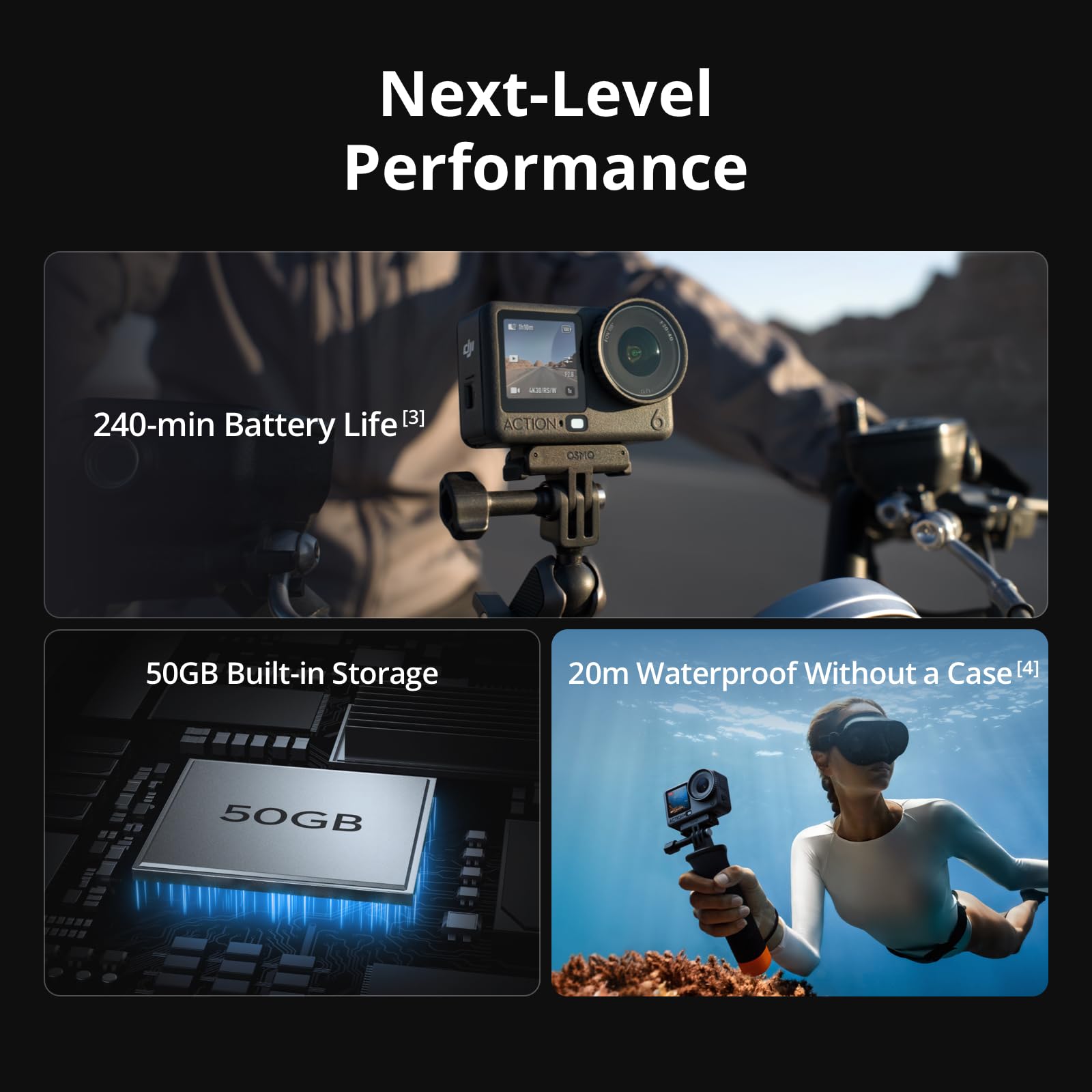
| Water resistance | Waterproof to 20 m (66 ft) without a case; 60 m (197 ft) with the DJI Waterproof Case, which is not in the Standard Combo |
| Standard Combo contents | Osmo Action 6 camera, Osmo Action Extreme Battery Plus (1950 mAh), Dual-Direction Quick-Release Adapter Mount, Curved Adhesive Base, Locking Screw, USB-C to USB-C PD cable, Anti-Slip Pad |
Image Quality
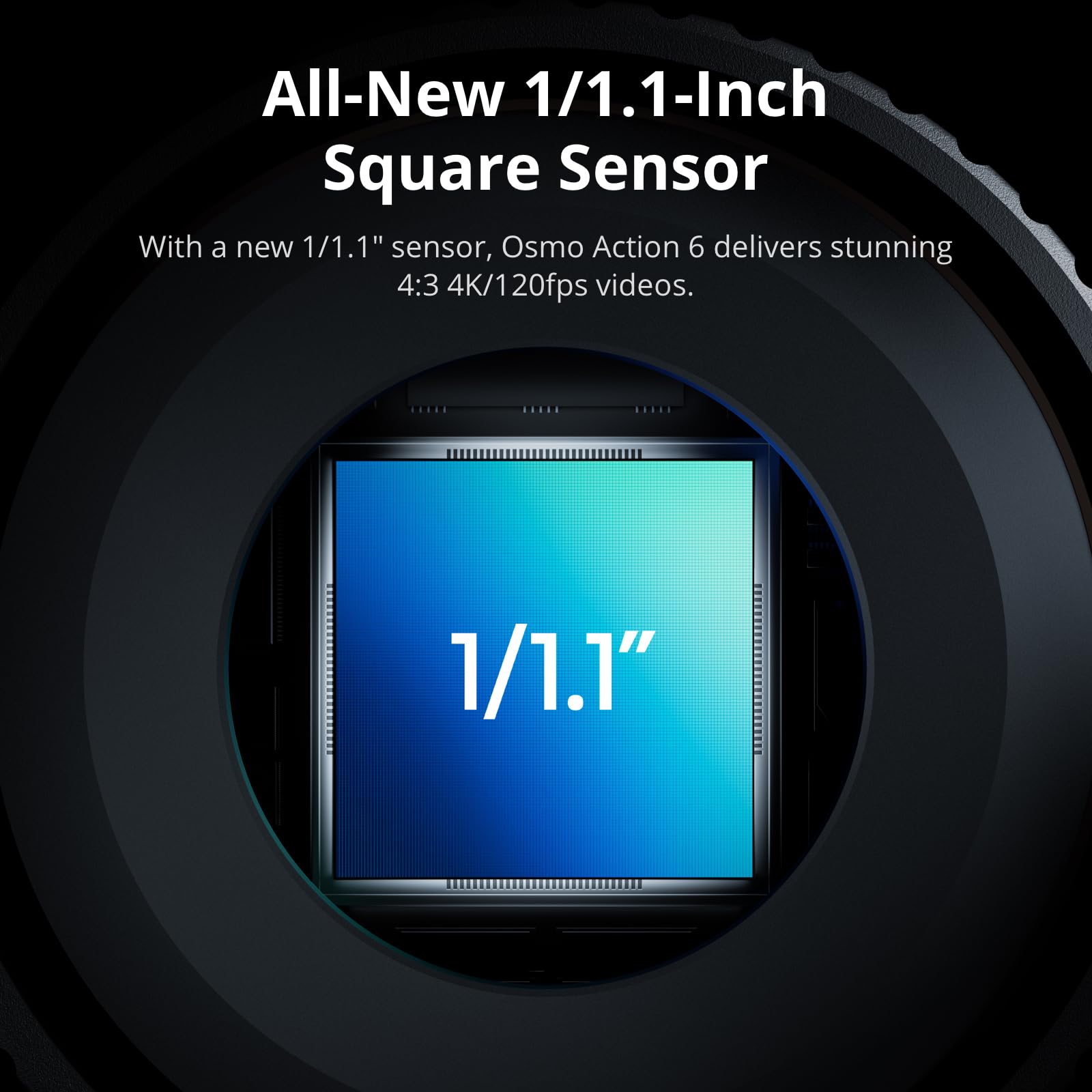
The sensor is the story. DJI moved to a 1/1.1-inch sensor, roughly 14mm across the diagonal, from the 1/1.3-type CMOS in the Action 5 Pro. On paper that is a meaningful jump in light-gathering area. Independent testers added an important caveat, though. The new sensor is larger only in height, so for standard 16:9 video the effectively used area is not bigger than the previous model's. If you shoot wide video only, do not expect a leap in noise performance purely from sensor size.
The variable aperture is the more practical upgrade. It runs from f/2.0 to f/4.0, where the Action 5 was fixed at f/2.8. Opening up helps in dim scenes. Closing down shrinks the minimum focus distance, so at settings like f/4.0 you can get closer to a subject. Reviewers called that ideal for handheld vlogging, and I agree it is the feature creators will use most.
In daylight, reviewers called the results genuinely impressive in bright, low-contrast conditions. In normal mode the footage is almost identical to the Action 4, and a touch sharper. That is the honest framing: the Action 6 refines rather than reinvents in good light.
Low light is more nuanced. Reviewers described video in moderate low light as excellent with very fine grain. In darker November conditions another group saw visible noise, but slightly less than on the Action 4, with a slightly brighter picture. Stills told a similar story. Detail gets a little smudged from around ISO 800 and up in gloomy indoor light, though noise is respectable outdoors or under direct artificial light, and colors stay punchy.
Two behaviors are worth knowing before you shoot. First, in-camera sharpening can be excessive in some cases, and reviewers suggest lowering Texture in Image Adjustment. Second, SuperNight brightens scenes significantly, but it can make details slightly mushy, although noise stays reasonably controlled. Treat it as a rescue mode, not a default.
Stills reach 38MP at 7168 x 5376 with 2.4µm pixels, and a Starburst mode is aimed at city lights at night. For a camera this small, the combination of a bigger sensor, an adjustable aperture and high-resolution stills makes it a more flexible tool than its predecessor.
Video Capabilities
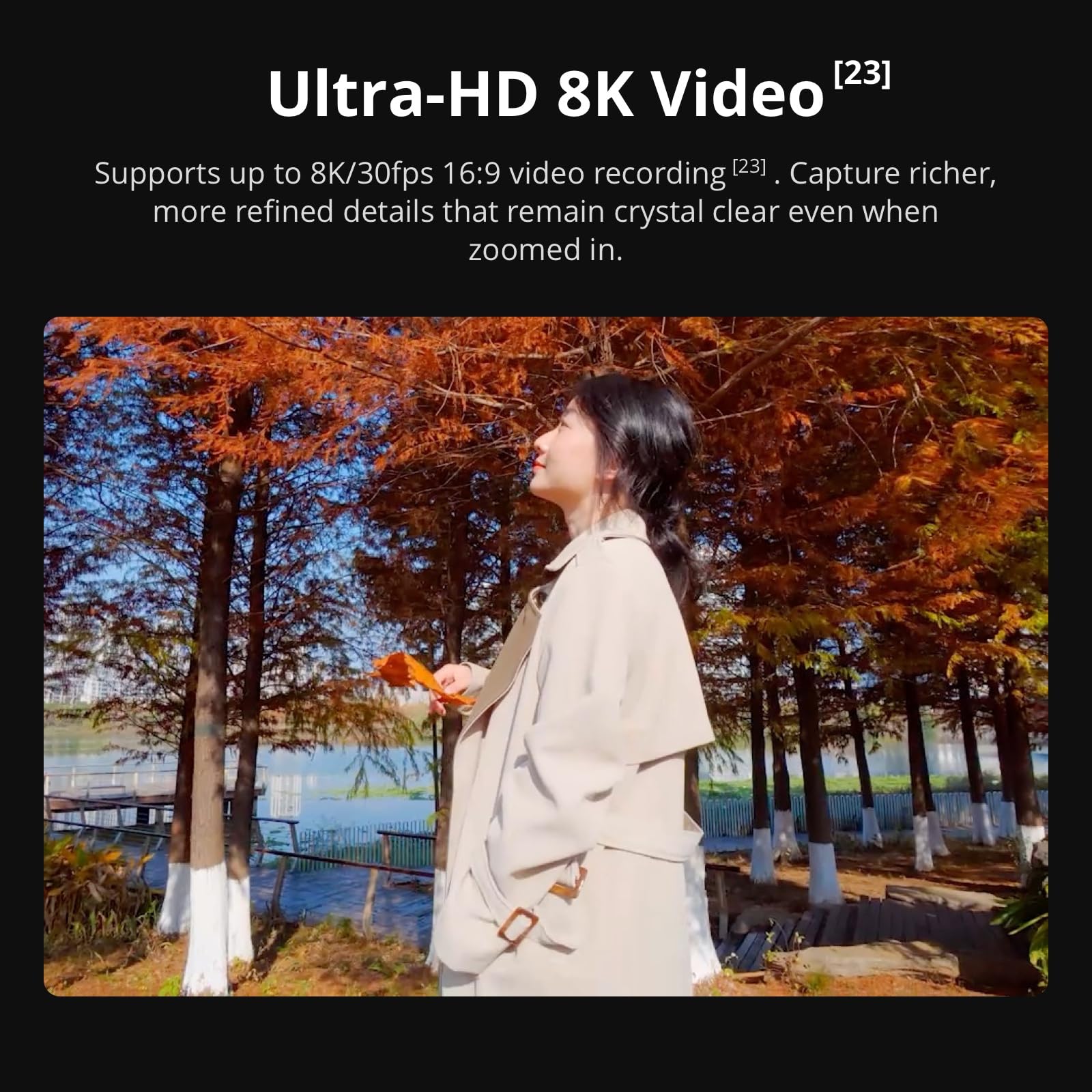
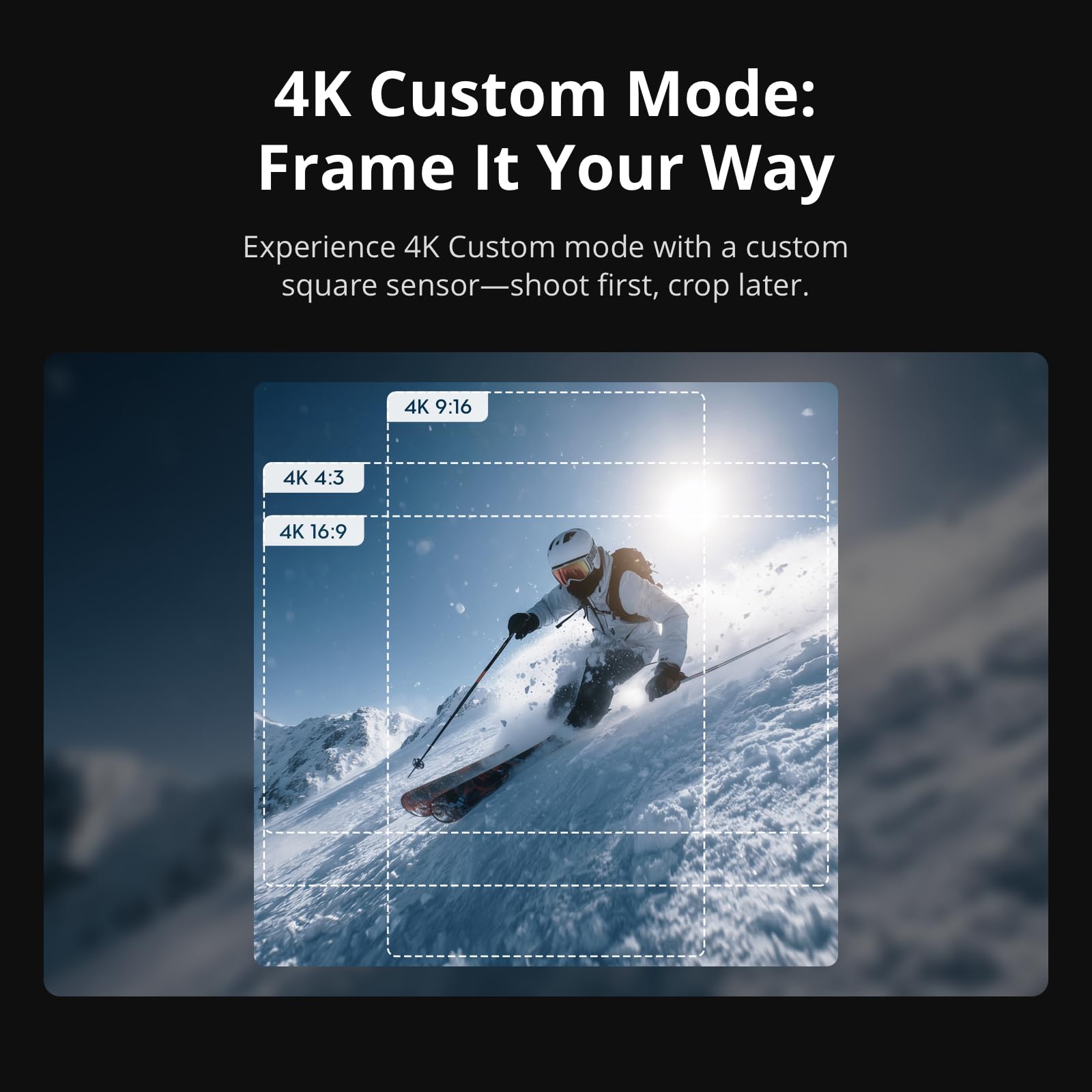
This is where the Action 6 earns its keep. It records up to 4K at 120fps in 4:3, and the square sensor enables a 4K Custom mode. That mode lets you reframe footage to different aspect ratios after shooting, so one clip can become a wide 16:9 edit and a vertical social cut. Independent testing calls it open-gate-like, but it is not true open gate, because horizontal recording tops out at 4:3. For most creators that distinction matters less than the workflow benefit.
Slow motion is generous. DJI offers up to 32x Super Slow Motion at 1080p, and 4K/120fps footage can also be slowed for smooth results at higher resolution. SuperNight reaches 4K/60fps, so low-light clips do not have to drop to a lower resolution.
For colorists, 10-bit D-Log M is the key addition, with an on-screen preview so you can judge the flat profile while shooting. Pairing a 10-bit profile with the bigger sensor gives you more room to grade, which matters on high-contrast scenes such as sunsets or backlit rides.
Stabilization uses RockSteady. Reviewers found handheld, running and jumping footage steady, and a noticeable improvement over the Action 4. Visible jitter showed up only on a stiff, unsuspended bike handlebar. Another group described good results for tracking and walking shots, but said it is not a gimbal replacement. That sounds right: this is excellent for an action camera, and it still cannot match a real gimbal.
Audio is covered by a built-in mic that reviewers called good. For better sound you can pair a DJI Mic Mini or DJI Mic 2 wirelessly by holding the link button until the light flashes blue. That is a clean setup for vloggers, with no receiver dongle to manage.
Handling and Autofocus
The Action 6 grew slightly. It measures 72.8 x 47.2 x 33.1mm, against 70.5 x 44.2 x 32.8mm for the Action 5 Pro. Reviewers still called it pocketable, though quite chunky next to the smaller GoPro Lit Hero. The practical consequence is that older Action 4 and Action 5 cases are unlikely to fit, though most other accessories still do.
The 2.5-inch main touchscreen is larger than the 2.27-inch screen on the GoPro Hero 13 Black, and it stayed responsive even when wet or covered in ground coffee. The 1.46-inch front screen, at 342 x 342 pixels, is genuinely useful for framing selfies and vlogs. The shutter button is large and easy to find by feel.
DJI also reworked small details. The magnetic quick-release mount now works in both directions, the battery and USB-C doors were redesigned (push right, then up or down), and a new color-temperature sensor sits on the front. The camera kept working after being submerged, and the lens and body shed droplets well.
Two annoyances stand out. App pairing is mandatory at first setup, and the camera keeps prompting for the app on boot. Voice control is also hit-and-miss. It sometimes did not respond, and one reviewer once did not realize recording had not stopped. Use the touchscreen or shutter button for anything important.
Focus performance does not stand out as a weakness in what reviewers reported. The close-focus behavior tied to the aperture is the notable part, and it suits handheld vlogging well.
Battery and Storage
DJI claims 240 minutes of battery life, similar to the Action 5 Pro. Reviewers who put it through a mixed 1080p and 4K session got about four hours on a single charge, which lines up well with the claim. RockSteady has only a minor battery impact. As with any lithium battery, life drops in cold weather, so carry a spare if you film in winter.
Storage is a quiet strength. There is 50GB built in, plus a microSD slot in the battery bay. The built-in space means you can start shooting without a card and treat the card as overflow. Putting the slot inside the battery bay also avoids the fiddly placement reviewers noted on the GoPro Lit Hero, where the card slot sits right next to the USB-C port.
If you want more power, the Adventure Combo adds extras, though listings differ on exactly what. One description includes two batteries, an extra quick-release mount with locking screw, a battery case and a 1.5m extension rod. Another unit came with a 1.5m selfie stick, three batteries, a triple charger, a grip with built-in battery, ND filters, a macro lens and a wide-angle lens.
Value for Money
The Standard Combo shows at $436.00 on a single backordered US retailer listing, which places it at a premium tier among action cameras. Abroad, listed prices are £329 for the Standard Combo and £415 for the Adventure Combo in the UK, and €379 and €479 in Germany direct from DJI, with European street prices starting around €359. Watch for listings called "Essential Combo," which sell near the Standard Combo's price but may lack mounts or accessories.
Who Should (and Shouldn't) Buy This
Buy it if you shoot in low light, vlog, or grade footage. The bigger sensor, variable aperture, 10-bit D-Log M, 4K Custom reframing and wireless DJI mic pairing add up to the best creator toolkit in the line.
Skip it if you need official US warranty and support from DJI's own channels. Also skip it if you own an Action 4 and shoot casual 16:9 clips, since the image gains are barely noticeable beyond better stabilization. Action 5 Pro owners get the larger sensor but the same claimed battery life.
Bottom Line
The Osmo Action 6 is a meaningful sensor and aperture upgrade, and the strongest results are in handheld stabilization, close focus and flexible reframing. The Standard Combo includes the camera, one 1950 mAh Extreme Battery Plus, a quick-release adapter mount, a curved adhesive base, a locking screw, a USB-C PD cable, an anti-slip pad, a DJI logo sticker and manuals. Creators will get the most from it, while casual shooters may be fine with an older model.
This is the first Osmo Action where the camera feels designed around how people actually vlog and shoot at dusk, not just around spec-sheet bragging rights. I would still wait on the Adventure Combo unless you genuinely need the extra batteries.
-- Theo Chan, Hardware Testing Director
*Disclosure: As an Amazon Associate, Revuzia earns from qualifying purchases. Prices and availability are accurate as of publication and may change.*