CRISPR Startup Edits Dog Allergen Out of Two Beagles With Zero Detectable ProteinCRISPR Startup Edits Dog Allergen Out of Two Beagles With Zero Detectable ProteinCRISPR Startup Edits Dog Allergen Out of Two Beagles With Zero Detectable ProteinCRISPR Startup Edits Dog Allergen Out of Two Beagles With Zero Detectable Protein
August 5, 2026
A one-person biotech startup has used CRISPR gene editing to produce two beagle puppies with zero detectable levels of the primary dog allergen, Can f 1 (a small lipocalin protein secreted from tongue tissue into saliva and from skin glands into dander), eliminating the
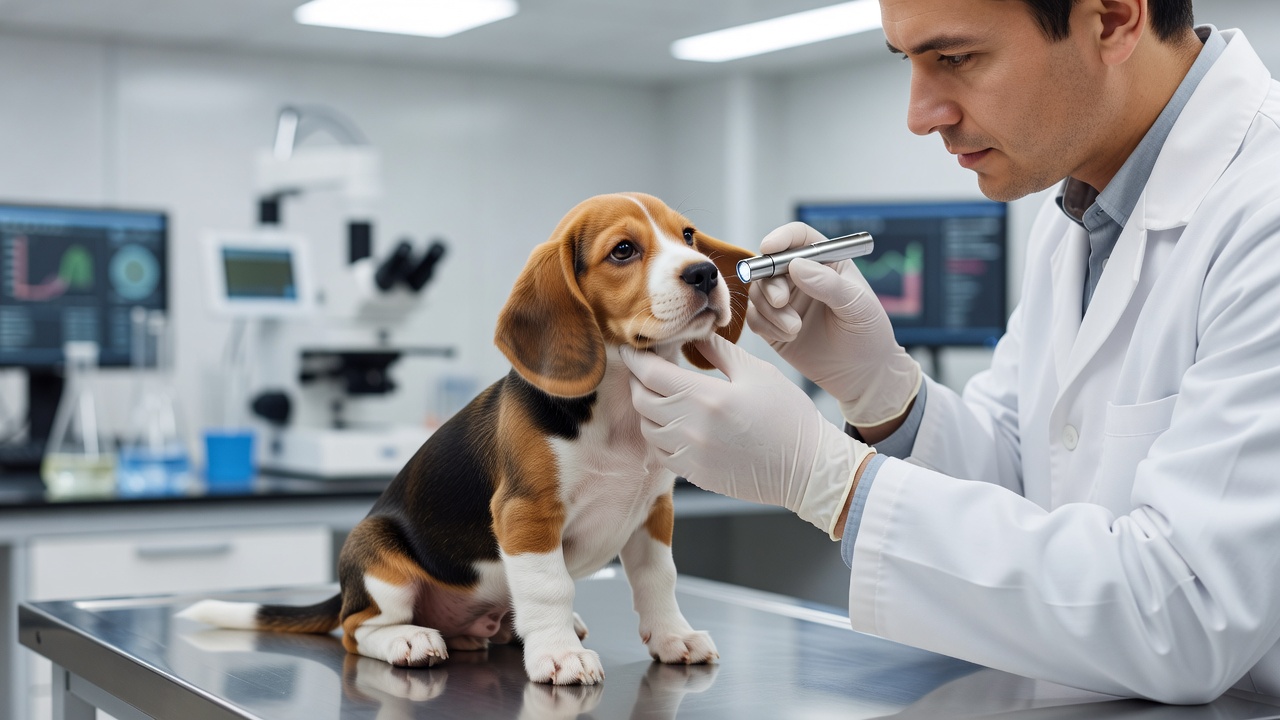
A one-person biotech startup has used CRISPR gene editing to produce two beagle puppies with zero detectable levels of the primary dog allergen, Can f 1 (a small lipocalin protein secreted from tongue tissue into saliva and from skin glands into dander), eliminating the IgE-mediated allergic response in a sensitized human tester with no apparent harm to the animals. The scientist behind the work, Matt Walker, PhD, is himself allergic to dogs and now lives with one of the puppies on the Upper West Side. Walker is the sole employee of Kindred Companion Sciences, a New York-based startup that operates out of a shared wet lab in Harlem, and the study was published August 5, 2026, in The CRISPR Journal.
Dog allergies are widespread, manifesting as allergic rhinitis and asthma. Conventional treatments target the patient's immune system through antihistamines or immunotherapy. Walker's approach inverts that logic: instead of modulating the human immune response, Kindred Companion Sciences edited out the allergen at its biological source, in the dog itself. The paper frames this as "a conceptual departure from conventional allergy therapeutics that primarily act by modulating the patient's immune response."
What the Research Found
Alfie and Bailey, the two beagle puppies at the center of the study, were born in September 2024 via somatic cell nuclear transfer (SCNT) (a cloning technique in which the nucleus of a genetically modified donor cell is inserted into an enucleated egg, which is then implanted in a surrogate). The surrogate beagle carried the embryos to term, and both puppies were born as genetically identical twins. At the time of publication, Alfie and Bailey are almost two years old and show normal physical development, steady growth, and no apparent health or behavioral abnormalities.
Walker and his co-authors confirmed the edit's effect through two independent assays. Western blot analysis (a standard laboratory technique for detecting specific proteins in a biological sample) of saliva and dander from Alfie and Bailey failed to detect any residual Can f 1 protein. The same assay confirmed high Can f 1 levels in poodle and goldendoodle controls, the breeds commonly marketed as "hypoallergenic" despite still producing the allergen. Skin prick testing on a sensitized subject (Walker) produced a strong reaction to wild-type beagle and poodle extracts. Extracts from Alfie and Bailey produced no response at all.
Walker described his first personal encounter with Bailey in a way that illustrates how seriously he took the possibility of a false positive: "When I had no reaction to Bailey after she came home with us, my immediate reaction was skepticism. What if my allergies have just gone away? What if I'm not allergic to puppies? So, I called some friends in Brooklyn and spent some time with their dog and confirmed that my allergies were still roaring." Whole-genome sequencing of both animals confirmed no off-target mutations or large-scale chromosomal rearrangements, addressing the most common safety concern in CRISPR editing of live organisms.
How the Science Works
The edit itself is precise and minimal. CRISPR-Cas9 (a molecular scissor system that can be programmed to cut DNA at a specific location) was directed to exon 1 (the first protein-coding segment) of the Can f 1 gene. The system introduced a single-base insertion, meaning one nucleotide was added to the sequence. That addition causes a frameshift mutation (a shift in the reading frame of the genetic code that scrambles all downstream protein instructions), which disrupts Can f 1 protein production entirely. No foreign DNA was introduced into the genome. As Walker explained: "We didn't introduce any foreign DNA. This type of genetic change occurs naturally in dogs. All we did was direct it at this specific site."
The workflow required two distinct technologies operating in sequence. First, CRISPR-Cas9 was used to edit canine primary fibroblasts (skin-derived cells used as nuclear donors). Those edited cells then served as the source material for SCNT: their nuclei were transferred into enucleated dog eggs, producing cloned embryos carrying the knockout mutation. The embryos were implanted in a surrogate beagle, which delivered Alfie and Bailey.
Prior mouse studies had demonstrated that eliminating the gene homologous to Can f 1 had no detrimental effect on health or viability, providing preclinical confidence before attempting the edit in dogs. The Kindred Companion Sciences work follows a feline precedent: in 2022, Nicole Brackett and colleagues published a paper in The CRISPR Journal demonstrating the feasibility of editing Fel d 1 (the primary cat allergen, a secretoglobin protein unrelated in structure to Can f 1), and South Korean researchers produced the first gene-edited hypoallergenic cats in 2024. The dog allergen problem required an independent engineering effort because Can f 1 and Fel d 1 are structurally unrelated proteins.
What It Means for Patients
Dog allergies are a substantial patient burden for many individuals, manifesting as worsening asthma and allergic rhinitis. Existing "hypoallergenic" breeds do not solve the problem. Walker reacted to his family's goldendoodle growing up, and poodle extracts triggered the same skin response in testing that wild-type beagle extracts did. The CRISPR approach produces measurably zero Can f 1 protein, a qualitatively different outcome from the reduced-but-present levels in selectively bred low-shedding dogs.
The study's authors state in their conclusion: "These findings demonstrate that targeted genetic knockout of the major dog allergen is compatible with canine development and can abolish the IgE-mediated allergic response, supporting the feasibility of a gene-based approach to reducing canine allergenicity."
There are important limits to what two dogs and one human tester establish. Dogs express multiple allergens beyond Can f 1, designated Can f 2 through Can f 7. Whether eliminating Can f 1 alone is sufficient to make a dog tolerable for all allergy sufferers is not addressed by this study. Some patients may react primarily to secondary allergens that remain fully intact in Alfie and Bailey. Walker has acknowledged the existence of secondary dog allergens and indicated plans to address them, but no data on those targets was included in the current paper. A single sensitized tester is also not an independent blinded allergy cohort. Larger human trials would be needed before clinical or commercial claims could be supported.
Competitive Landscape
No other company has publicly announced a competing CRISPR dog allergen program at publication time. Kindred Companion Sciences, formerly named Can9 Bioengineering, is the first organization to publish data on a complete knockout of the primary dog allergen in live animals.
The broader competitive backdrop involves conventional allergy treatment: antihistamines, nasal corticosteroids, and allergen immunotherapy (a multi-year desensitization course). These approaches require ongoing patient compliance and treat symptoms rather than removing the source of the antigen. Selective breeding for low-shedding coats reduces but does not eliminate Can f 1 exposure. None of these alternatives achieves the zero-protein outcome that Western blot and skin prick testing confirmed for Alfie and Bailey.
Independent analyst commentary specifically on this announcement was not publicly available at publication time.
The Road to Clinic
Genome-edited animals in the United States fall under the oversight of the U.S. Food and Drug Administration (FDA), which regulates them as biological products. Walker has confirmed that Kindred Companion Sciences is engaged with that process: "We're going to be tackling other breeds and hopefully applying our work to service animals. We're going through the regulatory process." No timeline, regulatory pathway classification, or precedent case was disclosed.
Gene-edited companion animals occupy a relatively undefined space in FDA jurisdiction, and a commercial pathway for selling CRISPR-edited dogs would require demonstrating safety and, depending on the regulatory classification, potentially efficacy data beyond what a two-animal proof-of-concept provides. Walker's reference to service animals is strategically significant: the allergy burden on handlers of guide dogs and mobility-assistance dogs represents a focused, high-need application that might attract regulatory attention faster than a general consumer pet market.
Scaling SCNT beyond two animals is a technical and economic challenge. The technique requires surrogate dogs, embryo transfer infrastructure, and per-animal costs not disclosed in the study. Walker has not revealed investors, grant funding, or a business model. At present, Kindred Companion Sciences operates as a one-employee startup with bench access at a shared wet lab in Harlem. The gap between a published proof-of-concept and a commercially available product involves manufacturing scale, regulatory approval, and capital that the current disclosure does not address.
What's Next
Walker's personal stake in the project is unusual even by startup standards. He has been allergic to dogs his whole life, as he said directly: "I've been allergic to dogs my whole life." His family acquired a goldendoodle only after he left for university, and he conceived the Can f 1 knockout idea while working in the lab of the late Nobel laureate Martin Chalfie at Columbia University, after his family's dog died. Chalfie shared the 2008 Nobel Prize in Chemistry for the discovery and development of green fluorescent protein (GFP). Walker completed his PhD at Columbia and co-founded Kindred Companion Sciences with Nick Gavin, whom he met as a student at Harvard and who now lives in Florida with Alfie.

The beagle was chosen as the proof-of-concept subject, but the Can f 1 knockout would need to be demonstrated across other breeds before any commercial pathway is viable. The stated ambition to apply the work to service animals is the clearest near-term application with a defined user population. Walker has also acknowledged secondary dog allergens as a future target, though no data or timeline was offered.
The broader implication of the Alfie and Bailey study extends beyond dog allergies. It establishes that CRISPR editing can be introduced into a companion animal via somatic cell nuclear transfer, confirmed by whole-genome sequencing to be free of off-target effects, and that the resulting animal can develop normally for at least two years. That combination of results is a template for other companion-animal engineering efforts, whether targeting allergens, hereditary disease, or other traits. The regulatory and ethical questions that follow are as significant as the science.
What This Means for You
For people who have avoided dog ownership because of allergy, the Kindred Companion Sciences result is a genuine proof of concept, not a product. If the FDA regulatory process proceeds and SCNT-based production scales, the eventual question will be cost per animal against a multi-year allergen immunotherapy course, which requires ongoing patient compliance over multiple years with no guarantee of full tolerance. A hypoallergenic dog purchased once competes economically with a treatment protocol renewed indefinitely. That comparison will drive both the business model and patient demand when, and if, a commercial animal reaches the market.
The real story is that a sole-employee startup, operating from a single bench in a shared Harlem lab, has produced the first peer-reviewed evidence that the dog allergen problem is solvable at the source, and that the animal appears healthy two years later. Walker spent his career being allergic to dogs, trained under a Nobel laureate, and then edited the allergen out of the animal he could never own. He now lives with Bailey. The FDA will decide what happens next.
-- Zara Velez, Emerging Technology Editor
Sources: GEN Biotechnology / The CRISPR Journal, Walker et al. (2026) · National Institutes of Health / PubMed Central, canine allergen research