Highlight's BO-112 Injection Shows Early Promise Against Facial Basal Cell CarcinomaHighlight's BO-112 Injection Shows Early Promise Against Facial Basal Cell CarcinomaHighlight's BO-112 Injection Shows Early Promise Against Facial Basal Cell CarcinomaHighlight's BO-112 Injection Shows Early Promise Against Facial Basal Cell Carcinoma
October 5, 2026
Highlight Therapeutics says its injectable RNA drug BO-112 met the primary endpoint (the main result the trial was designed to measure) in SPOTLIGHT-204, a 50-patient Phase 2b trial (a mid-stage test of whether a drug works) in basal cell carcinoma (BCC), with complete responses

Highlight Therapeutics says its injectable RNA drug BO-112 met the primary endpoint (the main result the trial was designed to measure) in SPOTLIGHT-204, a 50-patient Phase 2b trial (a mid-stage test of whether a drug works) in basal cell carcinoma (BCC), with complete responses in more than half of high-risk head-and-neck cases. The detail that matters is the yardstick: every patient was scheduled for complete surgical excision at week 24, so the drug is judged against tissue the surgeon removes anyway, in a study that describes no control group. It matters because on the nose, eyelids and ears, the company says surgery is the only recommended option for most patients, and it can leave significant scarring and functional compromise.
What the Research Found
Highlight Therapeutics presented the SPOTLIGHT-204 topline results (trial registry ID NCT06422936) as a late-breaker (a slot for newly available data) at the 35th EADV Congress in Vienna. The company says the study met its primary endpoint and its key secondary endpoints, including safety and tolerability. The design, as described in the company's release:
- 50 patients enrolled: 40 high-risk (36 of them with head-and-neck lesions) and 10 low-risk.
- A modified intention-to-treat (mITT) population of 46 patients with 54 evaluable lesions, assessed by a central review committee. The release does not explain the gap between 50 and 46.
- Three once-weekly injections of BO-112 into the lesion, then complete surgical excision at week 24.
- Median age 75 years (range 34 to 90), 48% female.
The primary endpoint is visual and pathological response at week 24, judged by the central review committee.

The subgroup that drew the emphasis is high-risk head-and-neck BCC. Josep Malvehy, MD, PhD, a professor at the University of Barcelona and director of the Skin Cancer Program in the Dermatology Department at Hospital Clinic of Barcelona, said in the company's release that these patients "achieved complete response in more than half of cases, and nearly two-thirds of those with facial lesions."
How the Science Works
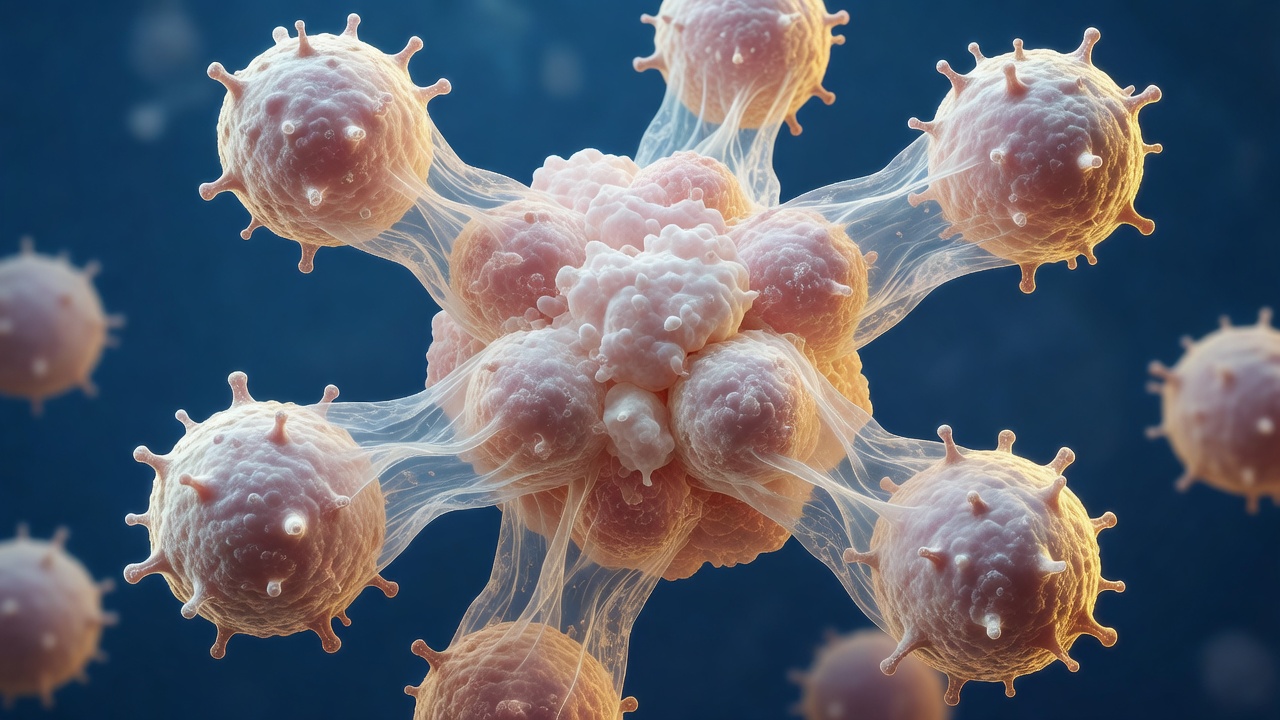
BO-112 is a double-stranded RNA nanoparticle (a tiny particle carrying a form of RNA that cells associate with viral infection) formulated for intralesional injection (delivered directly into the tumor rather than into the bloodstream). Highlight describes itself as a clinical-stage company developing "immune activators" for skin tumors, and BO-112 is one.
The company states a three-part mechanism. First, the drug activates innate antiviral sensing pathways (the cell's built-in alarm system for viral invaders), so the tumor behaves as though it were infected. Second, it induces immunogenic tumor cell death (tumor cells dying in a way that exposes their contents to the immune system rather than quietly). Third, that exposure is meant to generate tumor-specific adaptive immunity (a targeted immune response that learns to recognize the cancer).

In practice, the protocol is simple to describe: three weekly injections, then about 21 more weeks of waiting before the lesion is excised and examined. That timing is what allows pathologists to look for residual tumor in the removed tissue, which is why the endpoint is both visual and pathological. The release does not detail the formulation, dose or injection volume, so those are left out here. What the design cannot show is what would have happened to the same lesions without treatment, because the release describes no comparator arm.
What It Means for Patients
BCC accounts for about three-quarters of nonmelanoma skin cancers in the United States, according to the National Cancer Institute's PDQ summary. It grows slowly and rarely metastasizes, but it can be locally destructive, and the American Academy of Dermatology notes that most cases develop on the head and neck, including the ears, nose, eyelids and scalp. The NCI lists the central face, the area behind the ear, the ear itself, the forehead and the scalp as high-risk sites for recurrence after initial treatment.
That geography is the case for a non-surgical option. Highlight says Mohs micrographic surgery (removal in thin layers, each checked under a microscope until no tumor remains) and conventional surgery achieve high cure rates but can leave significant scarring and functional compromise on the head and neck. SPOTLIGHT-204's population skews old (median age 75), a group for whom a facial operation can weigh heavily.
Malvehy said the results "support BO-112's potential as a well-tolerated, non-surgical option for this population." That statement comes from the company's own release, not from an independent assessor. Whether he served as a trial investigator is not stated. BO-112 is investigational and not approved by any regulatory authority.
Competitive Landscape
The release names no competing drugs or trials, so this section covers only what is documented. Surgery is the incumbent, and the company calls it the only recommended option for most patients. Highlight also claims SPOTLIGHT-204 is "believed to represent the largest cohort of high-risk head and neck BCC patients treated to date with an intralesional therapy," a self-assessment that is hedged and unverified.

For context on the format, the FDA lists IMLYGIC (talimogene laherparepvec), made by BioVex, a subsidiary of Amgen, for local treatment of unresectable cutaneous, subcutaneous and nodal lesions in melanoma recurrent after initial surgery. That shows regulators have a pathway for injected, lesion-directed biologics, but in melanoma, not BCC, and it implies nothing about how BO-112 would be evaluated. Head-to-head comparisons and rival pipelines are not covered by the available material.
Independent analyst commentary specifically on this announcement was not publicly available at publication time.
The Road to Clinic
Chief Executive Officer Mercedes Diz called the readout "the first clinical validation of BO-112 in BCC" that gives the company "strong conviction to advance into late-stage development." She also said the company wants to bring "this potential non-surgical option a step closer to patients, particularly those with high-risk BCC in the head & neck, where the need is greatest." A company website snippet indicates Diz was appointed CEO on 20 Feb 2026; that date was not confirmed in the primary text.
Both Diz's and Malvehy's quotes come from the company's own release, so neither is independent. The timing is slightly blurred: the News-Medical copy is dated 1 Oct 2026, and the release says the data are presented "today" at EADV Vienna without giving the session date.
Late-stage development is a stated intention: the release gives no Phase 3 design, start date, financing or regulatory path. This is one company-reported Phase 2b study presented as a conference late-breaker, and the release cites no peer-reviewed publication.
What's Next
Watch first for the full presentation or a peer-reviewed paper. It should supply exact complete-response rates with confidence intervals (the range of uncertainty around a rate) for the high-risk head-and-neck and facial subsets, a definition of "visual and pathological response," and an account of the 50-versus-46 patients. The "more than half" and "nearly two-thirds" claims need checking against those numbers.
Next comes safety: the company says tolerability endpoints were met, but adverse-event types and rates, injection-site reactions and discontinuations are not given. Then durability: because every lesion was excised at week 24, the study cannot show whether a response holds without surgery. Any Phase 3 design would show how seriously the "non-surgical option" claim is being tested.
For a 75-year-old with a BCC beside the nose or eyelid, the trial's schedule works out to three injections in the first three weeks and a surgical date at week 24, with no approved version of that choice available today. If a later trial shows tumors clearing without the week-24 excision, the benefit would be measured in avoided facial operations; until then the surgeon remains the standard of care, and a suspicious growth should still be examined, since the AAD notes BCC is highly treatable when found early. The irony is that SPOTLIGHT-204's strongest claim leans on the scalpel it hopes to replace: the data that matter are what stays gone when no one operates.
-- Zara Velez, Emerging Technology Editor
Sources: FDA · Badgerherald · News Medical