Best TVs: Samsung S95H, S90H and Sony BRAVIA 6 Compared for Every Budget
November 17, 2026
The three OLED TVs in this guide list anywhere from the low four figures to $4,497 depending on model and screen size, so picking one means sorting real picture advantages from spec-sheet noise. Brightness, HDR format support, gaming features and sticker price all pull in
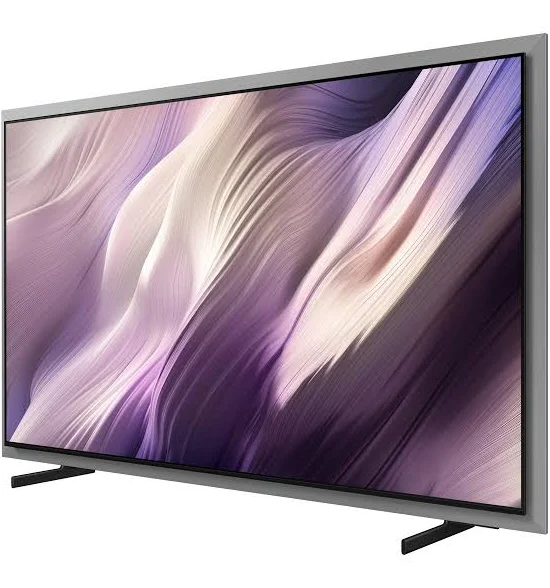
The three OLED TVs in this guide list anywhere from the low four figures to $4,497 depending on model and screen size, so picking one means sorting real picture advantages from spec-sheet noise. Brightness, HDR format support, gaming features and sticker price all pull in different directions, and no single set wins every category.
This guide covers three OLED TVs we think are worth a serious look: the Samsung S95H, the Samsung S90H and the Sony BRAVIA 6. It is written for shoppers deciding between a flagship splurge, a sensible mid-priced pick and a Dolby Vision-equipped alternative. Each section gives a clear verdict, the numbers behind it and an honest list of trade-offs. We also say plainly where the evidence is thin, because it is not equally deep for all three sets.
Why You Can Trust This Guide
We do not accept paid placement, and we get no favorable coverage in exchange for review units. Our recommendations come from comparing what matters in a TV: peak and full-screen HDR brightness, SDR brightness, color coverage, input lag, HDMI port count and refresh rate, HDR format support, anti-reflection screen finish, and built-in audio. Every TV in a category is judged against the same checklist.
Our data comes from three places: published measurements from independent test labs that use colorimeters and calibration software, manufacturer spec sheets, and hands-on impressions from reviewers. Where sources disagree, we report both values rather than picking the friendlier number. Revuzia does not run its own lab, so every measurement in this guide is attributed to the independent testing that produced it.
Spotted an error or want a TV considered? Email [email protected].
Our Top Picks at a Glance
Best Overall: Samsung S95H
The S95H earns the top spot because independent testing recorded the highest HDR brightness of any flagship OLED it had measured: 2,739 nits in a 10% window in HDR Filmmaker mode and 2,831 nits in Standard mode.
Full-screen HDR brightness reached 449 nits in Filmmaker mode and 463 nits in Standard, ahead of the older S95F's 390 and 380. One caveat: the LG G6 still measured brighter in the HDR Filmmaker 10% window (3,004 nits). Gaming specs are just as strong. It has four HDMI 2.1 ports running 4K at up to 165Hz with full VRR, HDR10+ Gaming and ALLM, and input lag measured 9.5ms at 60Hz. Samsung's NQ4 AI Gen 3 processor drives AI 4K upscaling and motion enhancement. Audio is a 4.2.2-channel, 70W OTS+ system, a step up from the S90H's 40W. Reviewers still call the sound only solid and suggest a soundbar. The Glare Free screen finish is described as effective in any environment without washing out the image.
At $2,299 for the 55-inch (and $3,299 to $3,399 for the 65-inch, depending on source), it suits buyers who watch HDR content in a bright room and want a screen that handles daylight without a fight. It also fits gamers with multiple 4K/165Hz sources. One viewing tip from testers: Filmmaker Mode looked a little dim in bright conditions, and they recommend Movie mode for bright rooms. Some also noticed hints of black crush in certain films.
Pros
- 2,739 to 2,831 nits peak HDR brightness in independent testing
- Four HDMI 2.1 ports at 165Hz with 9.5ms input lag
- 70W OTS+ audio, stronger than the S90H's 40W
- Glare Free finish handles reflections well
Cons
- No Dolby Vision, only HDR10+
- SDR brightness of 220 to 229 nits trails the LG G6, which measured 390 to 648 nits
- The FloatLayer frame divides opinion, reviewers called the remote subpar, and auto-playing Samsung TV Plus content drew complaints
- Most expensive TV in this guide
Best Budget: Samsung S90H
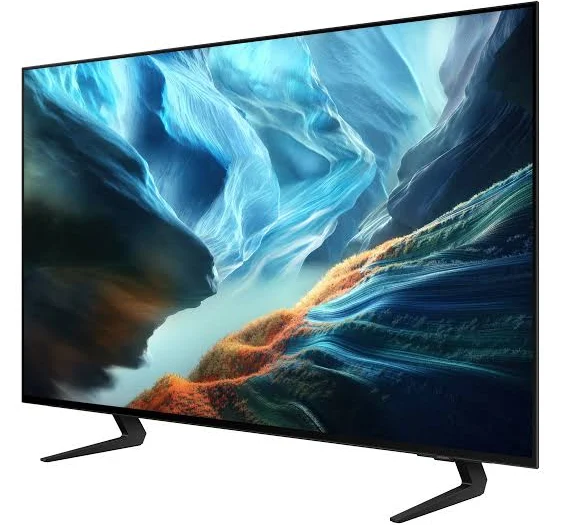
The S90H keeps the S95H's gaming credentials and matte screen at a lower price. On the 55-inch, it lists at $1,999 and is often found at $1,797, against $2,299 for the S95H.
It uses a WRGB OLED panel in every size, with a Glare Free matte filter that reviewers say removes practically all reflections. Independent Calman testing found Filmmaker Mode covers just under 99% of DCI-P3, and reviewers described LCD-like brightness in moderately lit rooms with inconsequential input lag. Tom's Guide measured the S90H at 1,497 nits on a 10% HDR window, against 2,721 nits for the S95H. Four HDMI 2.1 ports support up to 4K/165Hz with VRR, Nvidia G-Sync and FreeSync Premium Pro (the latter not on the 42 and 48-inch sizes). The NQ4 AI Gen 3 processor has 128 neural networks, and a 2.1-channel, 40W speaker system supports Dolby Atmos, OTS Lite and Q-Symphony. It also supports Apple AirPlay 2.
Sizes run from 42 to 83 inches, and it is the only set here offered at 42 inches, which suits a bedroom or small apartment. List prices are $1,297 for the 42-inch, $1,397 for the 48-inch, $1,997 for the 65-inch, $2,997 for the 77-inch and $4,497 for the 83-inch. The 55-inch weighs 32.2 lb without the stand and the panel is about 0.15 in thick. Reviewers also note that the older S90F and the cheaper S85H were $600 to $1,000 cheaper at press time, so shoppers who do not need the newest model have a lower-cost route to much of the same feature list.
Pros
- Four HDMI 2.1 ports at 165Hz with G-Sync and FreeSync Premium Pro
- Just under 99% DCI-P3 coverage in Filmmaker Mode
- Six sizes, 42 to 83 inches
- Glare Free screen handles bright rooms
Cons
- No Dolby Vision, only HDR10+
- Color volume is lower than the older S90F's QD-OLED, which covered more than 127% DCI-P3
- Glare Free filter can slightly lift blacks in very bright rooms
- Plastic-looking feet, and the lower section protrudes to 1.6 in, which leaves an awkward gap when wall-mounting
Best for Movies: Sony BRAVIA 6
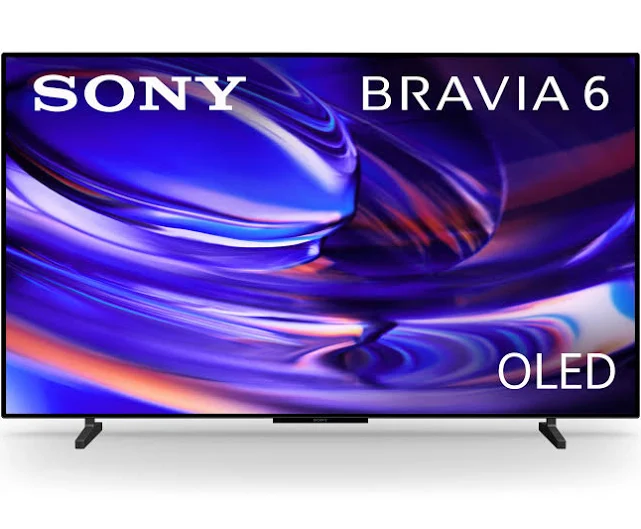
The BRAVIA 6 is the only TV here with Dolby Vision, plus DTS:X and Dolby Atmos, which makes it the natural fit for film fans whose streaming and disc libraries lean on Dolby's format. Choose.tv measured the BRAVIA 6's HDR brightness at 276 to 697 nits across its test patterns.
Its MediaTek Pentonic 800 processor is the heart of Sony's picture approach, and reviewers say the processing lifts it above affordable OLEDs from rival brands. Sony's processing is widely known for motion handling, upscaling and accuracy, though it often looks dimmer than rivals. Sony markets the set as "OLED essentials, now within reach."
Connectivity is a standout. All four HDMI ports are 2.1 with 4K/120Hz and VRR, a step up from the two on Sony's pricier models, and it supports ALLM and HDMI eARC. That suits a setup with a console, a streaming box, a disc player and a PC all plugged in at once. Google TV handles apps. Sizes are 48, 55, 65, 77 and 83 inches, and launch prices run from $1,300 for the 48-inch to $1,999 for the 65-inch and $4,000 for the 83-inch. The 48-inch undercuts the S90H's 48-inch list price of $1,397, but the S90H 42-inch lists at $1,297, and reviewers note Sony tends to discount cautiously while Samsung and LG discount aggressively. Do not assume the Sony stays cheaper once sales begin.
Pros
- Dolby Vision, Dolby Atmos and DTS:X support
- Four HDMI 2.1 ports at 4K/120Hz with VRR
- Sony processing praised for motion, upscaling and accuracy
- Five sizes up to 83 inches
Cons
- Capped at 120Hz while both Samsungs reach 165Hz
- Choose.tv's lab readings put the BRAVIA 6 at 276 to 697 nits in HDR, which it calls moderately bright.
How We Chose
We started with the criteria that decide an OLED purchase: HDR brightness, because it separates a vivid picture from a dim one; color accuracy and coverage; reflection handling; gaming readiness (refresh rate, VRR, port count, input lag); HDR format support; and sound.
We compared each TV against independent lab measurements and reviewer findings where they exist, and the depth of that evidence differs by set:
- Samsung S95H: the most complete data, including peak and full-screen nits in HDR and SDR plus input lag.
- It is judged on its feature set and Sony's processing reputation.
Because of that gap, we weighted measured results over marketing language and did not let a spec-sheet advantage stand in for a test result. Our overall confidence in these rankings is moderate for that reason. The S95H pick is the firmest, the S90H pick rests on specs plus partial testing, and the BRAVIA 6 pick rests on features and reputation.
Price mattered too, and it was the messiest input. Several list prices conflict between sources, and some retailer listings sat far below every list price reviewers found, probably because they were smaller sizes or different models, so we did not rely on them. A TV that costs several hundred dollars more has to show a clear gain. The S95H does in measured brightness and sound, while the BRAVIA 6 earns its slot through Dolby Vision.
What to Look For
HDR peak brightness. OLED panels create perfect black, but highlights need nits to pop. The S95H's 2,739 to 2,831 nits in a 10% window sets the current flagship bar. If you watch in daylight, favor higher numbers, and remember that SDR brightness matters too, where the S95H's 220 to 229 nits trails the LG G6.
HDR format support. Dolby Vision and HDR10+ are rival formats. The BRAVIA 6 supports Dolby Vision, while both Samsung sets use HDR10+ and lack Dolby Vision. Check which your streaming services and disc player favor.
Anti-glare finish. A matte filter such as Samsung's Glare Free cuts reflections from windows and lamps, though on the S90H it can slightly lift blacks in very bright rooms. A glossy panel looks richer in a dark room but fights daylight.
Gaming specs. Look for four HDMI 2.1 ports, VRR and a high refresh rate. The Samsungs go to 165Hz, the BRAVIA 6 to 120Hz. For a PlayStation 5 or Xbox Series X, 120Hz is plenty. PC gamers benefit from 165Hz.
Size and room. The S90H comes in 42 and 48-inch sizes for small rooms, while all three scale up to 83 inches. Match size to seating distance, and compare prices at your specific size, since the price gap between these sets changes from one size to the next.
Sound. Thin OLEDs have limited speaker space. The S95H's 70W system outclasses the S90H's 40W, but reviewers still suggest a soundbar.
Bottom Line
For a gamer with a console and a gaming PC who wants 165Hz and sub-10ms input lag, pick the Samsung S95H. Its 9.5ms lag and four 165Hz HDMI 2.1 ports keep everything at full speed, and its 2,739-nit peak is the best measured brightness of the three. In a very bright room, try Movie mode.
For a first-time OLED buyer or a small-apartment shopper working to a budget, pick the Samsung S90H. It offers four 165Hz HDMI ports and a matte screen, and its 42-inch size fits a bedroom where the others do not.
For a movie lover with a Dolby Vision-heavy streaming and disc library and four devices to connect, pick the Sony BRAVIA 6. Four HDMI 2.1 ports at 4K/120Hz mean no swapping cables. The BRAVIA 6 measured 276 to 697 nits in HDR, versus about 1,497 nits for the S90H.
The S95H shows how far peak brightness has moved, though its price asks you to value that headroom. The S90H and BRAVIA 6 are the easier choices for most households, and which one wins comes down to whether you want 165Hz gaming and a matte screen or Dolby Vision and Sony's processing.
-- Miles Danner, Consumer Electronics Editor