Best Mirrorless Cameras: Canon, Nikon and Fujifilm ComparedBest Mirrorless Cameras: Canon, Nikon and Fujifilm ComparedBest Mirrorless Cameras: Canon, Nikon and Fujifilm ComparedBest Mirrorless Cameras: Canon, Nikon and Fujifilm Compared
October 20, 2026
Choosing a mirrorless camera in 2026 means weighing a 45MP Canon flagship against two Nikons and two Fujifilms, with body prices running from $983 to $4,099. Every maker now sells subject-detection autofocus and 4K video.
Choosing a mirrorless camera in 2026 means weighing a 45MP Canon flagship against two Nikons and two Fujifilms, with body prices running from $983 to $4,099. Every maker now sells subject-detection autofocus and 4K video. The differences sit in sensor size, burst behaviour, video crop factors, card slots and how a camera feels in the hand, and those are what decide whether you enjoy shooting with it for years.
This guide covers five cameras: the Canon EOS R5 Mark II, Nikon Z50II, Fujifilm X-E5, Nikon Z f and Fujifilm X-T50. The Canon suits sports, wildlife and serious video work. The Z50II is the easiest way into the category. The X-E5 is a compact video-capable rangefinder, the Z f is a retro full-frame body for people who like dials, and the X-T50 is a light, high-resolution travel camera.
Why You Can Trust This Guide
We compare cameras on handling, dial and button layout, viewfinder and rear screen, autofocus behaviour, stabilisation, video modes and crop factors, card slots, and how much each body weighs when carried all day. Every camera in this guide goes through the same checklist, and we take no payment for placement. Receiving a review unit never buys favourable coverage.
Our figures come from three places: manufacturer spec sheets, hands-on handling notes, and retail listings. Battery numbers are the manufacturers' CIPA ratings. Where a retailer listing did not match the camera it claimed to sell, or looked like a gray-market or used offer, we excluded it and used the manufacturer's list price instead. Affiliate links never influence which camera wins a category. If you spot a mistake or want us to look at a camera, email [email protected].
Our Top Picks at a Glance
Here is how the five cameras compare on the points that matter most. Prices are body-only unless noted.
Best Overall: Canon EOS R5 Mark II
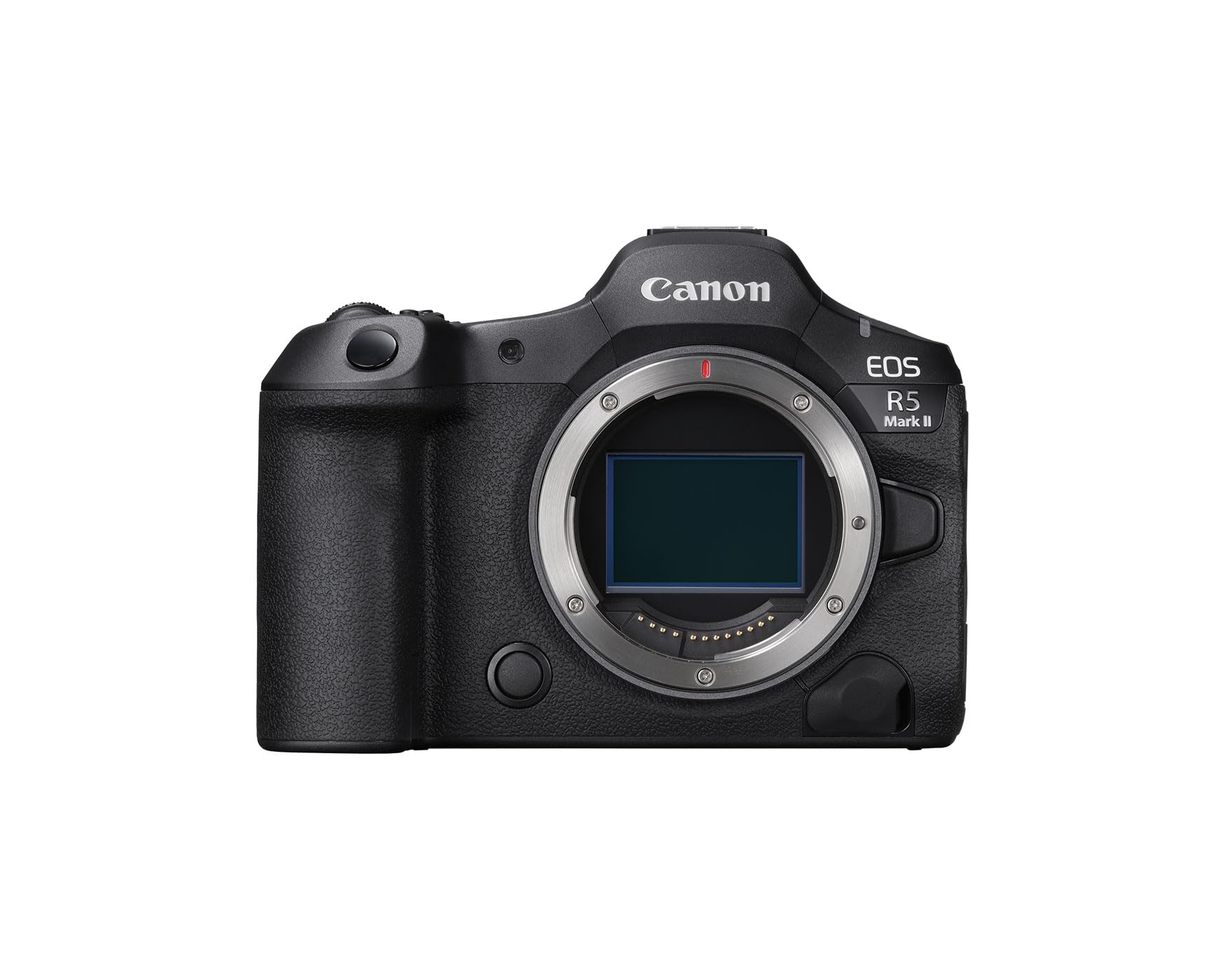
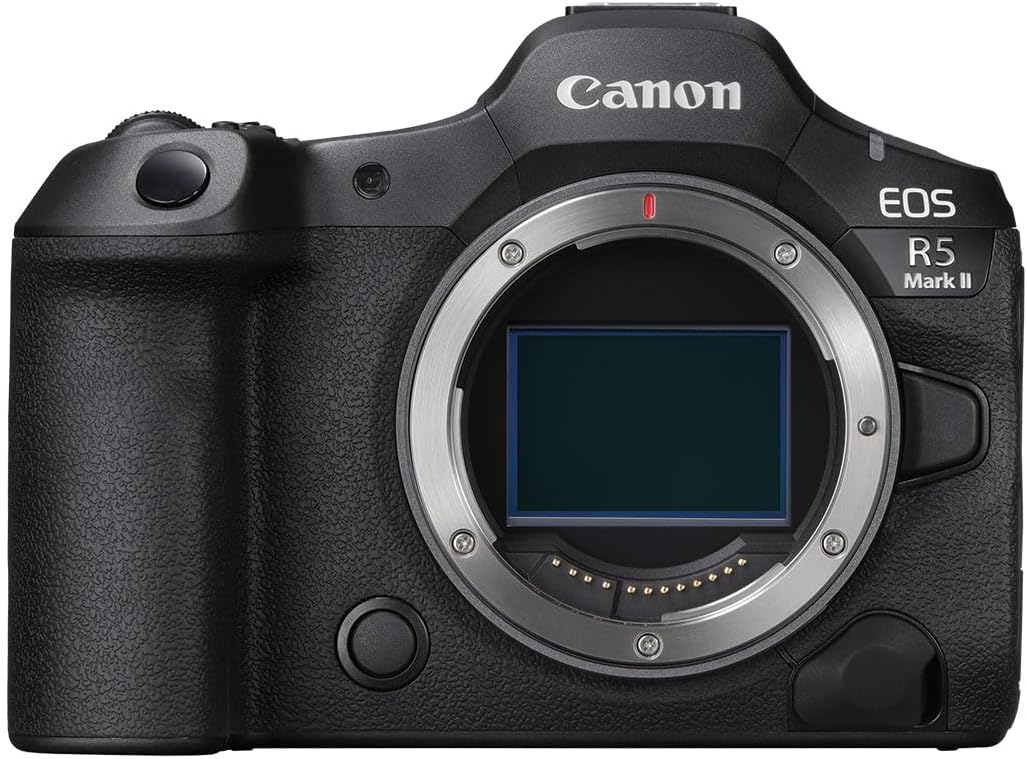
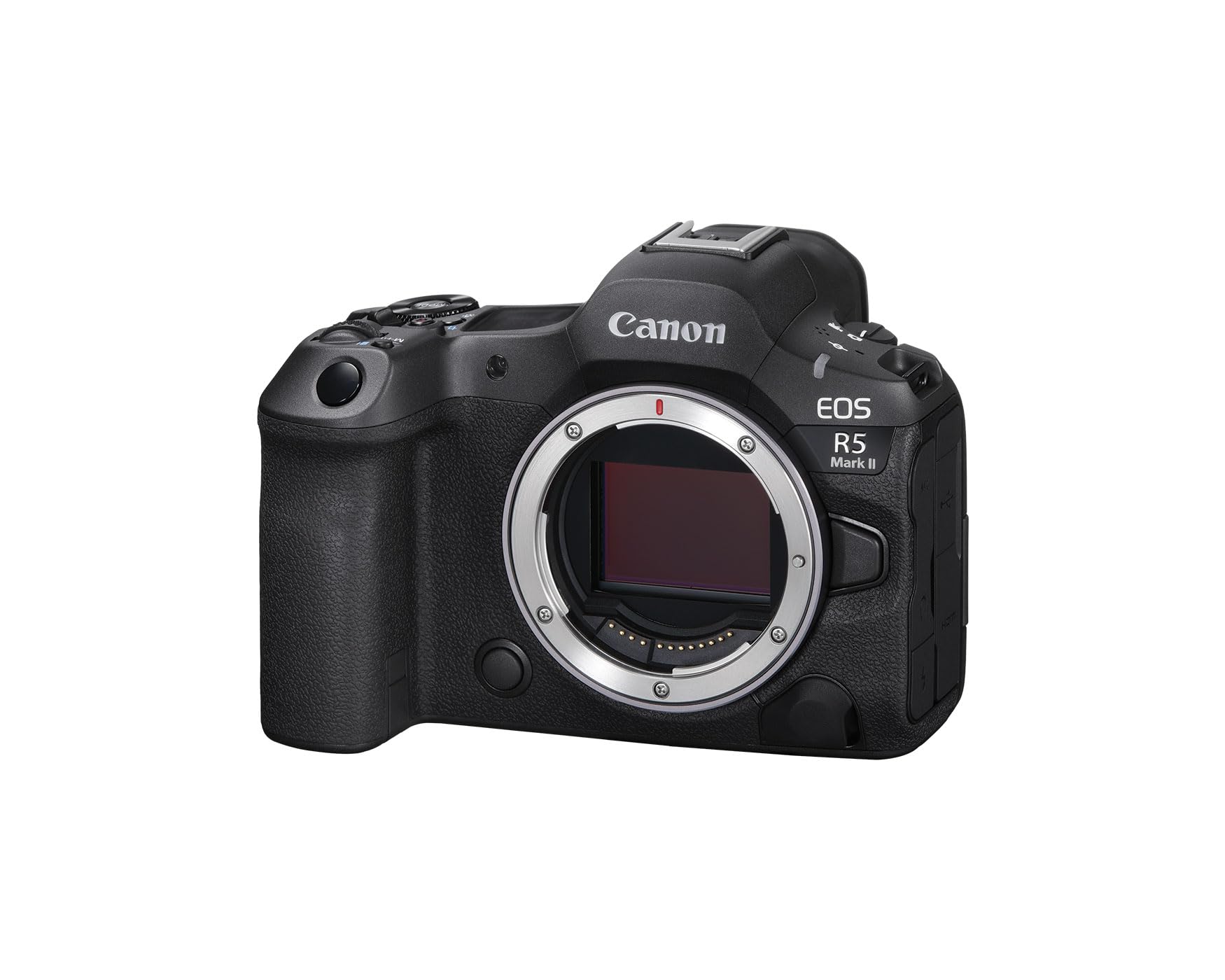
The Canon EOS R5 Mark II wins because no other camera here matches its stills and video together: a 45MP full-frame back-illuminated stacked sensor that shoots 30 fps electronic bursts with pre-capture and records 8K/60p RAW.
Key specs. The sensor is paired with a DIGIC X processor plus a DIGIC Accelerator. Burst shooting reaches 30 fps electronic and 12 fps mechanical, and pre-continuous capture records up to 15 frames before you fully press the shutter. The buffer holds 200 JPEGs or 93 RAW frames on CFexpress (86 on SD), the largest of the five and a step up from the 170 JPEG / 83 RAW of the original R5. Dual Pixel autofocus uses 5,940 phase-detect points, works down to -6.5EV, and tracks people, animals, motorsport vehicles, horses, aeroplanes and trains. An Action Priority mode covers football, basketball and volleyball, and Eye Control AF lets your gaze pick the focus point. Stabilisation reaches up to 8.5 stops with body and lens combined, and the 5.76M-dot electronic viewfinder is blackout-free.
Video. The R5 II records 8K/60p RAW for up to 120 minutes, 4K/120p, and 4K/60p oversampled from 6K, with a stated 16+ stops of dynamic range. It offers Canon Log 2, Log 3 and HLG, 4-channel 24-bit audio, and a full-size HDMI port. Storage is dual slots, one SD UHS-II and one CFexpress Type B, and Wi-Fi 6E is built in.
Who it is for. This is the camera for wildlife and sports shooters, working pros and filmmakers who need one body that does everything and does it fast. The pre-capture burst and 93-frame RAW buffer are built so you rarely lose a moment. It is also the obvious upgrade for anyone on the original R5, with a faster burst, bigger buffer and broader subject tracking. Canon rates the EOS R5 Mark II at approximately 630 shots per charge with the LCD and approximately 340 with the viewfinder.
Pros
- 30 fps electronic burst with up to 15 frames of pre-capture, and a 93-frame RAW buffer on CFexpress
- 45MP stacked sensor with 8K/60p RAW video and 4K/120p
- Up to 8.5 stops of stabilisation and a 5.76M-dot blackout-free EVF
- Dual card slots (SD UHS-II and CFexpress Type B) and a full-size HDMI port
Cons
- At $4,099 it is the most expensive camera in this guide, and the UK (GBP 4,499) and EU (EUR 5,149) body-only prices are just as steep
- Weather sealing is at the same level as the original R5, so there is no durability upgrade
- It has no built-in flash
Best Budget: Nikon Z50II
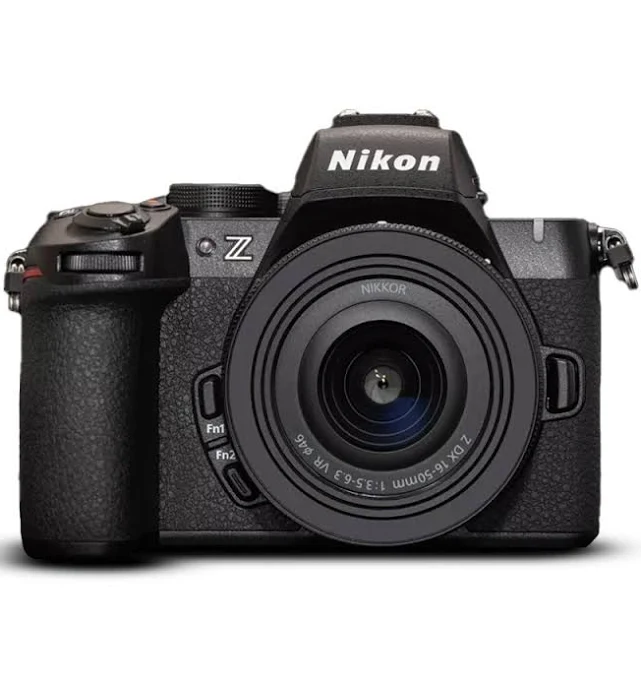
The Nikon Z50II is the cheapest way into this group at $983 for the body (GBP 849), and it still gives you a 30 fps burst with pre-capture and autofocus that recognises nine kinds of subject.
Key specs. The sensor is a 20.9MP APS-C unit, the same as the original Z50's, and the processor is the EXPEED 7 also found in the Z9 and Z8. The autofocus system uses 209 points with AI detection of people, dogs, cats, birds, airplanes, cars, motorcycles, bicycles and trains, plus 3D tracking and an improved AF-A mode. Burst shooting hits 30 fps with AF and AE tracking, and Pre-Release Capture records up to one second before the shutter is fully pressed. The 15 fps and 30 fps modes are JPEG only. The old Z50 managed 11 fps electronic and 5 fps mechanical, so this is a big jump.
Video and handling. You get 4K/60p with a 1.5x crop, or uncropped 4K/30p oversampled from 5.6K, plus FHD/120p. It is the first DX Nikon with 10-bit N-Log. A 3.2-inch vari-angle LCD and a 2,360k-dot EVF cover framing, and the body adds a headphone socket, an external mic input and wind-noise reduction. The magnesium-alloy body has a rubberised covering and a deeper handgrip than the original, weighs 495 g without battery or card (the Z50 was 395 g), and carries the only built-in pop-up flash in this guide besides the X-T50. It also supports Nikon Imaging Cloud and 31 Picture Controls.
Who it is for. Pick the Z50II if it is your first mirrorless camera, if you are moving up from a phone or a DSLR, or if you want strong autofocus without spending four figures. It also accepts full-frame Z lenses with a 1.5x crop, and F-mount lenses through the FTZ adapter, so the Nikon ecosystem is open to you from day one. Kit options are $1,050 with the 16-50mm lens and $1,299 with the 16-50mm and 50-250mm twin kit.
Pros
- The lowest price of the five at $983 body only
- 30 fps burst with Pre-Release Capture and 9-subject AF
- 4K/60p video and 10-bit N-Log
- Built-in pop-up flash and a deeper grip
Cons
- No AF joystick, so you move the focus point with the d-pad
- 4K/60p carries a 1.5x crop, and the fastest 15 and 30 fps modes are JPEG only
- Weather sealing is below the Z6 and Z7 series, and touchscreen AF-point selection is unavailable when using the EVF
Nikon Z50II is not available on Amazon. Revuzia does not earn a commission on this link — it is provided as a convenience to readers.
Best for Video: Fujifilm X-E5
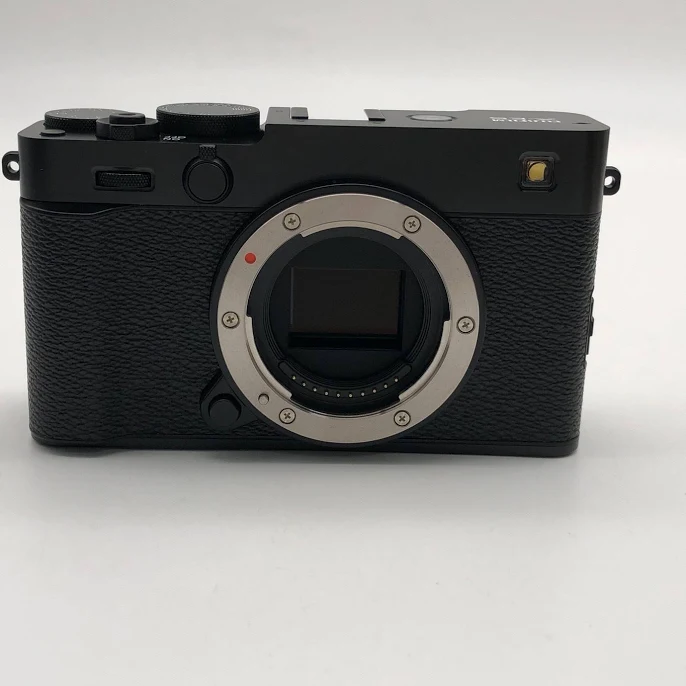
The Fujifilm X-E5 packs serious video into a compact rangefinder-style body: 6.2K/30p 4:2:2 10-bit internal recording and uncropped DCI 4K/60p, at a US list price of $1,699 body only ($1,899 with the new XF 23mm F2.8 R WR lens).
Key specs. The 40.2MP X-Trans CMOS 5 HR back-illuminated sensor runs on the X-Processor 5. It is the first X-E camera with in-body stabilisation, rated up to 7 stops. Video options include 6.2K/30p (with a 1.23x crop), DCI 4K/60p with no crop, and 1080/240p, with F-Log2 offering 14+ stops. You can also send ProRes RAW or Blackmagic RAW over HDMI, and apply up to 2x digital zoom in 4K. Autofocus covers 3.3 million phase-detect points, works down to -7EV and detects animals, birds, cars, bikes, planes and trains. Stills shoot at up to 20 fps, with an electronic shutter up to 1/180,000 s.
Handling. The top plate is anodised aluminium with three dials, including a Film Simulation dial with 20 simulations such as Reala Ace. Dual command dials return, along with a small handgrip. The camera weighs 445 g with battery and card, up from 364 g on the X-E4. The viewfinder is a 2.36M-dot OLED at 0.62x with a 100 fps refresh rate.
Who it is for. If you want to shoot video and stills without carrying a big body, the X-E5 is the one. Run-and-gun vloggers and documentary shooters get uncropped 4K/60p and F-Log2, and street photographers get the rangefinder shape and film-simulation dial. The price is the catch: at $1,699 it is the second most expensive body here and a lot for a compact camera.
Pros
- 6.2K/30p 10-bit video and uncropped DCI 4K/60p
- F-Log2 with 14+ stops and RAW output over HDMI
- 7-stop IBIS in a rangefinder body, plus 40.2MP resolution
- Premium anodised aluminium build
Cons
- A single UHS-II SD slot limits serious video rigs
- The 3.0-inch, 1.04M-dot LCD tilts forward only, not out to the side
- No Pixel Shift Multi-Shot, and it is heavier than the X-E4
Best for Portraits: Nikon Z f
The Nikon Z f gives you a full-frame 24MP sensor, 8 stops of stabilisation and the second-highest-resolution viewfinder in this group in a body that looks like a 1980s film camera. It launched at $2,000 body only, with a 24-70mm f/4 kit at $2,600.
Key specs. A 24MP full-frame sensor, the flagship Expeed 7 processor from the Z 9 and 5-axis IBIS rated up to 8 stops make up the core. The EVF is a 0.5-inch OLED with 3.69M dots, the highest resolution of the five, and the rear screen is a 3.2-inch vari-angle touchscreen with 2.1M dots. Burst shooting runs at 14 fps mechanical and 30 fps electronic. ISO runs from 100 to 64,000, expandable to 204,800. Dual slots take one SD UHS-II and one microSD UHS-I card, and the battery is rated at 430 shots (CIPA).
Handling. The FM2-style body has three top dials in a magnesium alloy shell wrapped in faux leather. Size is 5.7 x 4.1 x 2 inches at 22.9 oz. For portraits, a full-frame sensor gives you more depth-of-field control than the APS-C bodies here, and a 40mm f/2 kit is available at $2,240. If you own F-mount lenses, the FTZ II adapter ($300) lets you use them, and the reviewer we drew on saw no noticeable performance difference using an F-mount 300mm f/4 for windsurfing photography.
Who it is for. The Z f suits portrait and street photographers who want full-frame quality and tactile controls. It is a camera you pick up because you enjoy shooting with it, not because of its spec-sheet totals. Video shooters should look elsewhere, since 4K is limited to 30p at full frame.
Pros
- 24MP full-frame sensor with up to 8 stops of IBIS
- The best EVF of the group at 3.69M dots
- Dual card slots and a flagship Expeed 7 processor
- Retro design with three top dials
Cons
- 4K is limited to 30p full-frame, with 4K/60p only in DX-crop mode
- The grip is slender, and a third-party add-on grip (about $40) helps
- Battery rating is 430 shots (CIPA)
Best for Travel: Fujifilm X-T50
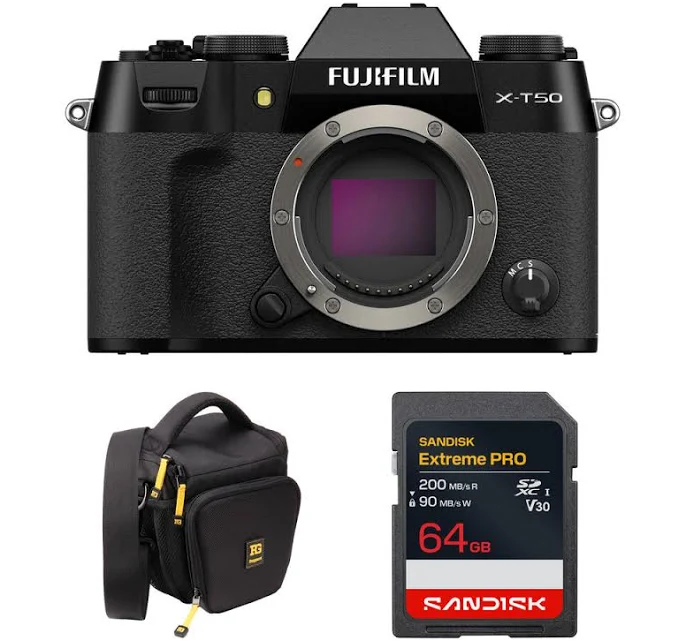
The Fujifilm X-T50 is the travel pick because it carries a 40.2MP sensor, 7-stop stabilisation and a pop-up flash in a body that weighs just 389 g without battery or card. That makes it the lightest camera in this guide. It lists at $1,600 body only.
Key specs. The sensor is a 40.2MP X-Trans CMOS 5 HR back-illuminated unit with the X-Processor 5, shared with the X-T5, X-H2 and X100 VI. It is the first X-Txx camera with IBIS, rated up to 7 stops. Burst shooting hits 20 fps electronic (with a 1.29x crop) and 5 fps mechanical, and the mechanical buffer holds 1,000+ JPEG or compressed RAW frames. Autofocus uses 3.3M phase-detect points down to -7EV and detects animals, birds, cars, bikes, planes and trains. The rear LCD is a 2-way tilting panel with 1.84M dots, the highest resolution of any current Fujifilm APS-C camera. Video includes 6.2K/30p 4:2:2 10-bit and uncropped DCI 4K/60p with F-Log2. With battery and card it weighs 438 g, against 557 g for the X-T5. Battery life is rated at about 305 shots (CIPA, LCD, normal mode), fewer than the X-T30 II's 390.
Handling. A Film Simulation dial joins the other top dials, a first for an X-T, and the Delete/Drive button and menu replace the old drive-mode dial. A built-in pop-up flash (guide number 5) and a hotshoe cover fill-in lighting and accessories.
Who it is for. Travellers who want X-T5-class image quality in a lighter body, with enough resolution to crop heavily. It is a good all-rounder for city breaks and hikes, and at $1,600 it offers the most resolution per dollar in the group.
Pros
- 40.2MP sensor with X-T5-level image quality
- 7-stop IBIS and 6.2K/30p 10-bit video
- 389 g body and a built-in pop-up flash
- 1,000+ frame buffer on the mechanical shutter
Cons
- Mechanical shutter tops out at 5 fps
- A single card slot sits under the camera inside the battery compartment
- No drive-mode dial, no Pixel Shift mode, and 4K recording is limited to 60 minutes at 4K/30p or 30 minutes at 4K/60p
How We Chose
We started with five cameras that all do the same job, interchangeable-lens mirrorless bodies, and judged them on five criteria: sensor and autofocus, stabilisation, video capability, handling, and price. Sensor and autofocus carried the most weight, since they decide whether a shot is sharp and in focus. Stabilisation came next, then video modes and crop factors, then ergonomics such as grip, viewfinder and card slots. Price decided close calls.
For pricing we looked at Amazon, Google Shopping and manufacturer list prices. Where a listing did not match the camera it claimed to sell, looked like a gray-market or used offer, or came from a third-party seller with almost no review history, we did not use it and quoted the manufacturer's list price. We also left out any spec that a source gave inconsistently, such as a conflicting burst speed on one Fujifilm, and used the figures that agreed with the camera's own spec sheet.
That is why we do not assign numeric scores. Retailer star ratings are not editorial scores, and none of them influenced the picks. The category labels are our judgement of which camera suits which buyer, not measured rankings.
What to Look For
Sensor size and resolution. Full-frame sensors such as the Canon's 45MP unit and the Z f's 24MP unit give more depth-of-field control than APS-C. The 40.2MP Fujifilm sensors give you cropping room, while the Z50II's 20.9MP suits web use and modest prints.
Autofocus subject detection. Look at what a camera can recognise, not only the point count. The Canon tracks people, animals, motorsport vehicles, horses, aeroplanes and trains, the Z50II recognises nine subject types, and the Fujis detect animals, birds, cars, bikes, planes and trains. If you shoot sport or wildlife, this matters more than resolution.
Stabilisation stops. In-body stabilisation lets you shoot slower shutter speeds handheld. The R5 II offers up to 8.5 stops with a stabilised lens, the Z f up to 8 and both Fujifilms up to 7. The Z50II has no in-body stabilisation, so it relies on lens-based systems.
EVF resolution. A sharper viewfinder makes manual focus and framing easier. The R5 II leads at 5.76M dots, then the Z f at 3.69M, with the Fujifilms at 2.36M and the Z50II at 2,360k dots.
Video modes and crop factors. Check whether 4K/60p is cropped. The Fujis do uncropped DCI 4K/60p, the Z50II crops 1.5x, and the Z f only does 4K/60p in DX-crop mode. Also check recording time limits, such as the X-T50's 30 minutes at 4K/60p.
Card slots and battery rating. Dual slots (R5 II, Z f) give you backup and overflow, while the X-E5 and X-T50 have one. Compare CIPA ratings, such as the Z f's 430 shots, rather than marketing claims.
Lens ecosystem and adapters. Nikon's FTZ II adapter opens up F-mount lenses on the Z f, and full-frame Z lenses fit the Z50II with a 1.5x crop. Fujifilm and Canon use their own mounts, so plan lens costs.
Body size, grip and real pricing. Handle the camera if you can. A slender grip, such as the Z f's, tires some hands, and a 389 g body such as the X-T50's is easier to carry. Buy from legitimate retailers rather than gray-market sellers, whose listings can leave you without warranty support.
Bottom Line
For a working wildlife or sports photographer who needs a 93-frame RAW buffer on CFexpress and 30 fps with pre-capture, pick the Canon EOS R5 Mark II at $4,099. It is also the only camera here that records 8K/60p RAW.
For a first-time buyer upgrading from a phone who wants 30 fps bursts and a pop-up flash at budget-tier pricing, pick the Nikon Z50II at $983.
For a vlogger or documentary shooter who needs uncropped 4K/60p and 6.2K/30p 10-bit in a 445 g body, pick the Fujifilm X-E5 at $1,699.
For a portrait shooter who wants a full-frame 24MP sensor and 8-stop stabilisation in a retro body, pick the Nikon Z f at $2,000.
For a frequent traveller who wants 40.2MP in a 389 g body, pick the Fujifilm X-T50 at $1,600.
Mirrorless cameras have never offered more, and the real differences now come down to burst behaviour, video crops and how a camera feels in the hand, not whether it can focus on an eye. Our advice is to pick the body you will carry every day.
-- Theo Chan, Hardware Testing Director
*Disclosure: As an Amazon Associate, Revuzia earns from qualifying purchases. Prices and availability are accurate as of publication and may change.*