Ben Affleck Explains Tensors and Pitches Consented AI Training for FilmBen Affleck Explains Tensors and Pitches Consented AI Training for FilmBen Affleck Explains Tensors and Pitches Consented AI Training for FilmBen Affleck Explains Tensors and Pitches Consented AI Training for Film
October 9, 2026
Ben Affleck, who sold his AI filmmaking startup to Netflix earlier this year for a reported $587 million, spent this week going viral for explaining tensors, convolutional neural networks and open-model fine-tuning on camera. The $587 million figure is the one the actor himself
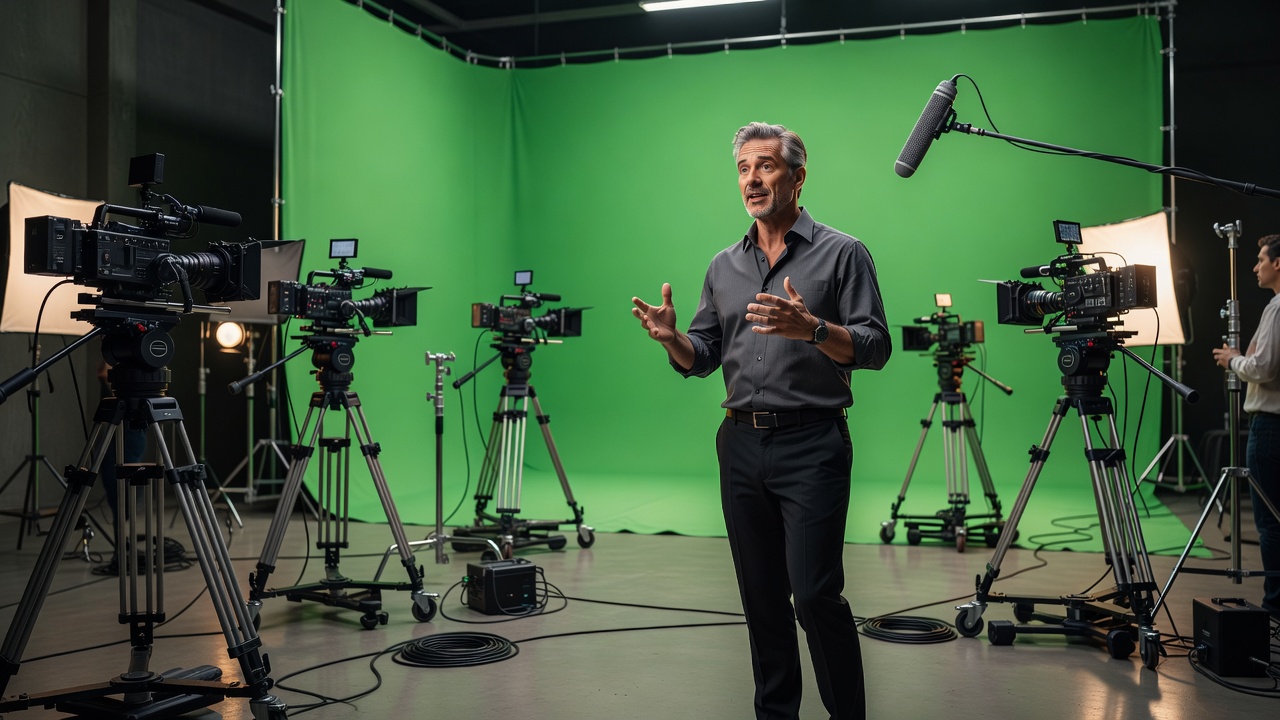
Ben Affleck, who sold his AI filmmaking startup to Netflix earlier this year for a reported $587 million, spent this week going viral for explaining tensors, convolutional neural networks and open-model fine-tuning on camera. The $587 million figure is the one the actor himself disputes: he says it is "not right" and that he "didn't own the whole company." The more useful story sits beneath the meme. Affleck is pitching a specific technical thesis, that filmmakers can fine-tune open models on a consented, proprietary dataset instead of scraping other people's work. For developers and product managers weighing AI in creative tooling, that thesis deserves scrutiny more than applause.
What Happened
The clips come from two interviews: GQ's "One More Question" series, hosted by Zach Baron, and a Bloomberg conversation with Lucas Shaw at the Screentime 2026 conference in Los Angeles. TechCrunch's Sarah Perez compiled them on October 8.
On GQ, Affleck opened with "I've always been kind of into computers since I was young." He said he grew more interested as film moved from analog to digital, and that "the visual effects workflow for many years has included machine learning." He added that he can write "pretty shitty Python scripts."
He then described a tensor (a grid of numbers that represents data, here a video clip) as "the numerical translation of a visual image, in numbers like the batch number, the frame number, the red, green, and blue values of each pixel in each frame." He called convolutional neural networks (models that scan images for local patterns) "the sort of precursors to what the transformer can do," with the transformer doing "much more computation simultaneously." He also described using neural nets for "identifying patterns enough to know, like this is where the window ledge is, so we can more easily take the green screen image out and replace it with something."
On the dataset, he said: "I raised the money. I shot for about eight months with a lot of cameras and a lot of equipment, and created a dataset that would serve as late-stage training for open models to do discrete tasks."
Why It Matters
Most AI-in-film claims come from executives who can describe a product but not its mechanics. Affleck's account is concrete enough to test. His method, as relayed from the Bloomberg clip, is to take open models, unfreeze their weights (allow the pretrained parameters to change during further training) and fine-tune them to meet "certain cinematic standards." The filmmaker keeps proprietary work and benefits from training a model for their own movie.
His stated motive is likeness rights. He said he "gambled on this notion that in order to do this in an ethical way," working "hand in glove with artists" in a community with "very fixed, long-standing relationships around likeness," the company "had to create our own dataset."
The tensor explanation is simplified, and he framed it that way himself ("It's just that simple, right?"). His list omits pixel height and width, so it is a teaching sketch, not a definition. The claim to weigh is the dataset strategy, not the vocabulary.
He also said a visit to OpenAI, made possible by his star status, gave him a look at emerging technology and ultimately led him to get more directly involved in AI. AI aided post-production on his movie "Animals," though the source gives no further detail.
The price is the shakiest number. A peer headline cited an earlier talks-stage figure of $600 million, which differs from the $587 million reported. The brief does not reconcile the two, and neither comes from a primary document.
Competitive Landscape
The brief names no rival filmmaking-AI companies, so none are listed here. The only named parties are the subject and its buyer. Peer coverage identifies the startup as InterPositive and says Netflix insisted it bought the company "to help filmmakers." A separate social snippet claims it was registered under a shell called Fin Bone LLC. Neither detail appears in the primary text, and the shell claim comes from a low-reliability source.
- Netflix: acquirer; the deal shows a streamer buying a toolmaker, though the terms are disputed.
- InterPositive: Affleck's company per peer reports; unverified in the primary text.
- OpenAI: named only as a place Affleck visited, not as a competitor.
Independent analyst commentary specifically on this announcement was not publicly available at publication time.
The Bigger Picture
The legal backdrop explains why a consented dataset is a selling point. The U.S. Copyright Office has published a multi-part report on AI. Part 1, on digital replicas, appeared July 31, 2024 and recommended a federal digital replica law. Part 2, on copyrightability of AI outputs, followed January 29, 2025. A pre-publication Part 3 on generative AI training was released May 9, 2025. A company that owns its training footage sidesteps part of that exposure, though the brief does not say how the Office's analysis would apply to Affleck's data.
The transformer lineage Affleck gestures at is real. The 2017 paper "Attention Is All You Need" proposed "a new simple network architecture, the Transformer, based solely on attention mechanisms, dispensing with recurrence and convolutions entirely." It reported 28.4 BLEU (a translation-quality score) on WMT 2014 English-to-German translation and was described as more parallelizable than prior models, which fits his "much more computation simultaneously."
His worries run elsewhere. "When I worry about AI, I worry about my kids in school. I worry about the 30% rise in the number of A's given out at colleges over the last three years. I worry about learned helplessness. I don't worry about Skynet, and I don't think that it's going to take over [the movie] business in any meaningful way. I think it's going to be additive." The 30% figure is his own, and the source gives no origin for it. It should be read as an unverified assertion, not an established statistic.
What's Next
The open questions are basic. The actual deal terms are unknown, since Affleck disputes $587 million and says he did not own the whole company. The brief does not say which open models were fine-tuned, how large the dataset is, or how Netflix will use the technology. No release dates or roadmap appear in any source, and none are speculated on here.
TechCrunch lists its Disrupt conference for October 13 to 15 in San Francisco, though nothing ties Affleck to it.
For developers and product managers, the practical read is narrow. A fine-tune of open weights on a purpose-shot dataset (Affleck says his took about eight months to film), aimed at one task such as isolating a window ledge for a green-screen swap, is a scoped engineering project. Ask any vendor pitching creative AI the same questions: who owns the training data, which base model, and which discrete task.
The irony is that the viral part, an actor reciting tensor shapes, is the least consequential. The consequential part is a quiet bet that a small, owned dataset beats a giant scraped one for narrow jobs. Affleck may be right, but the $587 million dispute, the unsourced 30% figure and the missing technical specifics mean the internet has praised the explanation before anyone has checked the product.
-- Aria Lin, Enterprise Technology Analyst
Sources: Stanford · Harvard · TechCrunch coverage of the GQ and Bloomberg interviews